


A developer who spent six months shipping LLM apps described the fine-tuning vs RAG mistake almost every team makes: he spent two weeks curating training data and fine-tuned a model to teach it his company's proprietary documentation, then watched it answer internal-process questions wrong about 30% of the time while a retrieval-augmented generation setup over the same docs hit roughly 85% (Moon Robert, DEV Community, March 2026). His conclusion: "Fine-tuning does not reliably make models memorize facts from your training data." That single category error — reaching for fine-tuning to make a model know something — is the most expensive default in enterprise AI right now. Last updated: July 3, 2026.
This is a decision framework for heads of AI and ML leads deciding how to ground an enterprise LLM, not a hype pick. Our position, stated plainly: the fine-tuning vs RAG choice is the easy part, and most teams get it directionally right once they hear the rule. Forrester frames retrieval as the pragmatic enterprise default — an "open-book exam" that lets applications reach data and policies "without requiring extensive model customization" (Rowan Curran, Forrester, 2024). The hard part starts after you choose — because "just use RAG" quietly hands you a data-engineering and retrieval-quality project nobody scoped, and fine-tuning hands you a maintenance liability that compounds every time your data changes.

Key takeaways
- RAG has won the enterprise default. In Menlo Ventures' 2024 survey of 600 enterprise decision-makers, retrieval-augmented generation reached 51% of production use cases while only ~9% of production models were fine-tuned (Menlo Ventures, Nov 2024).
- Fine-tuning does not reliably inject knowledge. In a controlled Microsoft study, RAG roughly doubled fine-tuning's accuracy on entirely new facts — 0.875 vs 0.504 for one 7B model (Ovadia et al., 2023).
- The hidden cost is human, not compute. Modern parameter-efficient fine-tuning made GPU cost collapse (QLoRA, 2023); the real fine-tuning cost is data preparation and re-tuning as your domain drifts.
- RAG moves the reliability problem to the retriever. Choosing RAG converts a model problem into an ingestion, chunking, and retrieval-quality problem — the part every vendor guide skips.
- Hybrid is the top performer where it's measured, but few teams have both the ML and data-engineering muscle to run it well.
Fine-tuning vs RAG: what each actually changes
The two approaches solve different problems for large language models, and the whole decision collapses once you internalize that. Fine-tuning updates a model's weights so it changes how it behaves — tone, format, domain response patterns. Retrieval augmented generation leaves the weights untouched and feeds the model relevant documents at query time, changing what it knows in the moment. The industry shorthand is the open-book exam: retrieval lets the model look things up; tuning is studying until the behavior is automatic.

That distinction — behavior versus knowledge — is the entire foundation of when to use RAG vs fine-tuning. The original RAG paper framed the advantage precisely: combining the model's parametric memory with a non-parametric retrieval index lets you update knowledge by swapping the index rather than retraining (Lewis et al., NeurIPS 2020). Fine-tuning has no equivalent shortcut; new knowledge means a new training run.
| Dimension | Fine-tuning | Retrieval-augmented generation |
|---|---|---|
| What it changes | Model weights (behavior, tone, format) | Context supplied at inference (knowledge) |
| Update mechanism | Re-train on new data | Add or remove documents in the knowledge base |
| Data freshness | Stale until the next training run | Current as of the last index refresh |
| Source attribution | None — answers are unsourced | Retrieved passages are citable |
| Primary failure mode | Confident hallucination on facts | Retrieving the wrong passage |
Why teams pick fine-tuning for the wrong reason
The single most common and costly mistake is fine-tuning to inject facts. Teams reason "the model doesn't know our documentation, so let's train it on our documentation" — and get a model that sounds authoritative while hallucinating. The controlled evidence is blunt: when Microsoft researchers tested knowledge injection head-to-head, RAG beat unsupervised fine-tuning across nearly every task, roughly doubling accuracy on entirely new facts (Ovadia et al., 2023).
Practitioners hit the same wall. One builder fine-tuned on 67,000 tokens of domain content and got hallucinations plus a training loss stuck at 1.86; a community moderator's verdict was that the model "will not pick these information up systematically during the fine-tuning process" (OpenAI Developer Community, Sept 2024). Does RAG replace fine-tuning entirely? No — but for the knowledge-injection job that draws most teams to fine-tuning first, it usually should. Fine-tuning earns its place when you need to change behavior: enforce a rigid output format, adopt a house style, or teach a narrow classification task. RAG earns its place when the answer depends on facts that live in your documents and change over time. This is also why grounding enterprise LLMs in retrieval is the first lever we reach for when a client's real complaint is inaccuracy — a pattern we cover in our published research on preventing AI hallucinations.
When to use RAG vs fine-tuning: a decision framework
Here is the thresholded rule most guides refuse to commit to. Start with RAG by default. Add fine-tuning only when a specific, measurable behavior gap survives after retrieval is working — and reach for hybrid when both a knowledge problem and a behavior problem are present in the same use case. The decision turns on four axes your team can actually score: data freshness, the nature of the gap, cost tolerance, and maintenance capacity. Microsoft's architecture guidance lands in the same place — fine-tune for stable, task-specific behavior; use RAG "when you need the most current information" (Microsoft Learn, updated Jan 2026).
| If your primary need is... | Data changes... | Start with | Add fine-tuning when |
|---|---|---|---|
| Answering from proprietary docs | Weekly or faster | RAG | Never — this is a retrieval problem |
| Consistent tone, format, or structure | Rarely | Fine-tuning | Format is non-negotiable at scale |
| Narrow classification or extraction | Rarely | Fine-tuning | Labeled examples exist and accuracy plateaus |
| Domain Q&A with a house voice | Weekly or faster | RAG, then hybrid | Retrieval is solid but voice still drifts |
| Lowest latency at high query volume | Rarely | Fine-tuning | Retrieval hop breaks your latency budget |
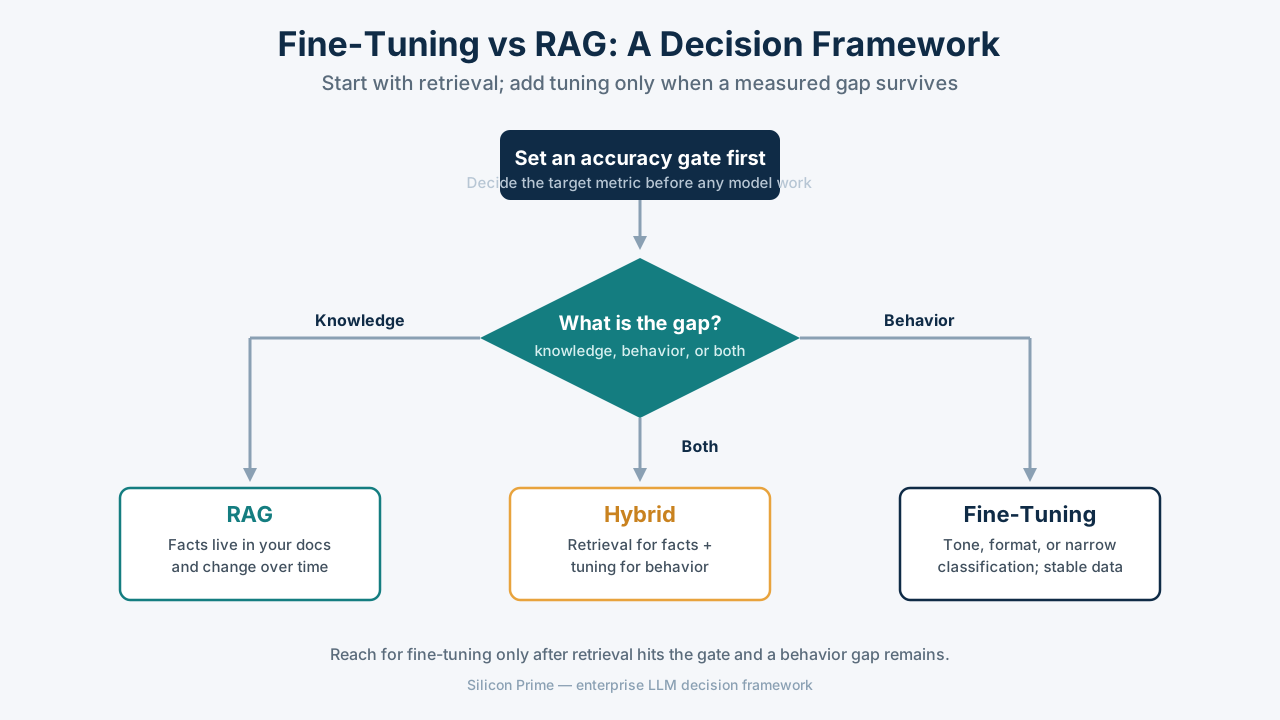
Start with retrieval, set an accuracy gate, and add fine-tuning only when a measured behavior gap survives.
The framework only works if you measure. Every serious production account — from research labs to industry teams — leads with an evaluation harness, not a model choice. Decide your accuracy gate first, get RAG to it, and only then ask whether fine-tuning closes a gap retrieval left open. Choosing between fine-tuning and RAG without an eval set is how teams end up three months into the wrong approach.
The real cost: fine-tuning vs RAG cost and maintenance
Cost is where the analysis usually goes wrong, because everyone quotes GPU hours and the GPU bill is no longer the story. Parameter-efficient methods collapsed the compute floor: QLoRA tuned a 65-billion-parameter model on a single 48GB GPU and reached 99.3% of ChatGPT's benchmark level after 24 hours of training on one GPU (Dettmers et al., 2023). The compute is cheap. The expensive part of llm fine-tuning is the human work around it — curating labeled examples, and re-running the whole cycle every time the underlying content drifts.
Practitioners put numbers on it. One tech lead who has shipped both in production estimated fine-tuning data prep at 40–100 human-hours and warned that "most teams underestimate data prep by 5–10x," while a RAG pipeline reached production in under a week (Tyson Cung, DEV Community, April 2025). Microsoft's guidance names the same fine-tuning tax explicitly: you must update fine-tuned models as your domain changes, and tuning for one task can degrade general performance through model drift (Microsoft Learn).
| Cost dimension | Fine-tuning | RAG |
|---|---|---|
| Up-front compute | Low with PEFT (LoRA/QLoRA) | Low — no training |
| Data preparation | High — 40–100 hrs labeling per iteration | Moderate — ingestion and cleaning pipeline |
| Ongoing maintenance | Re-train on every material data change | Re-index; retrieval-quality tuning |
| Failure recovery | New training run | Fix ingestion or chunking, re-embed |
| Hidden liability | Model drift degrading general skills | Silent retrieval errors on dirty data |
What "just use RAG" doesn't scope
This is the section the vendor guides skip, and it is where the money actually goes. Choosing RAG does not remove the reliability problem — it relocates it from the model to the retriever and the data pipeline. A widely-discussed Hacker News writeup on building a RAG system from scratch drew 322 points and a blunt top comment: "90% of the time companies don't need RAG but a good search system" (Hacker News, 2026). The thread's recurring lesson was that naive "PDF to markdown to vector database" pipelines produce confidently wrong answers, and that indexing large corpora is a multi-week data-engineering job.
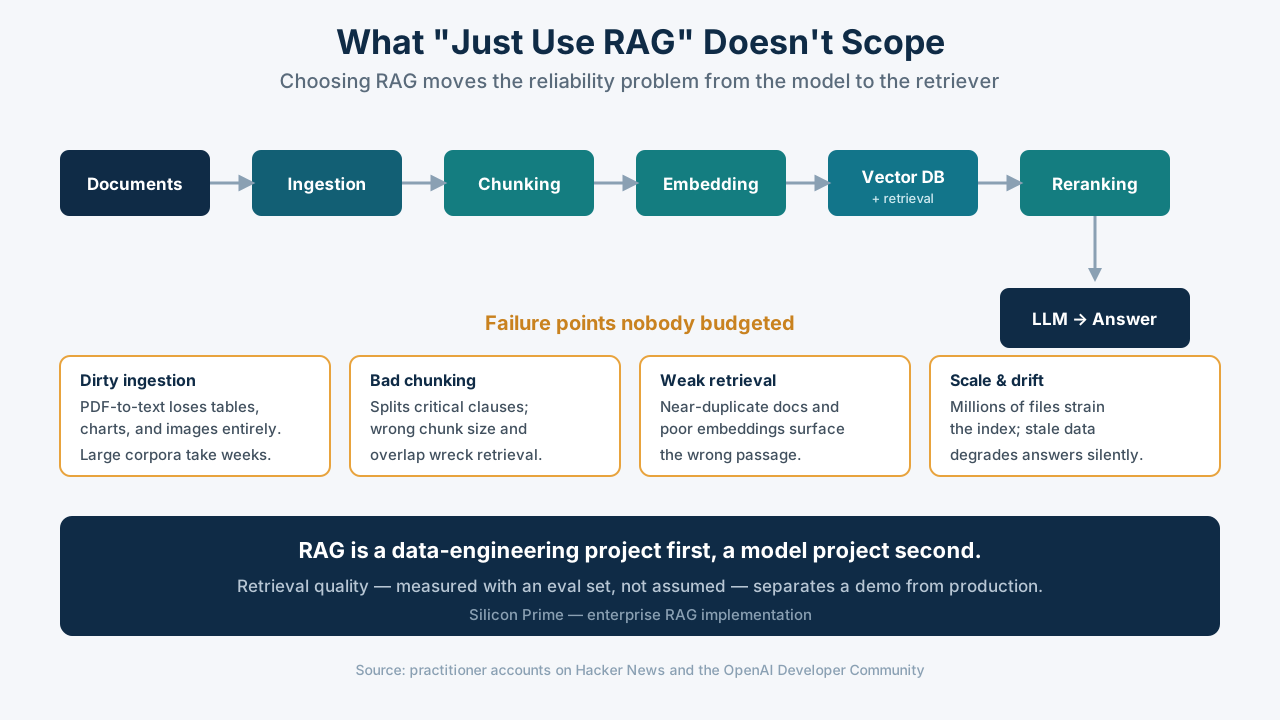
Every stage between your documents and the model is a place retrieval can quietly fail.
Scale makes it sharper. One team needed a domain Q&A chatbot over roughly 1.9 million HTML files and almost no headcount, and their first real question wasn't which model — it was "Can RAG be implemented on a dataset of 1.9 Million files?" (OpenAI Developer Community, June 2024). At that scale, chunk size and overlap, embedding model choice, reranking, deduplication of near-identical documents, and metadata filtering stop being details and become the project. A vector database is necessary but nowhere near sufficient; retrieval quality — measured, not assumed — is what separates a demo from production. This is why we treat enterprise RAG implementation as a data engineering engagement first and a model engagement second, and why so many AI pilots that pick the right architecture still stall — a pattern we've written about in why enterprise AI projects fail.
Combining RAG and fine-tuning: the hybrid default
Running the two together is the top performer nearly everywhere it's rigorously measured, which is why the mature enterprise answer is rarely either/or. In one private-document deployment, a hybrid of retrieval plus a tuned model plus an entity-hierarchy tree beat both simple RAG and fine-tuning alone (T-RAG, arXiv 2024). A Tencent engineering study over 160,000+ internal code files found retrieval beat tuning alone and scaled better with codebase size — and that the two are orthogonal, so combining them improved results further (Wang et al., FSE 2025).
There is also a subtler hybrid most teams miss: the fine-tuning that pays off in enterprise RAG is often on the embedding model, not the generator — tuning the retriever to your domain so it surfaces the right passages. The catch is organizational, not technical. Hybrid demands both mature MLOps for the fine-tuned components and disciplined data engineering for the retrieval layer, and few teams have both in place. Before committing to hybrid, be honest about whether you can staff and maintain two moving systems rather than one, which is squarely a question of MLOps and AI infrastructure maturity.
How we approach the decision at Silicon Prime
Our approach starts by refusing the framing "should we fine-tune or use RAG" until we've named the actual gap — knowledge, behavior, or both — and set an accuracy gate to measure against. In most enterprise engagements the honest first move is RAG with a properly engineered retrieval layer, because the presenting complaint is almost always "the model gets our facts wrong," which is a retrieval problem. We layer fine-tuning — often on the retriever — only when a measured behavior gap remains, and we build the grounding and evaluation discipline into our LLM development services and our patent-pending Aegis AI methodology for reliable, source-attributable answers. If you're weighing this decision, our AI readiness assessment is a low-commitment place to pressure-test which approach your data and team can actually sustain.
Where this is still uncertain
We would be overstating our confidence if we claimed the framework above is settled. It is not, and here is where it isn't:
- The benchmarks test narrow conditions. The strongest "RAG beats fine-tuning" evidence used unsupervised fine-tuning on small (7B) models for pure knowledge injection; it does not prove fine-tuning is weak for behavior tasks, and results may differ on frontier models.
- Long-context models may shift the line. As context windows grow, some retrieval work moves into the prompt, and the RAG-versus-fine-tuning boundary will keep moving with it.
- Hybrid ROI is genuinely case-dependent. For a small team with a stable, mid-sized document set, standing up two systems can cost more than it returns — sometimes a good search system, not RAG at all, is the right answer.
- When this isn't the right fit: if your use case is a narrow, stable classification task with abundant labeled data and no freshness requirement, fine-tuning alone may beat a RAG pipeline you'd otherwise over-engineer.
Further Reading
- Fine-Tuning or Retrieval? Comparing Knowledge Injection in LLMs — Ovadia et al. (Microsoft)
- 2024: The State of Generative AI in the Enterprise — Menlo Ventures
- Augment LLMs with RAG or Fine-Tuning — Microsoft Learn
- T-RAG: Lessons from the LLM Trenches — Fatehkia et al.
Frequently asked questions
Start with RAG by default and add fine-tuning only when a measured behavior gap survives after retrieval works. RAG changes what the model knows; fine-tuning changes how it behaves. Menlo Ventures found RAG in 51% of enterprise production use cases versus ~9% fine-tuned ([Menlo Ventures, 2024](https://menlovc.com/2024-the-state-of-generative-ai-in-the-enterprise/)), which reflects this default.
Not entirely, but for knowledge injection it usually should. A Microsoft study found RAG roughly doubled unsupervised fine-tuning's accuracy on new facts ([Ovadia et al., 2023](https://arxiv.org/abs/2312.05934)). Fine-tuning still wins for behavior — tone, format, and narrow classification — where the answer doesn't depend on changing facts.
For most enterprise cases RAG has lower total cost of ownership, because LLM fine-tuning's expense is human, not compute. Parameter-efficient methods made training cheap ([QLoRA, 2023](https://arxiv.org/abs/2305.14314)), but data prep runs 40–100 hours per iteration and repeats on every data change ([Tyson Cung, 2025](https://dev.to/tyson_cung/rag-vs-fine-tuning-ive-used-both-in-production-heres-what-actually-matters-3a31)).
Because fine-tuning does not reliably memorize facts; it adjusts behavior. One practitioner saw ~30% error fine-tuning on proprietary docs versus ~85% with RAG on the same content ([Moon Robert, 2026](https://dev.to/synsun/rag-vs-fine-tuning-what-i-actually-learned-after-6-months-of-building-llm-apps-1iac)). Move knowledge into a retrieval layer and reserve fine-tuning for behavior.
Because RAG relocates the reliability problem to the retriever. Naive PDF-to-vector pipelines return confidently wrong passages, and one widely-shared account argued that most companies don't need RAG so much as a solid search and retrieval system ([Hacker News, 2026](https://news.ycombinator.com/item?id=47499356)). Fix chunking, embeddings, reranking, and data quality before blaming the model.
Yes, but scale turns retrieval quality into the core project. A team faced exactly this over ~1.9 million files ([OpenAI Developer Community, 2024](https://community.openai.com/t/rag-or-fine-tuning-for-a-domain-specific-qa-chatbot/843661)). At that size, chunk strategy, deduplication, reranking, and metadata filtering determine success far more than which base model you use.
For most regulated workloads RAG is the safer default, because retrieval keeps proprietary documents in a governed store instead of baking them into the model's weights — so you can enforce per-user access controls, cite the exact source passage, and delete a record without retraining. Forrester describes retrieval as an "open-book exam" that reaches your data "without requiring extensive model customization" ([Forrester, 2024](https://www.forrester.com/blogs/rag-is-all-the-rage-retrieval-augmented-generation-demystified/)); fine-tuning instead absorbs training data into the weights, where it is unsourced and hard to remove ([Microsoft Learn, 2026](https://learn.microsoft.com/en-us/azure/developer/ai/augment-llm-rag-fine-tuning)).
When you have both a knowledge problem and a behavior problem and the team to maintain two systems. Hybrid approaches beat either alone in measured studies ([T-RAG, 2024](https://arxiv.org/abs/2402.07483); [Tencent, 2025](https://arxiv.org/abs/2505.15179)). In enterprise RAG the fine-tuning that pays off is often on the embedding/retriever model rather than the generator. Skip hybrid if you can't staff ongoing MLOps and data engineering.
Require an evaluation gate before any model work and insist the vendor scopes the data-engineering effort explicitly, not just the model. Most failures trace to picking an architecture without measuring, then discovering the real work — ingestion, retrieval tuning, or re-labeling — was never budgeted.
RAG needs re-indexing whenever source content changes and periodic retrieval-quality tuning. Fine-tuned models need re-training on every material data change and carry model-drift risk that can degrade general performance ([Microsoft Learn](https://learn.microsoft.com/en-us/azure/developer/ai/augment-llm-rag-fine-tuning)). RAG's maintenance is usually lighter and more incremental.
Ready to Build with AI?
Contact Silicon Prime — we help companies design and ship production-grade AI products.
Comments