

Plenty of AI readiness assessments open with a checklist. The checklist is rarely where things go wrong. Value tends to stall later, at the seam where a promising pilot has to survive production. What decides the outcome there is unglamorous: who signs off on the budget, who owns the data, how releases actually ship, whether governance exists on paper or in the pipeline, and who gets to make the call when something breaks. Model selection almost never makes that list. The eight pillars below are the ones we watch, because each one maps to a place where AI delivery either holds together or quietly comes apart against real business outcomes.
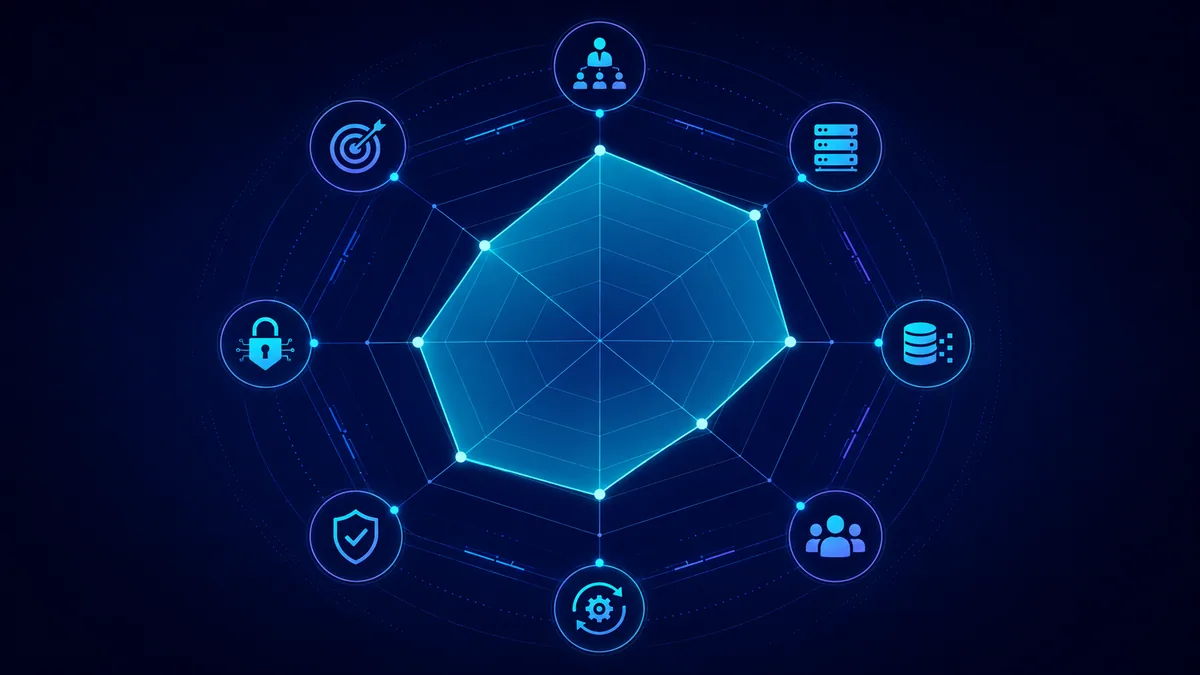
1. Organizational Maturity & Leadership Alignment
When an AI program fails, the model is usually fine. The damage traces back further, to operating decisions that nobody made in time. That is why we start with leadership alignment. Everyone who can veto or slow the work, budget owners, security teams, the people who run the affected departments, needs to be pulling in one direction before code ships. And the alignment can't be one-dimensional. Microsoft's own AI readiness assessment spreads across business strategy, AI governance, and several other axes, which is a fair signal of how many fronts you have to cover at once.

What aligned leadership looks like
You can usually tell alignment is real when a single executive is genuinely on the hook for outcomes, meaning the hard trade-offs between budget, risk, and scope get approved in one place instead of getting stuck in committee. The business goal should be concrete enough that teams can point to the specific workflow or decision AI is supposed to improve. Governance needs an address, so every department involved knows what it owns. And leadership has to be honest about pace, because a pilot and a production system are not the same animal and pretending otherwise sets a cadence nobody can hit.
2. Technical Infrastructure & Data Foundation
Infrastructure rarely breaks in a demo. It breaks at the integration points, or the first time something upstream changes without warning. So we don't run this pillar as a box-ticking exercise; we treat it as an operating test and see what actually holds. Google Cloud frames the same ground around data quality, governance, and architecture discipline, and that emphasis is well placed.
What to inspect in the stack
A serious infrastructure review pushes on a handful of things. The source systems have to expose stable APIs or event streams, otherwise you are building on sand. The data itself has to be current, complete, and structured well enough for the use case in front of you. Staging and production need to be genuinely separate environments. Teams should be able to see pipeline health and model behavior in one place rather than piecing it together after an incident. There have to be safe ways to make changes. And ownership of each system, along with the response when it fails, should be settled before anything goes live.
3. Workforce Capability & Skills Assessment
Ask an organization how ready its people are and the answer skews optimistic almost every time. Real readiness is narrower than that. It's role-specific: someone has to define the evaluation criteria, someone has to keep the system healthy after launch, and those are different jobs needing different skills. DataRobot, among others, runs training programs aimed squarely at closing that kind of gap.
How capable teams actually get built
The teams that end up capable tend to do three things. They train by role, so engineers, analysts, managers, and reviewers each get material that fits what they actually do. They fold the learning into live projects instead of front-loading it into a course nobody remembers by launch. And when outside experts come in, the point is to hand the knowledge over, so the in-house team can run the system once the consultants leave.
4. Data Strategy & Governance
The gap between a governance slide and a governance system is where a lot of AI programs stumble. It's one thing to write the policy; it's another for the framework to keep working as the data, the models, and the rules around them all shift. Aegis AI is one of the tools built to hold governance together through exactly that kind of change.
Governance that survives production
A grounded assessment checks whether the pieces actually function. There should be an approved inventory that spells out which data sources are fair game and how they can be used. Lineage has to be documented well enough that you can trace where data came from and what happened to it along the way. Policies covering access, retention, and privacy belong in the tooling, enforced automatically, not left to good intentions. And when a model produces an output that drives a decision, someone specific has to own that output.
5. Business Process & Workflow Readiness
A readiness score doesn't create value. The workflow does. That's why we plan the workflow first, then choose the platform, rather than the reverse. UiPath makes a similar argument for workflow-first thinking, and the payoff is AI that slots into how work already happens instead of fighting it.
Choose the workflow before the platform
Some workflows are ready for AI and some aren't, and the difference is usually visible up front. The inputs need to be clear, whether that's structured data or information a person can review. The decision has to be bounded, a specific task rather than an open-ended one. A human has to be able to supervise, with review built into the loop. And the result has to be measurable, showing up as an observable move in a metric you already care about.
6. Change Management & Organizational Culture
Culture does a lot of the quiet work in whether AI sticks. Adoption follows trust, and trust follows transparency; without either, even a strong system gets ignored or worked around. Firms like Prosci have built their whole change-management practice on that reality.
What culture signals matter
A few cultural signals tell you a lot. People need enough psychological safety to flag problems out loud without worrying about the fallout. Leaders have to be visibly on board, clear about what role AI plays and where human accountability still sits. Support can't stop at go-live; adoption needs help well past launch. And it helps to have champions inside each function, people who actually advocate for the thing day to day.
7. Security, Compliance & Risk Management
Do the security review before the project builds momentum, not after it's too big to slow down. IBM makes the case for treating risk as something you manage continuously rather than a score you compute once and file away, and we'd agree.
Risk management after launch
Once a system is live, risk work continues. You need clear boundaries on what the model is allowed to automate versus merely recommend. You need monitoring built to catch drift and misuse before they cause harm. You need a defined plan for what happens when an output turns out to be harmful. And you need to account for the risk that rides in through third-party providers.
8. Business Case & ROI Measurement Framework
If the business case is fuzzy, treat that as a warning. Snowflake pushes hard on measurable outcomes and baselines for good reason: without them, readiness never turns into ROI you can point to.
Measure value like an operator
Measuring value the way an operator would means starting with baselines, the workflow metrics as they stood before you touched anything. From there you track the business metrics that matter, cycle time and quality among them, alongside operational ones like review burden and uptime. And someone has to own the reporting after launch, because numbers nobody is responsible for stop getting looked at.
8-Domain AI Readiness Comparison
| Assessment Area | Implementation Complexity | Resource Requirements | Expected Outcomes | Ideal Use Cases | Key Advantages |
|---|---|---|---|---|---|
| Organizational Maturity & Leadership Alignment | Medium–High | Executive time, steering committee | Aligned strategy, lower failure rates | Enterprise AI launches | Prevents misaligned efforts |
| Technical Infrastructure & Data Foundation | High | Cloud infra, data engineers | Reliable deployments | Production ML systems | Enables scalable releases |
| Workforce Capability & Skills Assessment | Medium | Training budgets, mentors | In-house capability | Long-term AI teams | Durable expertise |
| Data Strategy & Governance | High | Legal/compliance, data stewards | Compliant models | Healthcare, fintech | Builds trust |
| Business Process & Workflow Readiness | Medium | Business analysts, SMEs | Measurable ROI | Efficiency projects | Focuses on business value |
| Change Management & Organizational Culture | Medium–High | Leadership engagement | Higher adoption | Large user deployments | Increases sustainability |
| Security, Compliance & Risk Management | High | Security engineers | Reduced risk exposure | Regulated industries | Ensures safe AI |
| Business Case & ROI Measurement Framework | Medium | Finance analysts | Clear ROI | Budget-sensitive projects | Data-driven decisions |
From Assessment to Action: Your Next Steps
A readiness assessment that ends in a report ends too early. Ours should leave you with things you can act on: which workflows deserve priority, which gaps have to close first, and who holds the operating model once the system is deployed. Readiness isn't a one-time verdict either; it should keep getting revisited as your capabilities grow. What we push for is an assessment that carries through to accountable delivery and value you can actually measure in operations.
Frequently asked questions
An AI readiness assessment is a structured diagnostic of whether your organization can move AI from pilot to production and sustain it. It evaluates eight interlocking pillars — leadership alignment, technical infrastructure, workforce skills, data governance, workflow fit, culture, security, and ROI measurement — rather than model selection, which rarely decides the outcome. The goal is to find where value stalls before you commit budget.
Most AI pilots fail on operating readiness, not the model. MIT's report [The GenAI Divide: State of AI in Business 2025](https://fortune.com/2025/08/18/mit-report-95-percent-generative-ai-pilots-at-companies-failing-cfo/) (NANDA, 2025) found roughly 95% of enterprise generative AI pilots delivered no measurable P&L impact, and [RAND](https://www.rand.org/pubs/research_reports/RRA2680-1.html) (2024) reports more than 80% of AI projects fail — about twice the rate of conventional IT. The usual culprits are data gaps, missing success metrics, and unclear ownership rather than weak algorithms.
There is no flat price — cost scales with scope. The main variables are how many business units and data sources are in scope, how deep the infrastructure and governance inspection goes, whether the deliverable is a scored report or an actionable roadmap with named owners, and whether implementation follows. Independent mid-market readiness studies commonly run into the low tens of thousands, with enterprise-wide, multi-unit assessments costing considerably more.
Timelines are driven by scope, not a fixed calendar. A focused single-domain review can take a couple of weeks, while a full multi-pillar, multi-business-unit assessment typically runs several weeks. What extends it is the number of stakeholders to interview, how quickly you can grant data-source access, and whether you want a scored snapshot or a delivery-ready roadmap with named owners and prioritized gaps.
Pick a partner who ties readiness to accountable delivery, not a slide deck. Ask who owns the operating model after the assessment, whether every finding maps to a specific workflow and gap, and how they transfer knowledge to your in-house team so you can run the system once they leave. Watch for red flags: a sub-$2,000 questionnaire sold as an evaluation, an 8-to-12-week discovery with no concrete deliverable, or a "credit-back" fee rebated against a future build, which is a conflict of interest.
Treat readiness as a moving target, not a one-time verdict. Most organizations run a full reassessment annually or before launching a major AI initiative, with lighter quarterly pulse checks on data quality, the number of use cases in production, and model performance. Readiness should keep getting revisited as your capabilities grow and the regulatory landscape shifts — EU AI Act transparency and high-risk obligations, for example, apply from August 2, 2026.
A grounded assessment verifies governance works in the pipeline, not just on a slide. It checks for an approved data inventory, documented lineage, access, retention, and privacy rules enforced automatically in tooling, and a named owner for every model output that drives a decision. [Gartner](https://www.gartner.com/en/newsroom/press-releases/2024-07-29-gartner-predicts-30-percent-of-generative-ai-projects-will-be-abandoned-after-proof-of-concept-by-end-of-2025) predicts organizations will abandon 60% of AI projects that lack AI-ready data through 2026 (Gartner, 2024), so data governance is often the deciding gap.
Measure value the way an operator would. Start with baselines — the workflow metrics as they stood before AI touched anything — then track business metrics like cycle time and quality alongside operational ones like review burden and uptime, and assign someone to own post-launch reporting. A vague business case with no baseline is the clearest early signal that readiness will not convert into ROI you can point to.
Common red flags: no single executive owns outcomes, data lives in inaccessible or low-quality silos, governance exists only on paper, and teams lack the role-specific skills to run the system after launch. Culture matters just as much — organizations that skip change management, incentives, and role-specific training alongside AI deployments are a leading reason adoption stalls.
Further Reading
- Making Agentic AI Work for Government: A Readiness Framework 2026
- The 2026 AI Index Report
- AI Readiness Assessment Scoring Guide
Ready to Build with AI?
Contact Silicon Prime — we help companies design and ship production-grade AI products.
Comments