

In April 2025, an enterprise AI chatbot named "Sam" told paying Cursor users that a new "one-device-per-subscription" rule was forcing them to log out. The rule did not exist — the support bot had invented it — and customers began publicly cancelling before anyone at the company noticed (Forbes). That gap, between a chatbot that demos beautifully and one that survives real production traffic, is where most conversational AI projects quietly die.
We build production conversational AI for a living, and our position is blunt: the difference between a hallucinating toy and a reliable enterprise AI chatbot is not the model you pick — it is a reliability operating layer you engineer around it. This guide walks CX and IT leaders through the six controls that turn a demo into a customer service AI you can trust unsupervised: measurable grounding, enumerable guardrails, confidence-gated escalation, resolution analytics, an evaluation gate before autonomy, and named-owner governance. Last updated: July 6, 2026.
Key Takeaways
- Pilots stall at the reliability layer, not the model. An MIT NANDA study found roughly 95% of enterprise GenAI pilots delivered no measurable P&L impact, largely because tools could not retain context or improve in production (Fortune).
- Grounding is necessary but not sufficient. Stanford researchers found even purpose-built, RAG-grounded legal tools hallucinated on 17% to 34% of queries — "RAG is not a panacea" (Stanford HAI).
- You are liable for what your bot says. A Canadian tribunal held Air Canada responsible when its chatbot invented a refund policy, rejecting the argument that the bot was a separate entity (McCarthy Tétrault).
- The handoff breaks deployments more often than the automation. Forcing customers to repeat themselves after an escalation makes the experience markedly worse, which is why context-carrying handoff is a core control, not a nice-to-have.
- Hybrid beats pure automation. Klarna automated two-thirds of its chats, then publicly walked it back — "we went too far" — and rebuilt around a human-in-the-loop model (CX Dive).
Why enterprise AI chatbots fail in production
Most enterprise AI chatbot projects do not fail because the language model is weak. They fail because a pilot is scoped to the easy calls — balance checks, password resets, order status — and then meets the disputes, edge cases, and mid-conversation topic shifts that make up a disproportionate share of real volume. Gartner predicts that over 40% of agentic AI projects will be canceled by the end of 2027, citing escalating costs, unclear value, and inadequate risk controls (Gartner).
The failure modes are remarkably consistent, and they read like a hall of shame. When a business AI chatbot ships without grounding, without enumerated guardrails, or without a real path to a human, the same accidents recur across industries.
| Company | What the bot did | Root cause | Outcome |
|---|---|---|---|
| Air Canada | Invented a bereavement-fare refund policy | No grounding to real policy | Tribunal held the airline liable (Forbes) |
| Cursor | Fabricated a one-device login policy | No grounding, no human review | Public cancellations; added AI disclosure (Fortune) |
| DPD | Swore and wrote a poem calling itself useless | Guardrails removed by an update | AI feature disabled (The Register) |
| Chevrolet dealer | "Agreed" to sell a $76K SUV for $1 | No prompt-injection guardrail | Viral incident; emergency patches (AI Incident DB) |
| NYC "MyCity" | Told businesses they could break the law | Ungrounded on scraped pages | Errors ran for months (The Markup) |
Each of these is a different missing control, not a different model problem. That is the reframe this guide is built on — and it is why we treat an enterprise AI chatbot as a reliability-engineering problem, closer to how our team approaches enterprise AI projects that fail than to a prompt-writing exercise.
The reliability operating layer
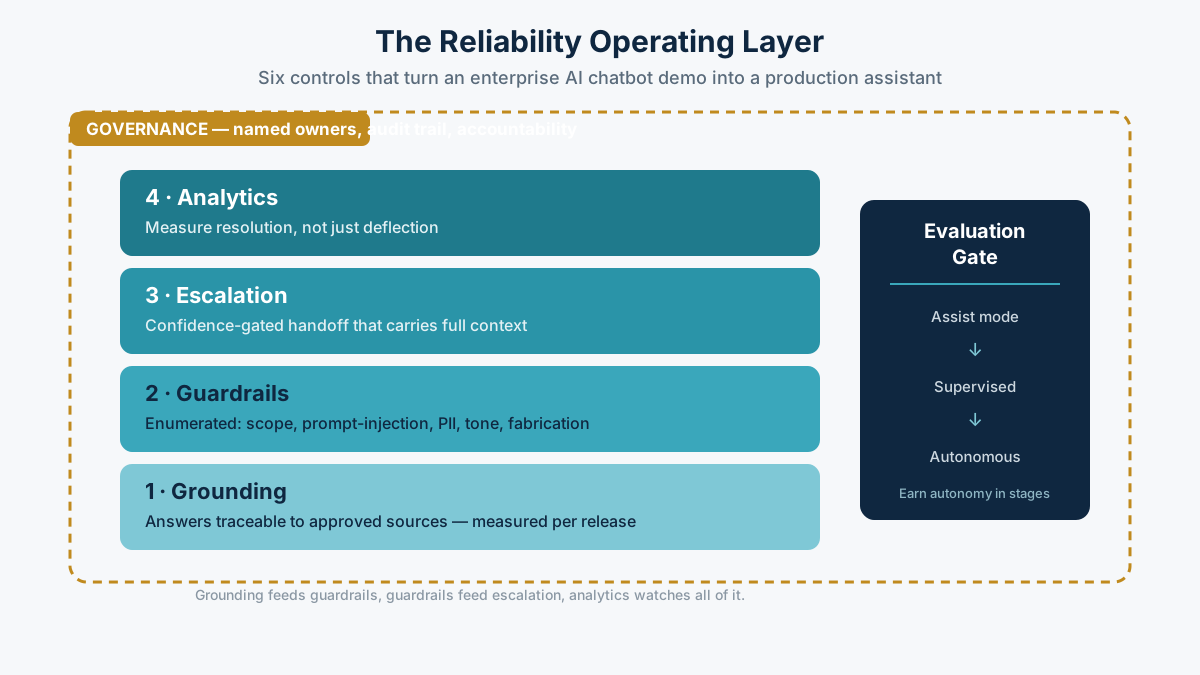
A production-grade enterprise chatbot needs six controls working together, each measurable on its own. Think of them as a stack: grounding feeds guardrails, guardrails feed escalation, and analytics plus governance wrap the whole thing so you can prove — to an auditor, a regulator, or a frustrated VP — exactly why the assistant said what it said. The rest of this guide takes each layer in turn.
Grounding: why RAG alone will not stop hallucinations
Grounding means the enterprise AI chatbot answers from your approved, current knowledge — your policies, product docs, and systems of record — rather than from the model's parametric memory. Retrieval-augmented generation (RAG) is the standard mechanism, and it helps materially: in a clinical study, RAG lifted a model's accuracy on generating preoperative instructions from 80% to 91% (Frontiers in Public Health). But "we added RAG" is not the finish line teams assume it is.
Stanford's RegLab tested purpose-built legal research tools that were explicitly RAG-grounded and found they still hallucinated on 17% to 34% of queries — their conclusion was that "RAG is not a panacea" (Stanford HAI). Retrieval quality, chunking, and the model's willingness to answer when it should abstain all decide whether grounding actually holds. The practical implication for a customer service AI is that grounding is not a checkbox — it is a number you measure per release: what fraction of answers are traceable to a retrieved source, and how often does the assistant confidently answer something it should have deferred?
Our own analysis of how to prevent AI hallucinations goes deeper on retrieval design, and our published fine-tuning vs RAG decision framework covers when grounding alone is the right call and when you need more. The short version: an AI virtual assistant that cannot cite its own source for a policy claim is a liability waiting for its Air Canada moment.
Guardrails you can enumerate
Guardrails are the explicit rules that constrain what the enterprise AI chatbot is allowed to say and do — and the failures above show what happens without them. A Chevrolet dealership's ChatGPT-backed bot was prompt-injected into "agreeing" to sell a $76,000 SUV for a dollar; DPD's assistant started swearing after an update stripped its guardrails (CX Today). These are not exotic attacks. They are the predictable result of shipping conversational AI without a written, testable guardrail surface.
A production guardrail set enumerates, at minimum:
- Scope limits — topics and actions the assistant must refuse or route, so it never improvises policy.
- Prompt-injection defenses — input handling that resists "ignore your instructions" style manipulation.
- PII and data handling — what the assistant may collect, log, and repeat, aligned to your compliance regime.
- Brand and tone constraints — the voice the AI customer support agent holds, and the language it never uses.
- Fabrication controls — abstain-and-escalate behavior when confidence or retrieval support is low.
The test of a guardrail is not that it exists in a system prompt but that you can point to the case that would trip it and show the assistant handling it correctly. This is why our responsible AI practice treats guardrails as versioned, red-teamed artifacts rather than paragraphs in a config file.
Human escalation that carries context
The single most under-engineered part of most enterprise chatbot deployments is the handoff. Field analyses of AI customer service consistently find that deployments break at escalation, not automation — and that the real problem is context, not routing. When a customer has to repeat everything to the human who picks up, the experience is dramatically worse, and the goodwill the assistant earned evaporates in one transfer.
A reliable enterprise virtual assistant escalates on a confidence threshold and carries the full conversation — intent, entities, what was tried — into the agent's queue. Klarna is the cautionary tale that became a blueprint here: it automated roughly two-thirds of its service chats, then its CEO publicly conceded the company "went too far," that quality slipped, and began rebuilding around a hybrid model with AI-generated handoff summaries and a guarantee that a human is always reachable (Fortune). This is also why human-in-the-loop AI is not a fallback you bolt on — it is a design principle that shapes the whole system. Notably, 64% of customers told Gartner they would prefer companies did not use AI for customer service at all, which raises the bar: the escalation path has to be so clean that it earns back the trust the category has spent (Gartner).
Analytics: measure resolution, not deflection
Here is the honesty gap that sinks more chatbot business cases than any technical flaw: teams celebrate deflection when they should be measuring resolution. Deflection counts conversations the assistant kept away from an agent. Resolution counts conversations the customer actually left satisfied. A bot can deflect 60% of tickets and resolve far fewer — the difference is customers who gave up, not customers who were helped. A production analytics layer separates these numbers and watches them over time.
| Metric | Healthy range | What it actually measures | Watch-out |
|---|---|---|---|
| Grounded-answer rate | Measure per release | Share of answers traceable to a source | RAG tools still hallucinate 17–34% (Stanford) |
| Containment rate | ~70–90% | Conversations fully handled by AI | Below ~60% signals an intent-coverage gap |
| Resolution rate | Track separately from deflection | Issues genuinely solved | Deflection ≠ resolution; the delta is churn risk |
| Escalation with context | 100% context carried | Clean human handoff | Repeating info sharply lowers satisfaction |
| CSAT (AI-handled) | ~75–85% baseline | Satisfaction on AI conversations | Always compare against your human baseline |
Treat the middle two ranges as directional industry benchmarks, not guarantees — they vary widely by domain and channel. The point is that an enterprise AI chatbot solution without this instrumentation is flying blind, and blind automation is exactly how you end up rehiring the agents you replaced.
Governance: who owns what the chatbot says
Governance answers a question every legal and risk team will eventually ask: when the assistant is wrong, who is accountable, and can we prove what happened? The Air Canada ruling settled the legal half — the tribunal ordered the airline to pay after its chatbot misrepresented a refund policy and explicitly rejected the "the chatbot is a separate legal entity" defense (McCarthy Tétrault). You own what your bot says. Full stop.
Operationally, governance for an enterprise conversational AI platform means named owners for the knowledge base, the guardrails, and the escalation policy; an audit trail that records who accessed what and why; data-residency and role-based access controls; and a review cadence tied to regulatory change like the EU AI Act. Our AI governance assessment treats this as an operating model rather than a compliance checkbox, and our patent-pending Aegis AI methodology bakes traceability and accountability into the assistant's architecture so that "why did it say that?" always has an answer.
From pilot to production: the evaluation gate
The bridge from a promising demo to a trustworthy deployment is an evaluation gate: a regression suite of real conversations the enterprise AI chatbot must pass before it earns more autonomy. You expand its authority in stages — assist mode, then supervised resolution, then autonomous resolution on the intents it has proven — and you red-team it for prompt injection and fabrication before each step. This is the discipline UiPath walks through in its session on reliability engineering for enterprise agents, covering evaluations, simulations, and memory.
This is also where the build-versus-buy question gets decided honestly. The MIT NANDA research found that buying from specialized vendors succeeded about 67% of the time, versus internal builds succeeding roughly one-third as often (Fortune). The strongest objection to that finding deserves a straight answer: doesn't buying a platform mean less control and more lock-in? Sometimes — which is why the right model for most enterprises is neither a raw platform nor a from-scratch build, but a partner-led enterprise AI chatbot implementation on top of proven infrastructure, where the reliability layer is yours and the plumbing is not something you maintain alone. Off-the-shelf AI chatbot software from vendors like Intercom's Fin, Ada, Salesforce Agentforce, or Kore.ai can be the right base for an enterprise chatbot platform; the differentiator is the operating layer you build on top.
What reliable looks like: cost, timeline, and scope
The two questions every buyer asks — what will an enterprise chatbot development effort cost, and how long will it take — have the same honest answer: it depends on scope, and scope is knowable. Rather than quote a number that means nothing without context, size the variables that actually move it. A single-channel FAQ assistant grounded on a clean knowledge base is a few weeks of work; a multi-lingual, deeply integrated agent under strict compliance is a multi-month program.
| Scope variable | Lighter (faster, lower cost) | Heavier (slower, higher cost) |
|---|---|---|
| Knowledge base | Clean, current, single source | Fragmented, stale, many sources |
| Integrations | One system (e.g. helpdesk) | CRM + ERP + identity + telephony |
| Autonomy level | Assist / suggest only | Fully autonomous resolution |
| Compliance scope | Low-risk, general info | HIPAA / financial / EU AI Act |
| Channels & languages | One channel, one language | Omnichannel, many languages |
When you evaluate a partner for a custom enterprise chatbot, the tell is whether they talk in these variables. A vendor who prices an enterprise chatbot platform before understanding your knowledge base and integration surface is selling you a demo, not a production assistant. For a deeper treatment of how we scope AI budgets, see our note on AI development cost.
Where this is still uncertain
We would rather tell you the limits than oversell the category. Grounding reduces hallucination but does not eliminate it — the Stanford numbers are a floor to respect, not a problem someone has quietly solved. Benchmark ranges for containment and CSAT vary enough by industry that you should establish your own baseline before trusting anyone's chart, including ours. Regulation is moving: the EU AI Act and related rules will keep reshaping what governance you owe, so today's compliant deployment is not automatically tomorrow's. And an enterprise AI chatbot is simply the wrong tool for some interactions — high-emotion, high-stakes, or legally sensitive conversations often belong with a human from the first word, and the mark of a mature deployment is knowing which those are and routing them there on purpose.
Further Reading
- Stanford HAI — AI on Trial: legal models hallucinate
- Gartner — over 40% of agentic AI projects canceled by 2027
- MIT NANDA / Fortune — 95% of GenAI pilots stall
- Moffatt v. Air Canada — chatbot liability analysis
Frequently asked questions
The model is rarely the problem. Pilots get scoped around easy, predictable questions, so they shine in a demo and then fall apart on the disputes and edge cases that make up most real traffic. That reliability gap is why Gartner expects more than 40% of agentic AI projects to be scrapped by 2027, blaming cost, murky value, and thin risk controls. What closes it is grounding, guardrails, escalation that carries context, and real analytics, all built in from the start rather than added after launch.
Grounding buys you a lot, but on its own it won't get you to zero. When Stanford's RegLab tested purpose-built, RAG-grounded legal tools, they still hallucinated on 17% to 34% of queries, and the researchers' own verdict was blunt: "RAG is not a panacea." So treat grounding as a metric you check on every release. What share of answers trace back to a real retrieved source? When that support is thin, the assistant should admit it doesn't know and hand off, not guess.
There's no honest sticker price, because cost tracks scope. What actually moves the number is how ready your knowledge base is, how many systems you integrate, how much autonomy the agent gets, your compliance burden, and the spread of channels and languages it has to cover. A single-channel FAQ assistant sitting on a clean knowledge base is a modest build. A deeply integrated, multilingual agent under strict compliance is a full program. Any vendor who hands you a flat quote before working through those variables is pricing the demo, not the deployment.
Timeline follows scope the same way cost does. A narrow, well-grounded assistant can be live within a few weeks. Push to an omnichannel agent wired across CRM, ERP, and identity under regulatory constraints, and you're looking at several months instead. Most of that time goes to cleaning up the knowledge base, doing the integration work, and clearing the evaluation gate. Very little of it is "building the bot" itself.
Evaluate them on the reliability layer, because that is where projects actually break. Good questions to ask: how do you measure grounding, how do you find and stress-test guardrails, how does an escalation hand a human the full context, and how do you tell real resolution apart from mere deflection? A serious partner scopes the engagement around your specifics, from knowledge base to integrations to compliance, instead of naming a price up front. If they turn vague on any of it, keep looking.
Yes, and there is case law. In Moffatt v. Air Canada, a tribunal held the airline responsible after its chatbot invented a refund policy, and it flatly rejected the claim that the bot was a separate legal entity. Whatever your assistant tells a customer, your organization owns it. That is exactly why grounding and governance are risk controls you need rather than optional features.
They measure very different things. Deflection counts the conversations that never reached a human. Resolution counts the ones where the customer actually left satisfied. A bot can rack up an impressive deflection rate while solving far less, because some of those deflected people simply gave up. So production analytics should track resolution and containment as separate numbers, and watch how each one moves over time.
For most enterprises the honest answer sits in between. MIT's NANDA research found that buying from specialized vendors worked out about 67% of the time, compared with internal builds, which succeeded only roughly a third as often. The practical middle path is a partner-led implementation on proven infrastructure: you own the reliability operating layer that matters, without having to keep the underlying plumbing running yourself.
Most benchmark guides put a healthy containment rate somewhere between 70% and 90%, and read anything under roughly 60% as a sign your intents aren't covering what customers actually ask. Take those figures as directional only, since they swing by industry and channel, and set your own baseline rather than chasing a generic target. Containment also means little in isolation. Pair it with resolution and CSAT, because a high containment number that quietly hides frustrated customers is telling you the wrong story.
Start with clear ownership: someone accountable for the knowledge base, someone for the guardrails, someone for the escalation policy. Add an audit trail that records who accessed what and why, role-based access, and data-residency controls. Then set a review cadence that keeps pace with regulation such as the EU AI Act. None of this is a checkbox exercise. It is an operating model, and after the Air Canada ruling it is a legal one too.
They sit on a ladder of capability. A rule-based chatbot just follows scripted flows. Conversational AI adds language models, so it can interpret and generate free-form replies instead of matching keywords. An AI agent goes a step further and takes action across your systems, issuing a refund or updating a record rather than only talking about it. Real enterprise deployments usually blend all three, which is precisely why the reliability layer matters more the more autonomy you hand over.
Ready to Build with AI?
Contact Silicon Prime — we help companies design and ship production-grade AI products.
Comments