

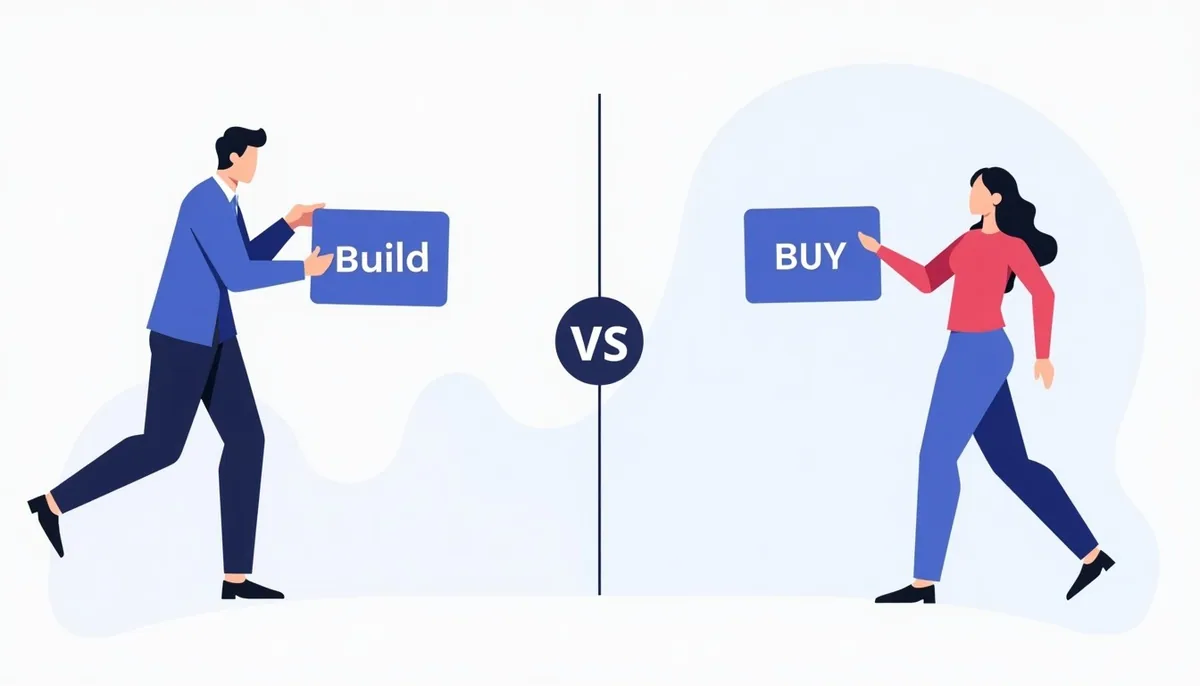
Building internal AI tools can be tempting, but understanding when to build, buy, or partner is crucial for success. In a Hacker News thread, TheBoomerDev discusses how AI tools have simplified development. Yet, deciding to build from scratch isn't always straightforward. It's essential to evaluate options carefully, especially when considering ai agent development services as a viable alternative.
Last updated: July 17, 2026.
Our perspective is that the decision framework should be: "Build what defines you, buy what frees you, partner to scale responsibly."
Build What Defines You
See this walkthrough for more:

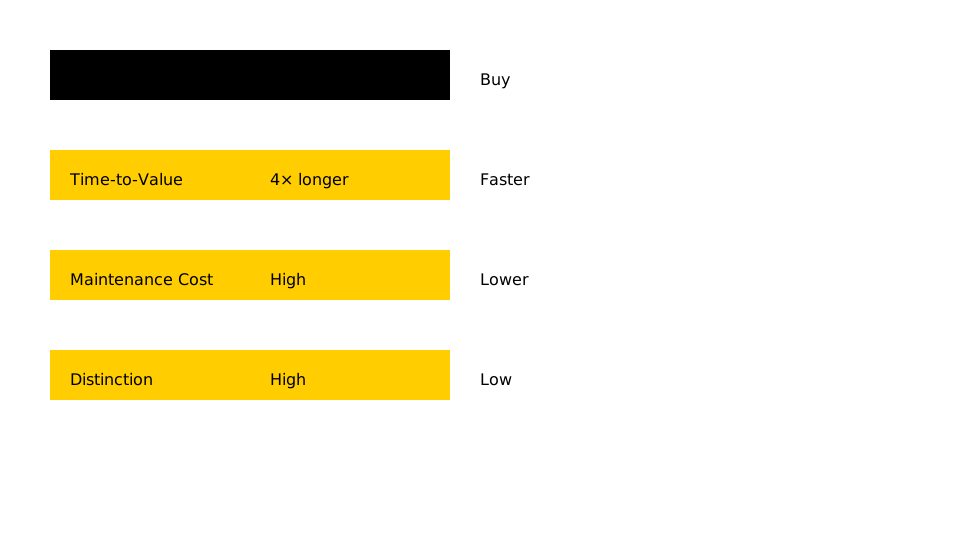
Key factors in deciding to build or buy AI tools.
For capabilities that truly set your organization apart, building may be the best approach. McKinsey suggests focusing development on what makes your organization distinctive. However, beware of the long-term maintenance costs. AI tools have compressed build timelines, enabling rapid prototyping, but maintaining those tools long-term can become onerous (Omilia).
| Factor | Build | Buy |
|---|---|---|
| Time-to-Value | 4× longer (Rotascale) | Faster |
| Maintenance Cost | High | Lower |
| Distinction | High | Low |
Using ai agent development services can help if you lack the internal expertise to build proprietary systems.
Buy What Frees You
For common or operational AI use cases, buying off-the-shelf solutions accelerates time-to-value. This approach minimizes initial investment and enables rapid deployment. Organizations that deploy AI tools to production faster often use documented decision frameworks, bringing AI to production 45% quicker (VE3).
Consider engaging with an ai chatbot development company to access expertise without overextending resources.
Partner to Scale Responsibly
Sometimes, partnering is the best path when internal capabilities are missing. A hybrid model can yield a 3.2× ROI, with reduced risk and accelerated time to market (Rotascale). Partnerships are advisable when the internal team is hampered by talent gaps, identified by 40% of organizations as a slowing factor (TechTarget).
Autonomous ai agent development services, for instance, can empower businesses to expand AI capabilities more effectively.
Understand the Pitfalls
Rapid development can mislead organizations about long-term ownership costs. It's cheap to build at first, but as QA Wolf notes, it's not cheap to own. Governance and regulatory challenges, such as those narrated by Deloitte's survey, complicate AI tool deployment, with 48% citing regulatory pressures (TechTarget).
Implement a Formal Framework

Cyclical process for successful AI deployment and reassessment.
Deploying a formal, documented build-vs-buy framework facilitates not just faster deployment but also more successful outcomes. Businesses showing discipline in auditing and reassessment every quarter, as supported by McKinsey's framework, seem more adaptable and responsive to innovation (McKinsey).
Our published research on AI development strategies highlights how our patent-pending Aegis AI methodology guides firms to achieve seamless integrations and optimized performance.
Where This Is Still Uncertain
While frameworks ground decisions in data, the dynamic nature of technology and market demands can introduce unpredictability. The evolving AI landscape necessitates frequent reassessment, and while our earlier analysis aids understanding, adaptation is the signal to watch.
This builds on our own published research — see our earlier analysis — applying our patent-pending Aegis AI methodology throughout.
Frequently asked questions
Ai agent development services help organizations create AI-driven applications tailored to specific needs, ensuring optimized performance and alignment with business goals.
Opt for these services when internal expertise is lacking, the complexity is high, or when a timely solution is required to leverage AI capabilities effectively.
Evaluate based on experience, alignment with your business needs, past clientele, and support capabilities to ensure a good fit.
These services provide expertise in deploying generative AI models, offering strategies for integrating AI into business processes creatively and efficiently.
Use a documented decision framework to evaluate if building aligns with your core capabilities, buying accelerates time-to-value, or partnering reduces risks and enhances expertise.
Maintaining and scaling AI tools can become costly over time; governance and adapting to regulatory environments add layers of complexity that can derail projects.
Ready to Build with AI?
Contact Silicon Prime — we help companies design and ship production-grade AI products.
Comments