

Not long ago, AI development services were where companies ran experiments. Now the same work sits underneath things the business actually depends on. This article walks through why that shift happened, what an AI development engagement really includes, how a project moves from idea to production, and what the money looks like. It also covers how to pick a partner and where to start once you decide to move.
Why AI Development Services Are Now Core Infrastructure
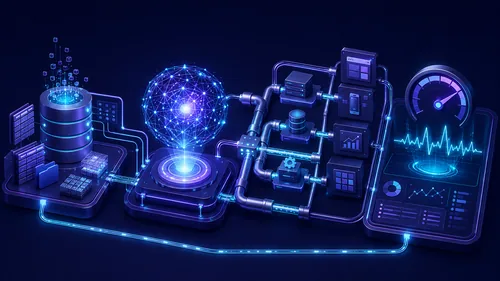
Turning a model into something the business can keep running takes real engineering. That means data pipelines, a way to evaluate whether the model is any good, and monitoring after it goes live. AI development services cover that work. Industry reports point to rising AI adoption, and it shows up in the planning: teams now treat AI as part of the platform and product roadmap rather than a side project.
You see the same emphasis elsewhere. Tools like IBM Watson and Google Cloud AI lean hard on infrastructure and operational integration, because that is what keeps an AI solution reliable over time.
Deconstructing AI Development The Core Service Offerings
Models get the attention. The system around them is what makes them work: a data strategy, the model development itself, and integration into whatever already exists.
What you are actually buying
Think of a proof of concept as an engine prototype. It doesn't ship anything. It shows enough signal to justify spending more. Past that point, four things do the heavy lifting: data strategy, model development, integration, and monitoring. Take one away and the implementation tends to wobble. Competitors like Amazon Web Services (AWS) Machine Learning package the same set of pieces into their service stacks.
Why hybrid architecture usually wins
Most projects don't need a model built from scratch. A hybrid setup takes pre-trained models and adds task-specific modifications on top, which keeps things flexible without the cost of starting over. Platforms such as Microsoft Azure AI push the same approach.
A Typical AI Project Lifecycle From Idea to Impact
AI projects run through a set lifecycle. The structure exists to catch risk early and get the thing delivered.

The deliverables that matter
Every phase produces something concrete. Discovery and planning, then productionization and integration. Each one owes specific deliverables, and skipping them is usually where trouble starts.
Where projects usually stall
Projects stall for predictable reasons. Nobody owns the success metric. The user workflow never gets mapped. When a project does land, it is because the team treated AI as part of how the business runs, not as a demo bolted on afterward.
From Theory to Practice An Anonymized Case Study
A restaurant operator's AI initiative shows why operational integration matters more than the model.
What the client actually needed
What the client wanted was an operational system. Something that could verify order assembly and still bend to the way different stores actually work.
What made the rollout stick
It stuck because the team ran the AI like a production system. Clear checkpoints, small releases, and it folded into the normal delivery process instead of sitting off to the side.
Budgeting for AI Engagement Models and Real Costs
How an AI project is priced shapes the risk you carry. Worth understanding before you sign anything.
How the commercial models differ
Engagement models vary, and each one fits a different kind of work. Time and Materials, Fixed Scope, and Dedicated Teams all trade off differently.
| Model | Best For | Pros | Cons |
|---|---|---|---|
| Time and Materials | Discovery-heavy work | Flexible, adaptable | Budget can drift |
| Fixed Scope | Well-defined use cases | Strong accountability | Change requests can be frictional |
| Dedicated Team | Multi-phase programs | Preserves context | Can become open-ended |
Why production costs jump fast
Two things push production costs up fast: how many interfaces you have to touch, and the state of the data. Running a real production system means integration and monitoring across all of it, and that adds up.
The AI Partner Selection Checklist
Picking a partner comes down to whether they can actually operate what they build and deliver it without drama.
Questions that expose shallow vendors
Ask about post-launch monitoring. Ask about release safety and data governance. Vendors without real answers tend to reveal themselves quickly.
What strong answers look like
A strong partner shows you operational artifacts, not slides. They can tell you exactly how they monitor a system and how they handle change once it is live.
Making AI Real Your Next Steps
AI works when you run it as a disciplined delivery process. Pick a clear problem. Check whether your data is ready. And vet partners on whether they can operate what they ship, not just build it.
Frequently asked questions
AI development services cover the full system that makes a model useful in production: data strategy and pipelines, model development (or adaptation), integration into your existing tools, and post-launch monitoring. A proof of concept only shows enough signal to justify further investment; the four pillars above are what turn that signal into a capability the business can depend on.
Most enterprise projects do not need a model built from zero. A hybrid approach adapts a pre-trained model with task-specific tuning and guardrails, which keeps you flexible and cuts time-to-value without the cost of training a foundation model. Building fully custom only makes sense when your problem is genuinely novel or your data is a durable competitive moat.
There is no flat rate; cost is driven by scope. The biggest levers are data readiness (clean, labeled, accessible data is far cheaper than raw or fragmented data), the number of systems you integrate with, model complexity, and the level of governance and monitoring required. Because unclear scope is a top cause of overruns, insist on a data-readiness assessment before any fixed quote.
Timelines scale with scope rather than a fixed calendar. A narrow, single-workflow pilot can reach a usable state in weeks, while a multi-system enterprise deployment with legacy integration, security review, and change management typically spans several months. The largest timeline driver is almost always data preparation and integration, not model training, so front-load your data work.
Expect the first measurable ROI from a well-scoped pilot, not from the full program. That requires defining a success metric and capturing a baseline before development begins; without a named owner and baseline, you cannot prove impact. Enterprise-scale ROI that justifies the whole program usually arrives later, once the system is integrated into daily operations and adoption is real.
Most fail for non-technical reasons: no one owns the success metric, the user workflow is never mapped, and the data is not ready. Gartner predicted at least 30% of generative AI projects would be abandoned after proof of concept by the end of 2025 ([Gartner, 2024](https://www.gartner.com/en/newsroom/press-releases/2024-07-29-gartner-predicts-30-percent-of-generative-ai-projects-will-be-abandoned-after-proof-of-concept-by-end-of-2025)), and separately that organizations would abandon 60% of AI projects unsupported by AI-ready data through 2026 ([Gartner, 2025](https://www.gartner.com/en/newsroom/press-releases/2025-02-26-lack-of-ai-ready-data-puts-ai-projects-at-risk)). Treating AI as a disciplined delivery process, not a demo, is what gets it over the line.
Vet partners on whether they can operate what they build, not just prototype it. Ask how they handle post-launch monitoring, release safety, data governance, and model drift, and ask to see operational artifacts (runbooks, evaluation reports, monitoring dashboards) rather than slides. This matters because Gartner predicts over 40% of agentic AI projects will be canceled by the end of 2027, often from weak risk controls and unclear value ([Gartner, 2025](https://www.gartner.com/en/newsroom/press-releases/2025-06-25-gartner-predicts-over-40-percent-of-agentic-ai-projects-will-be-canceled-by-end-of-2027)).
Ownership is defined per engagement and written into the contract before work starts. In a typical Silicon Prime build, you own your data, the trained model weights, and the custom code we deliver, while any pre-existing frameworks or third-party foundation models stay under their original licenses. Settle IP assignment, data-handling, and any model-reuse terms in the statement of work upfront so there are no surprises at handover.
Further Reading
- AI Guide for Government
- A Guide to Artificial Intelligence in the Enterprise
- AI Readiness Assessment Framework: A Step-by-Step Guide for Consultants
Ready to Build with AI?
Contact Silicon Prime — we help companies design and ship production-grade AI products.
Comments