


Most companies do not have one application problem. They have a dozen web apps that each hold a slice of the truth, and none of them talk to each other. Sales data lives in the CRM, orders live in the commerce platform, support tickets live somewhere else again, and someone spends an afternoon each week copying rows between them. Web-based application integration is the work of wiring those systems together so data moves on its own. This guide skips the theory and gets to the methods that actually ship: REST and GraphQL APIs, webhooks, message queues, iPaaS connectors, and the batch job that is still occasionally the right call. We also cover how to pick one, and how to keep it from breaking at 2 a.m.
Key takeaways:
- Web app integration connects independent web applications so data and events flow between them without manual copying, using APIs, webhooks, message queues, or scheduled jobs.
- REST APIs suit request-response reads and writes; GraphQL lets a client fetch exactly the fields it needs in one round trip.
- Webhooks push events the moment they happen, so you stop polling and react in near real time (Stripe webhooks docs).
- Message queues and event buses decouple systems so a slow or down consumer never blocks the producer (AWS EventBridge).
- Every integration needs authentication, retries, and idempotency, or duplicate and lost data will find you (Stripe idempotency).
What Web-Based Application Integration Actually Means
Web-based application integration is the practice of connecting two or more web applications so they share data and trigger each other's actions automatically. Instead of a person exporting a CSV from one tool and importing it into another, a defined connection moves the data. The apps stay separate and keep their own databases. What changes is that an event or a record in one becomes visible to the others within seconds or minutes, without a human in the loop.
This is the narrower, hands-on sibling of enterprise application integration. EAI is the org-wide strategy for connecting everything. What we cover here is the concrete plumbing between web apps specifically, where the interfaces are HTTP, the payloads are usually JSON, and the tooling is mature.
The Benefits Worth the Engineering Effort
Integration earns its keep by removing manual handoffs. When your commerce platform tells your accounting system about a sale the instant it closes, nobody re-keys the invoice, and nobody transposes a figure. The gains compound across four areas that most teams feel quickly.
One source of truth. When a customer updates their address in one system and it propagates, you stop maintaining six slightly different versions of that customer. Reporting gets trustworthy because everyone reads the same numbers.
Automation and faster workflows. A support ticket can open a task, a signed contract can provision an account, an order can trigger fulfillment. Each of these used to wait on someone noticing and acting. Now they happen on the event.
Fewer errors and more scale. Manual data entry is where mistakes breed, and machine-to-machine transfer with validation removes a whole class of them. It also stops the volume you can process from being tied to how fast people click, which is often the real business case.
The Core Methods for Integrating Web Applications
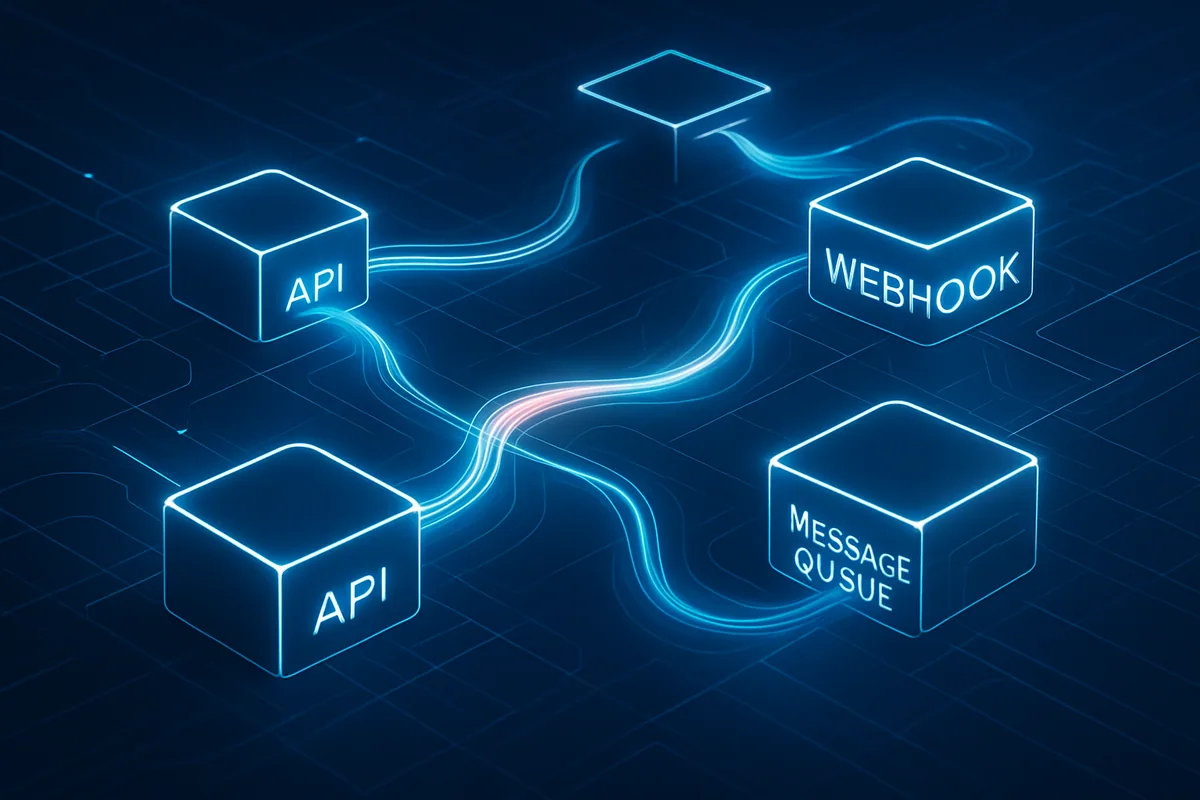
There is no single correct way to integrate. The method depends on whether you need to ask for data or be told about it, whether the systems must respond instantly, and how much traffic flows. Here are the five approaches you will reach for most, and where each fits.
REST APIs
REST is the default. A client sends an HTTP request to a URL, the server responds with JSON, and the standard verbs map to operations: GET reads, POST creates, PUT and PATCH update, DELETE removes (MDN HTTP methods). Almost every SaaS product ships a REST API, so it is usually the first door you try. It shines for request-response work: fetch a record, create an order, update a status. The main friction is over- and under-fetching, where an endpoint returns more fields than you want or forces several calls to assemble one view.
GraphQL
GraphQL answers the fetching problem. The client sends a query describing exactly the fields it wants, across related objects, and gets back precisely that shape in a single request (GraphQL docs). It is a strong fit when a page needs data from many related entities and you want to avoid chatty round trips or bloated payloads. The trade-off is a more involved server, and caching that is harder than with plain REST.
Webhooks
Webhooks flip the direction. Instead of your app polling an API every minute asking "anything new?", the source system sends an HTTP POST to a URL you registered the moment something happens. Stripe uses them to notify you a payment succeeded; GitHub uses them to tell you a pull request opened (GitHub webhooks). This is the right tool for near-real-time reactions without the waste of constant polling. The catch is that you now run a public endpoint that must verify signatures, respond fast, and tolerate duplicate deliveries.
Message Queues and Event Streaming
When systems must be decoupled, a message queue or event bus sits between them. The producer drops a message and moves on; the consumer picks it up when it is ready. A queue like Amazon SQS holds work until a worker processes it, so a slow or crashed consumer never blocks the producer (Amazon SQS). An event bus like Amazon EventBridge routes events to many subscribers by rule (AWS EventBridge). This pattern handles spikes gracefully and lets you fan one event out to several systems. It adds operational surface: a broker to run, and eventual consistency to reason about.
iPaaS Connectors
An integration platform as a service gives you pre-built connectors to common apps and a visual builder to route data between them. It is the fastest path for standard, well-known integrations, and it puts simple flows in reach of teams without a spare backend engineer. The limits show up with unusual logic, high volume, or anything the platform's connectors do not cover, where you end up fighting the tool.
Batch and ETL Jobs
The scheduled batch job is not dead. When you need to move large volumes, reconcile nightly, or feed a data warehouse, running an extract-transform-load job on a schedule is simpler and cheaper than streaming every record in real time. Real-time delivery is overkill for a report that runs once a day. Reach for batch when freshness in minutes does not matter and throughput does.
How to Choose the Right Method
Start from three questions. Does the receiving system need to know instantly, or is a delay fine? Does data flow one way or in both directions? And how much volume moves through? Real-time and event-driven needs point to webhooks or a message bus. Bulk, tolerant-of-delay movement points to batch. Standard app-to-app connections with no exotic logic often point to iPaaS. The table below lines up the trade-offs.
| Method | Latency | Complexity | Best for | Watch out for |
|---|---|---|---|---|
| REST API | Low (on request) | Low | Request-response reads/writes | Over/under-fetching, chatty calls |
| GraphQL | Low (on request) | Medium | Fetching exact fields across relations | Harder caching, heavier server |
| Webhooks | Near real time | Medium | Reacting to events as they happen | Duplicate/lost deliveries, public endpoint |
| Message queue / event bus | Near real time, async | High | Decoupling, spikes, fan-out | Broker to operate, eventual consistency |
| iPaaS connector | Varies | Low to build | Standard app-to-app flows | Cost at scale, limited custom logic |
| Batch / ETL | High (scheduled) | Low to medium | Bulk moves, nightly reconciliation, warehousing | Data is stale between runs |
A quick rule of thumb: use REST or GraphQL to pull data, webhooks to be pushed events, a queue when you need to decouple and survive load, iPaaS to move fast on common flows, and batch when volume beats freshness.
Security and Reliability Concerns You Cannot Skip
An integration that works in a demo and falls over in production usually failed on three things: authentication, retries, and idempotency. Get these right and most of the pain goes away. Skip them and you get duplicate charges, missing records, and endpoints anyone can spoof.
Authentication and authorization. Every call and every incoming webhook needs to prove who it is. APIs typically use OAuth 2.0 or scoped API keys. Webhook receivers should verify a signature on each payload so a random POST cannot impersonate the sender; Stripe signs every event and documents checking that signature as a core step (Stripe webhook best practices). Use TLS for everything, and scope credentials to the least access the integration actually needs.
Retries and failure handling. Networks drop, servers restart, endpoints time out. A serious integration retries failed deliveries with backoff, and routes messages that keep failing to a dead-letter queue for inspection instead of losing them. Queues and event buses give you this behavior; if you build your own, you have to add it.
Idempotency. Retries create a hazard: the same event can arrive twice. Without protection, that means two orders or two charges. An idempotent operation produces the same result no matter how many times it runs (MDN: idempotent). The common fix is an idempotency key, a unique token attached to each request so the server recognizes and ignores a repeat. Stripe supports exactly this on write calls (Stripe idempotency). Treat every webhook handler as if the same event will be delivered more than once, because eventually it will.
A Practical Rollout Sequence
You do not integrate everything at once. Pick the connection that hurts most, usually the one someone copies by hand every week, and wire that first. Confirm the APIs and events you need exist on both sides before designing anything. Handle auth, retries, and idempotency from day one. Log every message so you can see what moved and replay what failed. When one integration is stable, move to the next. This is the kind of work we do at Silicon Prime through our API development services and microservices development practice, where event-driven and queue-backed designs keep the connections resilient.
FAQs
Frequently asked questions
Web-based application integration connects two or more web applications so they exchange data and trigger each other's actions automatically, without a person exporting and re-importing files. The apps stay independent with their own databases; a record or event in one becomes available to the others through a defined HTTP interface, usually with JSON payloads. It matters because the average enterprise runs 897 applications but integrates only about 29% of them ([MuleSoft Connectivity Benchmark Report, 2024](https://www.mulesoft.com/lp/reports/connectivity-benchmark)), leaving most systems siloed. Common methods include REST and GraphQL APIs, webhooks, message queues, iPaaS connectors, and scheduled batch jobs.
Use webhooks when you need to react to events soon after they happen and want to avoid the waste of constant polling. Polling means repeatedly asking an API "anything new?", which burns requests and still adds delay. A webhook flips that: the source system sends an HTTP POST to your registered URL the moment the event occurs, as Stripe and GitHub do for payments and repository events ([Stripe webhooks](https://docs.stripe.com/webhooks)). The trade-off is that you run a public endpoint that must verify signatures and tolerate duplicate deliveries.
An idempotent operation produces the same result no matter how many times you run it ([MDN](https://developer.mozilla.org/en-US/docs/Glossary/Idempotent)). Integrations need it because retries and at-least-once delivery mean the same request or event can arrive more than once. Without protection, a repeated "create order" call makes two orders. The standard fix is an idempotency key: a unique token on each request that lets the server recognize a duplicate and return the original result instead of acting again. Stripe supports idempotency keys on its write endpoints ([Stripe](https://docs.stripe.com/api/idempotent_requests)).
No. Real-time delivery is the right choice when freshness in seconds matters, but plenty of work does not need it. Moving large volumes, reconciling records nightly, or loading a data warehouse is often simpler and cheaper as a scheduled extract-transform-load job than as a stream of individual events. The rule of thumb: if a delay of minutes or hours is acceptable and throughput is high, batch is a reasonable, low-complexity choice. Use event-driven methods when the delay is not acceptable.
Verify a signature on every incoming payload so an attacker cannot POST fake events to your URL. The sender signs each event with a shared secret, and your handler recomputes and compares the signature before trusting the data; Stripe documents this as a core practice ([Stripe best practices](https://docs.stripe.com/webhooks/best-practices)). Beyond signatures, serve the endpoint over TLS, respond quickly with a 2xx and process asynchronously, scope credentials to least privilege, and design the handler to tolerate the same event arriving twice.
Use an iPaaS when the integration is standard, the platform already has connectors for both apps, and you want to ship fast without dedicating an engineer. Build custom when the logic is unusual, volume is high, or the connection is core to your product and you need full control over auth, retries, and data shape. Many teams blend both: iPaaS for commodity flows, hand-built services for the connections that matter. We help clients make that call and build the custom pieces at [Silicon Prime](https://siliconprime.ai).
Cost depends on scope, not a fixed price, so the honest answer is a set of variables rather than a number. What moves it: how many systems you connect and whether each exposes a clean, documented API; one-directional versus bidirectional sync; real-time delivery (webhooks or a message queue) versus scheduled batch; data volume; and how much custom transformation, authentication, and error-handling logic is required. A single well-documented REST connection is modest; a multi-system, event-driven pipeline with retries, idempotency, and monitoring is a larger build. A commodity flow an iPaaS already supports costs far less than a bespoke service, which is why we scope each connection against these variables before quoting.
Timeline scales with the same variables as cost. A standard connection between two apps with mature APIs can ship in days to a couple of weeks; a custom, event-driven pipeline across several systems with authentication, retries, idempotency, and monitoring takes longer. What usually stretches a schedule is not the happy-path code but discovery, confirming the exact APIs and events you need actually exist on both sides, and hardening for production. Building the riskiest connection first and adding reliability from day one keeps the estimate predictable.
Integrations that pass a demo usually fail in production on three things: authentication, retries, and idempotency. Networks drop and endpoints time out, so deliveries must retry with backoff and route persistent failures to a dead-letter queue instead of vanishing. Those retries then create duplicates, so every handler needs idempotency to avoid double orders or double charges ([Stripe idempotency](https://docs.stripe.com/api/idempotent_requests)). The fix is to design for least-privilege auth, at-least-once delivery, and duplicate events from day one, and to log every message so you can see what moved and replay what failed.
Further Reading
Ready to Connect Your Web Apps?
Manual copy-paste between web apps is a tax you pay every week. We design and build the APIs, webhooks, and event-driven pipelines that make your systems talk to each other reliably. Reach out to Silicon Prime and we will map your integrations and ship them.
Comments