

Most teams that miss deadlines aren't short on effort. They're organized in a way that makes shipping harder than it should be. Here's a look at why, and how the common team models stack up against each other.
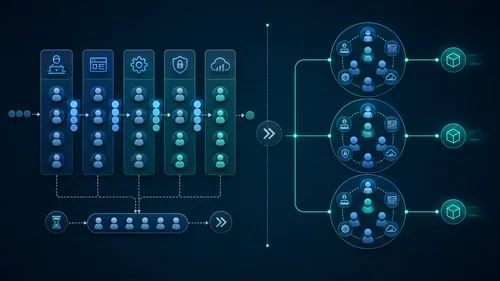
Why Your Current Team Structure Is Probably Slowing You Down
I keep seeing the same pattern: engineering split by function, each specialist booked solid, work queuing at every desk. A feature crosses product, design, backend, frontend, QA, and release before it ships, and none of those six groups owns the result. Planning turns into a fight over whose queue moves first instead of a plan to build the thing.
Leadership on these teams usually blamed bad estimates, developer productivity, or weak sprint discipline first. The real issue was smaller: too many decisions needed too many people to sign off before anything could move.
The Signs Are Usually Obvious
A reorg isn't justified by a framework. It's justified when the same pain keeps showing up on repeat:
- Dependencies dominate planning: Teams spend more time negotiating sequencing than shipping.
- Quality arrives late: QA or security review happens after implementation, when changes are expensive.
- Ownership is blurry: Incidents expose that everyone touched the service but nobody owns it.
- Managers become routers: Engineering managers spend their week escalating blockers instead of coaching teams.
- Roadmaps become fiction: Commitments assume smooth handoffs that never happen in reality.
Effort isn't what's missing here. The structure is what turns routine coordination into daily friction.
The fix a good software development team structure is reaching for is simple to state and hard to arrange: put the authority to decide in the same place as the responsibility to deliver. When a team is on the hook for a customer problem, hand it enough of the design, engineering, testing, and release muscle to actually close that problem out, so it isn't queued behind three other groups to get anything done.

The Building Blocks of High-Performing Teams
I've watched teams with sharp people, a clean roadmap, and solid tooling still blow their dates because the underlying design was wrong. What holds up is the mix of three things together: the right responsibilities, operating rules people actually follow, and enough technical range to ship without breaking things.
Roles That Carry Real Delivery Weight
A delivery team needs product direction, delivery coordination, analysis, design, architecture, engineering, quality, and release covered by someone. Titles matter less than accountability. On a small team one person can wear three of those hats, as long as nothing goes ownerless.
The roles that actually move outcomes are the ones that kill waiting:
- Product ownership: Sets priority, defines success, and makes scope decisions fast enough to keep work moving.
- Engineering and architecture: Turns product intent into systems that can change without expensive rewrites.
- Design and analysis: Resolves workflow, edge cases, and user intent before they become engineering churn.
- Quality engineering: Builds test coverage into delivery instead of acting as a late-stage inspection queue.
- DevOps and platform support: Owns pipelines, environments, observability, and release safety so shipping is routine instead of stressful.
Team Size Changes How Fast Decisions Happen
Small teams keep winning for a simple reason: less to coordinate, fewer mistakes to make. Research on medium-sized information systems backs it up, pointing to teams of 3 to 7 people, with the 3-to-5 band performing best.
| Team Size | Best Performing Range |
|---|---|
| Medium-Sized Information Systems | 3 to 7 people |
You can go too far the other way, though. Shrink a team below what it takes to run its own service and you get a group with nobody free to write test automation, answer a page at 2am, or keep the deployment pipeline healthy.
Operating Principles Matter as Much as Roles
A solid team design still falls apart with a sloppy operating model. A few shared habits separate the teams that hold up:
- One backlog, one clear owner: Priority disputes get resolved inside the team, not escalated across functions every sprint.
- Quality work happens during development: Test automation, code review, security review, and release checks happen as the work is built.
- Production ownership stays close to the builders: The people changing the system also see incidents, alerts, and customer impact.
- Interfaces are explicit: Distributed teams need clear API, service, and decision boundaries or coordination overhead explodes.
- AI output is reviewed like any other dependency: Generated code increases throughput only if teams have standards for validation, traceability, and risk control.
I've watched it show up directly in the numbers: tighter ownership and fewer handoffs mean faster releases, quicker incident recovery, and far less time lost to status meetings about who's blocked on whom.
Specialist Depth Still Matters
Going cross-functional does not make specialists optional. Security, data engineering, platform reliability, ML operations, these still call for people who go deep, and that is doubly true when you are shipping under compliance rules or leaning hard on AI.
A hybrid usually wins: delivery teams stay accountable for the outcome, with specialist coverage layered in through embedded roles, rotation, or a platform group behind a clean interface.
Common Software Development Team Structure Models Explained
There is no software development team structure that suits every company. A shape that thrives on fast customer feedback can come apart inside a regulated platform, and a shape built to guard architectural consistency can grind delivery down to a crawl.
Feature Teams
Feature teams organize around a customer outcome end to end: one team owns frontend, backend, testing, and release. I reach for this model when product requirements are still moving and speed matters. Handoffs drop, and accountability doesn't get lost between backlog and production.
Component Teams
Component teams split along technical lines instead: one team owns the API, another owns mobile, another owns the data platform. It buys deep expertise and consistency, and earns its keep on large systems with stable interfaces.
| Model | Organized Around | Key Advantage | Key Disadvantage | Best For |
|---|---|---|---|---|
| Feature Teams | Customer-facing features | Faster end-to-end delivery | Risk of uneven technical patterns | Product-centric work with changing requirements |
| Component Teams | Technical layers or subsystems | Deep specialization | Cross-team dependencies | Large systems with stable boundaries |
| Platform Teams | Shared internal capabilities | Better enablement at scale | Can become a ticket queue | Organizations with many delivery teams |
| Product-Aligned Teams | Business domains or product areas | Strong ownership and prioritization | Boundary design can be hard | Companies organized around products or domains |
| Matrix Structures | Dual reporting across functions and initiatives | Flexible access to expertise | Conflicting priorities | Organizations balancing shared experts and multiple programs |
| Pods or Squads | Small autonomous units | High accountability and speed | Coordination between pods still matters | Fast-moving organizations with clear missions |
Platform Teams
Product features are not really a platform team's job. What they build are the internal capabilities other teams lean on to ship safely and stay consistent. When it clicks, a platform team takes the repetitive engineering off everyone's plate and pulls the baseline quality up across the board.
Product-Aligned Teams
Product-aligned teams are organized around a business area such as checkout, onboarding, claims, or merchant operations. They tend to work well when the company already thinks in product lines or business domains.
Matrix Structures
Matrix structures combine functional leadership with cross-functional delivery assignments. An engineer may report to an engineering manager in one line and work on a product initiative led elsewhere.
Pods and Squads
Pods and squads are small, mission-driven units with the skills needed to ship independently. They often combine product, design, engineering, and quality inside a compact team.
How to Choose the Right Structure for Your Goals
Picking a structure is less a matter of taste than of the result you have to keep hitting. Say the board wants releases that don't scare anyone, less operational risk, and faster learning from real customers. Then the team's shape has to make those exact behaviors easy, or it is fighting you.
Start with the Release Model You Need
Start with one plain question. For this slice of the business, how often do you need to be able to change things without breaking them?
Answer "we need to ship to production constantly" and the team has to own its own testing, its own read on whether a release is ready, and the operational follow-up after it goes out. A long chain of dependencies will simply not hold up under that kind of cadence.
Use Trade-offs Instead of Ideology
Leaders get stuck when they search for the best model in the abstract. There isn't one. There are only structures that make some things easier and other things harder.
| Question | If your answer is yes | Structure bias |
|---|---|---|
| Do you need frequent low-risk releases? | Teams need end-to-end control | Feature or product-aligned teams |
| Do you support complex shared infrastructure? | Deep expertise matters | Component or platform teams |
| Are you missing architectural consistency? | Shared standards need stronger ownership | Platform support or a lighter matrix |
| Are external dependencies overwhelming delivery? | Handoffs are the real cost center | Smaller autonomous pods |
The final test is simple. Can a team take a valuable piece of work from idea to production with minimal waiting, clear accountability, and acceptable operational risk? If not, the structure still needs work.
A Real-World Example of a Team Structure Overhaul
One of the clearer restructures we've been part of happened inside a mid-market digital product company with strong growth pressure and a delivery model that hadn't caught up. The company had good engineers, serious product ambition, and a release process everyone distrusted.
What Was Broken
Nothing about the symptoms was exotic. Product managers were out lobbying several teams at once just to get their work looked at. QA ended up holding all the late risk, because testing had been shoved to the very end where it belonged to no one until it was too late.
Something that looked like a two-day feature in planning would quietly balloon into a string of coordination tasks. No one set out to add drag. The structure produced it on its own, without anyone deciding it should.
What Changed and What Got Messy
We rebuilt the org around product-aligned squads. A squad took a bounded slice of the product and carried a wider span of delivery work than before. The shared specialists did not vanish; their role changed, from gatekeepers you had to get past into partners embedded in the work or enabling functions behind it.
The result was real, though messy for the first few weeks. Release risk dropped once squads carried smaller scopes and clearer accountability. Deployments moved from a tense every-other-week cadence to several smaller, safer pushes each week, and once things settled, user-reported bugs fell.
| Metric | Before Overhaul | After Overhaul |
|---|---|---|
| Release Frequency | Bi-weekly | Multiple times per week |
| User-Reported Bugs | High | Reduced |
Adapting Your Team for AI Transformation and Outsourcing
I've seen fully staffed teams seize up the moment AI tools or outside partners enter the workflow. Both hit coordination costs before they touch headcount.
AI Changes Work Distribution More Than Job Titles
Whether AI replaces engineers isn't the useful question here. What matters more is which parts of the delivery loop get cheaper, which parts get riskier, and who ends up owning the consequences.
In practice, that reshapes work in three ways:
- Keep review with the team shipping the change: The people using AI tools should own validation, code review standards, and production behavior after release.
- Put senior judgment where it matters most: Engineers and product leaders still decide what fits the architecture, risk tolerance, customer promise, and margin profile.
- Shift QA toward prevention: AI can produce more tests. It does not replace risk-based test strategy, exploratory testing, or release decisions under uncertainty.
How to Structure External Partners Without Losing Control
Outsourcing runs the same test on your structure. It can close real gaps: capacity crunches, legacy systems nobody internal wants to touch, specialist work you can't hire for, follow-the-sun coverage, or just keeping shipping while your own hiring lags. Mismanaged, the partner becomes a detached pair of hands waiting on internal approvals, and lead time pays for it.
A Future-Ready Shape
If I were redesigning a team today, I would start with small domain-aligned squads, strong platform support, explicit service ownership, and selective specialist overlays for security, data, ML, and compliance. I would use AI inside those teams as part of normal delivery work. I would bring in external partners as accountable contributors inside the same operating model, not as a parallel organization.
Your Structure Is a Tool Not a Monument
Too many companies treat their org chart like architecture carved into stone. That mindset creates stale teams, slow releases, and endless workarounds. A software development team structure should be treated more like a product backlog. Revisited often. Changed when reality changes. Judged by outcomes, not elegance.
A healthy organization keeps asking a few uncomfortable questions:
- Where are teams waiting?
- Who owns production outcomes?
- Which handoffs are useful, and which are just history?
- Does this structure help us ship smaller, safer changes more often?
A good reorganization doesn't make the org chart prettier. It makes routine work less expensive and important work easier to finish.
Frequently asked questions
Restructure when the same friction repeats: dependencies dominate planning, QA and security land late, incidents expose that nobody owns a service, managers spend the week routing blockers, and roadmaps assume handoffs that never go smoothly. The trigger is recurring operational pain, not a framework fad. If teams negotiate sequencing more than they ship, the structure, not the effort, is the bottleneck.
Aim for small, cross-functional teams that own a customer outcome end to end, sized at roughly 3 to 7 people. Amazon's widely cited [two-pizza rule](https://docs.aws.amazon.com/whitepapers/latest/introduction-devops-aws/two-pizza-teams.html) captures the ceiling: if two pizzas can't feed the team, it's too big and communication overhead swamps the work. Below about three, you lack the coverage to run your own testing, on-call, and deployment. The best software development team structure aligns decision authority with delivery responsibility inside that compact unit.
Feature teams organize around a customer outcome and own frontend, backend, testing, and release for it end to end, which cuts handoffs and keeps accountability clear, best when requirements move fast. Component teams split by technical layer, one owns the API, another the data platform, buying deep specialization and consistency at the cost of cross-team dependencies. Feature teams optimize for speed and ownership; component teams for stable, large-system boundaries.
Start with the release cadence the business actually needs, then pick the structure that makes that cadence cheap rather than the model that sounds best. Frequent, low-risk releases favor feature or product-aligned teams with end-to-end control; complex shared infrastructure favors component or platform teams. Google's [2024 DORA State of DevOps Report](https://dora.dev/research/2024/) finds that teams with autonomy and clear ownership tend to perform better on delivery and stability, so weight trade-offs, not ideology.
There's no flat price; cost is driven by scope variables you control. The main levers are team count and size, seniority mix, whether you use in-house, offshore, or blended staffing, how much platform and QA automation you build versus buy, and the coordination overhead of your chosen model. A single autonomous pod is far cheaper to stand up than a matrix spanning shared specialists. Price the operating model and ownership boundaries first, then staff to them, rather than hiring roles and hoping a structure emerges.
Bring external partners in as accountable contributors inside your existing operating model, not as a detached execution arm waiting on internal approvals. Give them a bounded slice of the product with clear service ownership, explicit API and decision boundaries, and the same backlog, review, and release standards as internal teams. Outsourcing fails on lead time when handoffs, not headcount, become the cost center, so the fix is embedding partners in the delivery loop, keeping architecture and risk decisions in-house, and measuring them on the same outcomes.
AI reshapes how work is distributed more than it changes job titles: some parts of the delivery loop get cheaper, others get riskier, and someone must own the consequences. Keep validation and code-review standards with the team shipping the change, put senior judgment on architecture, risk, and customer-promise decisions, and shift QA toward risk-based prevention rather than volume. Treat generated code like any other dependency, with standards for traceability and review, so throughput rises without quietly raising defect risk.
Most fail because leaders redraw the org chart but leave old approval chains, shared gatekeepers, and blurry production ownership in place, so friction reappears in weeks. Expect a messy first few weeks even for a good reorg, then improvement as squads carry smaller scopes and clearer accountability. Judge it by outcomes: Google's [2024 DORA report](https://dora.dev/research/2024/) frames high performance as pairing frequent deployment with low change-failure and fast recovery, so track release frequency, failure rate, and lead time, not how tidy the chart looks.
Product ownership sets priority, defines what success means, and makes scope decisions fast enough that work never stalls waiting for a call. In a high-performing team it sits inside the squad rather than above it, so trade-offs get made with full delivery context instead of routed through a distant approver. Weak or absent ownership is where roadmaps quietly decay into backlogs of half-finished, unprioritized work.
Further Reading
- Team Topologies | Atlassian
- The Importance of DevOps Team Structure | Atlassian
- Agile at scale | Atlassian
Ready to Build with AI?
Contact Silicon Prime — we help companies design and ship production-grade AI products.
Comments