

My first outsourcing project didn't fail on the vendor's side. We treated a complex product decision like a staffing purchase, and the mismatch stayed hidden until it caused real damage.
The partner's engineers were sharp and the budget held. We never agreed on a definition of done or who would maintain the system after launch. Code shipped; the product wasn't operable.
Introduction My First Failed Outsourcing Project
Integration week exposed it: APIs that didn't match our assumptions, acceptance criteria buried in email threads, thin test coverage, and no named owner for production support.
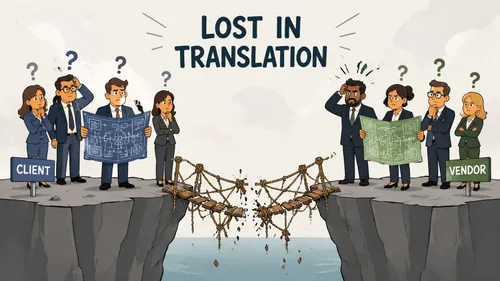
Governance had quietly slipped to the vendor along with execution, and none of us decided that on purpose. Recovery was expensive: estimates lost trust, the vendor defended scope boundaries, and every bug became an argument over defect versus new requirement.
What the failure actually taught me
That project reset how I evaluate outsourcing deals: keep architecture, acceptance, and release authority explicit, no matter how much code the partner writes.
This isn't a niche market anymore.
| Year | Global Market Estimate | Projected Market | North America Share |
|---|---|---|---|
| 2024 | USD 534.9 billion | USD 940.0 billion by 2034 | 34.7% |
Half a trillion dollars. The real question is buying this quarter's velocity without financing next year's instability.
What works better than vendor theater
Polished delivery decks make me suspicious. Talent, rates, capacity charts: none of it decides a project's fate.
Three things decide it:
- Boundaries agreed before signature: architecture, backlog, security, release sign-off, maintenance.
- Quality visible to both sides: Git, JIRA, code review, acceptance criteria that don't depend on memory.
- Handoff planned from day one: documentation, runbooks, test assets, shadow support.
Every outsourcing failure I've walked into traced back to a decision nobody wrote down.
This guide comes from what actually held up.

Choosing Your Engagement Model
The earliest self-inflicted wound is picking a model for comfort: dedicated team sounds like continuity, fixed price sounds like certainty.
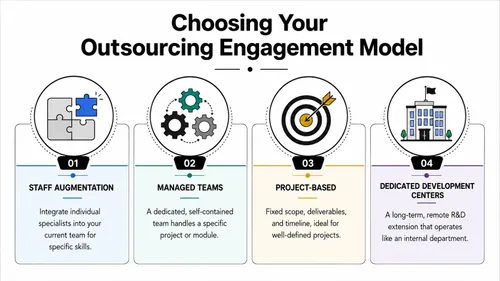
Rule of thumb: the less clearly you can define scope, the more dangerous a rigid contract gets. Strong leadership holds onto control safely; thin leadership needs a partner able to absorb more delivery responsibility, or the work turns into a black box.
The four models that actually matter
Four models cover most engagements, each breaking differently when the fit is wrong.
| Model | Fits when | Warning sign |
|---|---|---|
| Staff augmentation | You run delivery well and need hands fast | Idle staff, usually from unclear tickets or slow review |
| Managed teams | You keep product direction, vendor owns a self-contained team | No stable product owner or decision access |
| Project-based outsourcing | Scope and deliverables are genuinely fixed | Learning cycles turn into contract renegotiations |
| Dedicated development centers | You need long-term continuity and deep product context | Architecture and documentation drift out of your control |
A practical comparison
| Model | Best For | Control Level | Cost Structure |
|---|---|---|---|
| Staff Augmentation | Filling skill gaps inside an existing team | High client control | Usually time-based |
| Managed Teams | Owning a module or workstream with shared oversight | Medium to high shared control | Time-based or blended |
| Project-Based | Well-defined deliverables with low requirement volatility | Lower day-to-day client control | Fixed fee or milestone-based |
| Dedicated Development Centers | Long-term product or platform extension | Shared strategic control | Ongoing team-based budget |
How to decide without overcomplicating it
A short filter picks between them.
| Model | Choose it when |
|---|---|
| Staff augmentation | Your PM, engineering manager, and architect already have bandwidth |
| Managed teams | You want ownership of a bounded domain while keeping product control |
| Project-based delivery | Scope is stable and acceptance criteria can be written tightly |
| Dedicated development center | You're building lasting capability, beyond a one-off staffing gap |
Practical rule: A fixed-scope contract sells fake certainty when your roadmap still depends on discovery. You pay for it later in change orders and rework.
The model has to match the uncertainty in the work itself.
The Real Benefits and Hidden Risks
The obvious reason companies outsource is cost. That matters, and the economics are real.
| Cost Savings | Delivery Timelines Reduction | Companies Outsourcing IT |
|---|---|---|
| 40% to 60% | Up to 30% | 76% |
But cost isn't the reason the best outsourcing deals succeed. They succeed because they provide capability the internal org cannot hire or ramp quickly enough.
What teams really buy when they outsource
A serious engineering leader usually outsources for one of four reasons:
- Specialized expertise: AI engineering, cloud migration, performance tuning, security hardening, data platform work.
- Capacity for a narrow window: a release train, a re-platform, an acquisition to integrate.
- Raw speed, when hiring is slow or the roadmap is already full.
- Staying focused: keep the core team on differentiators while a partner carries a defined build stream.
The best outcome I've watched came from automating a brittle back-office workflow costing staff two days a cycle in spreadsheets. After handoff the cycle ran in five minutes, validations and audit logging built in. The edge was pattern recognition: they'd done that automation before.
The risks that show up after the kickoff call
The serious risks build quietly, after week one.
| Risk | What it looks like |
|---|---|
| Vendor lock-in | Undocumented context piles up until switching gets painful |
| Weak knowledge transfer | Engineers can't safely support production after launch |
| Shadow architecture | Structural decisions live in tickets and Slack, never in a design record |
| Security and compliance drift | Nobody verifies secrets, access, logs, or test data handling |
| Misleading progress signals | Ticket velocity looks good while integration risk grows unnoticed |
Outsourcing a core area purely to relieve delivery pressure buys a short-term win and a long-term problem.
Any vendor can build it. What matters: will your team still understand and improve it six months out?
Building a Bulletproof Governance Framework
Most outsourcing relationships run heavy on optimism, light on control. Good governance costs no delivery speed and keeps escalation routine.
Mature buyers already operate this way.
| Market Share in 2024 | Governance Approach |
|---|---|
| 68.3% by large enterprises | Milestone acceptance, compliance expectations, and explicit scope discipline |
A version of that memo goes to every CIO we talk to.
Start with contracts that match engineering reality
Start on the operational questions; lawyers handle the rest.
IP ownership covers more than source code: infrastructure, design files, pipelines, runbooks, and the repositories holding them each need a named owner. Vague terms surface when performance drops and the relationship strains.
Security and compliance need the same rigor: map ISO 27001, HIPAA, PCI, or SOC 2 obligations into access rules and evidence you'll collect. 'Secure development' measures nothing on its own.
Run delivery as a control system
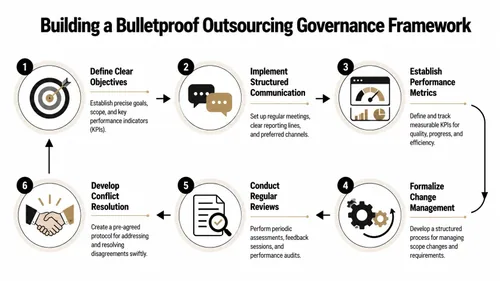
Well-run governance feels like engineering. It runs on a short list of controls.
| Control | What it does |
|---|---|
| Weekly planning and risk review | Confirms priorities, blockers, and decisions needing client input |
| Daily or near-daily coordination | Standups that stay useful by surfacing dependency risk |
| Shared tooling | Git, JIRA, CI, ADRs, and test reporting visible to both sides |
| Formal acceptance criteria | Explicit pass conditions for every increment |
| Quality gates | Code review, unit and regression testing, release readiness, defined up front |
Good governance assumes the vendor is honest and still asks for the evidence.
Delivery environments that lean hard on AI need one further control: a written process for reviewing, validating, and testing generated code. Our Aegis AI model does this, combining smaller release increments, AI-assisted planning, and quality checks ahead of every release. The specific approach matters less than the discipline: faster code generation raises the cost of weak review.
Design the handoff before coding starts
Handoff is where well-run projects still fail: code ships, launch happens, and a month later nobody can say who's operating the thing.
- A named owner for incidents, triage, hotfixes, rollback.
- Knowledge transfer spread through the engagement, since a final-week download never sticks.
- Durable records: architecture decisions, environment assumptions, known limitations.
- Could another team step in without guessing?
A vendor that resists this level of transparency is signaling risk.
How to Select the Right Partner A Practical RFP Checklist
Selection fails when the smoothest sales team wins. Reward evidence: proof the partner works inside your technical reality, decision pace, and risk appetite.
Specialized work raises the stakes further.
| Organizations Closing Capability Gaps with External Partners |
|---|
| 53% |
That number carries the most weight in partner selection. It pushes the conversation toward fit: stack, problem class, compliance load.
What to test in the RFP
"Do you have cloud experience" always gets a yes. Push for proof that maps onto your own system.
Ask for prior work on your stack and data constraints, then walk them through code review and incident response. Watch whether bad news travels and senior people from the pitch stay on the account.
Questions that expose the truth fast
Good RFP questions leave nowhere to hide.
| RFP area | What to ask |
|---|---|
| Stack expertise | Show a recent project using our core technologies and explain the hardest engineering trade-off you handled |
| Quality model | What blocks code from reaching production in your process |
| Security | How do you manage access, code ownership, and non-production data handling |
| Delivery governance | Who owns scope decisions, escalation, and milestone acceptance |
| Operability | What artifacts do you provide so an internal team can support the system after launch |
If a vendor answers hard questions with process slogans, keep looking.
Reference calls only pay off with hard questions. Skip client happiness and ask what went wrong, how disagreements got handled, whether senior talent stayed assigned, and how rough maintenance turned out after go-live.
The strongest partners do two things weaker ones avoid: narrow their claims, and say no to work outside their model.
How AI Is Reshaping Outsourcing Strategy
AI coding tools are changing the economics of outsourced delivery, but not in the simplistic way people often frame it. The value of external partners is moving away from routine implementation and toward system design, integration judgment, domain understanding, and governance.
The market already shows it. Buyers are rethinking what routine coding is worth outsourcing and drifting toward embedded arrangements, co-development and hybrid delivery among them. When AI accelerates boilerplate and some categories of test creation, raw coding throughput gets hard to keep paying for.
Routine coding is losing value
Low-complexity coding is being compressed. Outsourced teams will survive that; the work worth sending out is what changes.
Some things belong in-house regardless. Product logic that defines competitive advantage. Architecture decisions with long lock-in. Regulated workflows where auditability matters, and your own policies on AI usage, review standards, and model risk.
What still travels well is work rewarding concentrated expertise, durable delivery systems, or implementation patterns your team rarely uses.
What a modern partner should bring now
Producing code faster is table stakes now. The partners worth hiring help with the questions that got harder.
Three of them matter most to me. When AI is multiplying output, can they cut the work into increments small enough that review still means something? Can they demonstrate, concretely, how generated code gets validated? And will they accept a co-development arrangement in which your engineers keep the product context and the architectural ownership?
Recent experience backs this up. The strongest external teams I've worked with lately won the engagement on their handling of ambiguity, their ability to get through hard technical decisions without theatrics, and the fact that our internal team came out the other side more capable than it went in.
Conclusion Your First 90 Days to Success
The first three months shape an outsourcing engagement. Governance, role clarity, and handoff expectations need to exist before the first major miss.
Days 1 through 30
Finalize the statement of work operationally. Get repos, tooling access, security expectations, and the acceptance process live before the team accelerates, and confirm who owns architecture and release sign-off.
Days 31 through 60
Watch code quality, ticket clarity, defect patterns, and escalation behavior. Hidden bad news, slow decisions, vague acceptance criteria: fix each one now.
Days 61 through 90
Use the first increments to tune the model: adjust team shape, tighten quality gates, decide what stays with the partner. By day ninety you'll know whether you bought capacity, capability, or confusion.
Outsourcing works best as an operating model decision rather than a procurement shortcut.
Frequently asked questions
Reward evidence over sales polish. Ask for recent work on your exact stack, walk through their code review and incident response, and run a small paid pilot before committing. In Deloitte's 2024 Global Outsourcing Survey, 80% of executives plan to maintain or grow outsourcing investment, with skilled talent and agility now rivaling cost as the reason ([Deloitte, 2024](https://www.deloitte.com/global/en/issues/work/global-outsourcing-survey.html)). The strongest partners narrow their claims and say no to work outside their model.
There's no flat rate, so price the variables, not a headline number. Cost is driven by developer region and seniority, the engagement model (time-and-materials versus fixed-price versus a dedicated team), project complexity and requirement volatility, and hidden costs most quotes omit: onboarding ramp, communication overhead across time zones, and QA. Treat any fixed quote on a still-changing scope as certainty you'll repay later in change orders.
Match the model to how well you can define scope. Staff augmentation fits when you run delivery well and need hands fast. Managed teams suit a bounded domain where you keep product direction. Project-based works only when scope is genuinely fixed. Dedicated development centers fit long-term continuity. The rule: the less clearly you can define scope, the more dangerous a rigid fixed-price contract becomes.
Most fail on governance, not talent. Code ships but nobody owns architecture, acceptance, or post-launch support, so integration exposes gaps all at once. The Standish Group's CHAOS Report found only about 31% of software projects fully succeed, while 50% are challenged and 19% fail outright ([Standish Group, 2020](https://budgetoverrun.com/studies/standish-chaos-report)). Keep architecture, acceptance criteria, and release sign-off explicit no matter how much code the partner writes.
Run delivery as a control system, not on optimism. The core controls are weekly planning and risk review, shared tooling both sides can see (Git, JIRA, CI, architecture decision records), formal acceptance criteria with explicit pass conditions per increment, and quality gates - code review plus unit and regression testing - defined before delivery starts. Good governance assumes the vendor is honest and still asks for the evidence.
Put ownership and controls in the contract before work starts. Name an owner for every artifact - source code, infrastructure definitions, design files, pipelines, and runbooks - not just the source. Map real compliance obligations (ISO 27001, HIPAA, PCI, SOC 2) into concrete access rules, logging, and evidence you'll collect. As a US-based partner, Silicon Prime frames IP ownership per engagement; "secure development" as a slogan measures nothing.
Design the handoff before coding starts, because a final-week download never sticks. It needs a named owner for incidents, triage, hotfixes, and rollback; knowledge transfer spread across the whole engagement; and durable records - architecture decisions, environment assumptions, and known limitations. The real test: could another team operate the system without guessing? A vendor that resists this transparency is signaling risk.
AI is compressing low-complexity coding, so the value of a partner is shifting from raw throughput to system design, integration judgment, and governance. Buyers are moving toward co-development and hybrid models. The questions that matter now: can the partner slice work into increments small enough that review still means something, show concretely how generated code is validated, and leave your team more capable than before?
A shared definition of done is a written agreement - before work starts - covering deliverables, the quality bar, and acceptance criteria, so "finished" doesn't depend on anyone's memory. It's the single cheapest safeguard in software development outsourcing: without it, every bug becomes an argument over defect versus new requirement, and estimates lose trust the moment integration exposes the gaps.
Ready to Build with AI?
Contact Silicon Prime — we help companies design and ship production-grade AI products.
Comments