

Most IoT projects that go sideways do so before a single board fails. The damage gets done early, when someone commits to a communication model without looking hard at the field conditions it will face. This piece walks through how IoT protocols drive device cost, cloud architecture, and operational risk. It covers the layers of the protocol stack, works through the major application protocols in detail, and closes with a decision framework for picking one you can defend at scale.
The High-Stakes Choice of Your IoT Stack
A CTO approves a pilot for remote monitoring. Six months later, the team is not arguing about dashboards. They are arguing about battery life that misses the service window, SIM costs that break the unit economics, and a cloud ingestion path that was cheap at 500 devices and painful at 50,000.
That pattern is common because protocol selection is not a narrow transport decision. It shapes device behavior, gateway requirements, security operations, and the cost of supporting the fleet after deployment. Once hardware is in the field, changing course usually means firmware rework, certification delays, truck rolls, or all three.
The business impact shows up fast. A protocol that is slightly misaligned in a lab can become a recurring expense in production. Power budgets get tighter. Coverage assumptions fail in real buildings and rural routes. Certificate rotation becomes an operational burden. Message overhead inflates data charges and backend processing. These are architecture decisions with P&L consequences.
I usually frame the risk in four areas:
| Risk area | What drives it |
|---|---|
| Battery economics | Message overhead, connection behavior, and retry patterns decide whether a device lasts years in the field or burns through its power budget early. |
| Infrastructure cost | Chatty protocols push extra traffic through gateways, brokers, and cloud pipelines, raising compute and network spend together. |
| Security operations | Encrypted transport alone doesn't resolve identity, provisioning, key rotation, and authorization. |
| Scale behavior | A pilot hides what poor connectivity, intermittent power, fleet-wide updates, and bursty traffic do once the fleet grows. |
One test cuts through most protocol debates: if the strongest argument for a choice is that the software team already knows it, total cost of ownership is being underestimated. A wrong pick here forces different silicon, shorter battery life, a fatter carrier bill, and extra compliance work.
One team building industrial monitoring hardware picked HTTP for the first release simply because the web engineers already knew it. Nothing wrong showed up in the demo. Production told a different story: cellular coverage dropping in and out, handshakes repeating every few minutes, payloads carrying more header than data. Power draw crept up and the data bill followed. Swapping telemetry and command traffic onto MQTT behind a broker fixed both at once. Support tickets thinned out.
Ask this before hardware ships: will the stack survive the real power budget, the network it actually runs on, the security model, and the fleet size expected three years out? Not just the pilot.

The IoT Protocol Layers Explained
Most architecture reviews still list LoRaWAN, Wi-Fi, MQTT, CoAP, and TCP as one undifferentiated pile of options. That flattening is usually where the wrong hardware gets locked in.
Why Protocol Comparisons Often Go Wrong
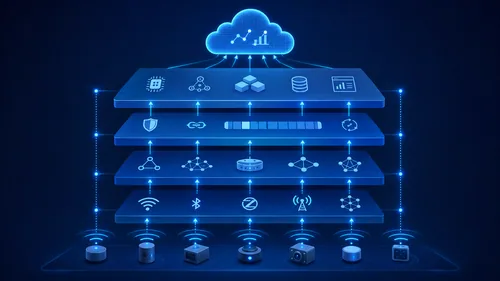
"Bluetooth or MQTT" and "LoRa or HTTP" sound like the same kind of question. They aren't. One is a radio decision, the other a messaging decision, and folding them together buries the design work that actually matters. A production stack splits out like this:
- Physical and data-link layer: Wi-Fi, Bluetooth, ZigBee, LoRa, NB-IoT
- Network layer: IP and adaptations for constrained devices
- Transport layer: TCP or UDP
- Application layer: HTTP, MQTT, CoAP, LwM2M, XMPP
A battery-powered sensor might talk to a gateway over a low-power radio while the gateway speaks IP upstream and the cloud ingests via MQTT or HTTP. One team only figured this out after deployment, once support tickets forced a remap by layer. The drain and retry storms traced back to the application protocol; the radio had been taking the blame for months.
A Practical Mental Model for the Stack
Treat the stack as an org chart for decisions. Each layer has an owner.
| Layer | What it decides | Typical engineering question |
|---|---|---|
| Physical | How bits move through air or wire | What hardware and radio constraints do we have? |
| Data Link | How nearby nodes exchange frames | Do we need mesh, pairing, or local reliability? |
| Network | How packets get addressed and routed | Do we need IP end to end? |
| Transport | Delivery behavior | Is low latency or reliable delivery more important? |
| Application | Message semantics | Is this telemetry, command and control, or device management? |
The model matters beyond engineering. Finance can trace physical and data-link choices to device BOM, battery replacement cycles, and carrier costs. Security leaders can see where identity, encryption, and certificate management live. Protocol planning belongs next to the company's data engineering services strategy instead of sitting inside a hardware silo.
Compare options within a layer first, then test the assembled stack as a system.
Deep Dive on Major Application Protocols
Judge an application protocol on four things: how it fails, what message pattern it assumes, what it costs to run day to day, and how much control it gives over the device's lifecycle.
MQTT
Publish/subscribe is why MQTT ends up as the default pick for most fleets: devices push events to a topic, a broker fans them out, and adding a new consumer never touches device firmware. The failure mode is rarely the protocol itself. It's topic hierarchies that grew without a naming convention, or broker scaling left as a someday problem, neither of which shows up until the fleet is large enough to make fixing it expensive. Teams running a sizeable brokered deployment do better tying broker operations to the cloud infrastructure management services plan rather than treating it as a side decision.
CoAP
CoAP earns its keep when the constraints are real: tight bandwidth, tight memory, tight power, and request/response still fits the workload better than publish/subscribe. It gets harder to defend once enterprise integration starts mattering more than raw efficiency.
HTTP
HTTP is the protocol every team already understands, which is sometimes reason enough to use it. Give it stable power and a reliable connection, and it rides straight into existing APIs and web tooling. The bill comes due on constrained hardware: fresh connections, bulky headers, and full request/response overhead on payloads that might carry a few bytes of actual data.
AMQP
AMQP belongs to enterprise messaging more than to constrained endpoints, with richer routing and firmer delivery guarantees than field telemetry usually needs. That capability comes with real complexity, which earns its place inside a broader enterprise event architecture and is overkill everywhere else.
LwM2M
LwM2M solves a different problem: managing the device itself over years in the field. Provisioning, configuration, and firmware coordination are where fleets get expensive long after launch, and it pays for itself anywhere a truck roll to fix one unit wipes out the margin on the whole batch.
Application Protocol Comparison
| Protocol | Pattern | Underlying Transport | Overhead | Primary Use Case |
|---|---|---|---|---|
| MQTT | Publish/subscribe | Typically TCP | Low | Telemetry, monitoring, remote control |
| CoAP | Request/response | Typically UDP | Low | Constrained devices and compact exchanges |
| HTTP | Request/response | Typically TCP | Higher | Web integration and familiar API workflows |
| AMQP | Message-oriented | Typically TCP | Higher | Enterprise messaging and complex routing |
| LwM2M | Device management oriented | Commonly built for constrained environments | Low to moderate | Provisioning, configuration, lifecycle management |
What Actually Matters in Selection
Definitions are the easy part. The harder question is which failure mode the business can absorb.
| Protocol | Choose it when |
|---|---|
| MQTT | The core workload is event-driven telemetry or command delivery across a large fleet, especially where decoupling producers from consumers lowers integration cost. |
| CoAP | Devices are constrained, exchanges stay compact, and the team can support a specialized embedded toolchain. |
| HTTP | Integration speed, existing API infrastructure, and developer familiarity matter more than protocol efficiency. |
| AMQP | IoT traffic has to plug into established enterprise messaging patterns with richer routing and delivery controls. |
| LwM2M | Device lifecycle management will drive long-term operating cost and field support burden (typically paired with another protocol instead of running alone). |
Picking on popularity or team familiarity is the recurring mistake. Fleet economics is the better map: battery life, ingestion patterns, support model, security controls, update strategy. That narrows the field faster than any feature checklist.
Deep Dive on Connectivity and Network Protocols
A network-layer mismatch rarely fails in the pilot. It shows up months later, in batteries replaced early and carrier bills that break the unit economics. The real question is what this deployment optimizes for: bandwidth, battery life, coverage, mobility, or recurring cost. Nothing on this list wins at all five.
Short-range Choices
Dense placement, indoor coverage, sites with infrastructure already in place: short-range radio's territory.
| Option | Best fit | What it costs the team |
|---|---|---|
| Wi-Fi | Mains-powered devices, firmware downloads, video, anything that wants throughput | Drinks power; someone has to manage credentials, roaming, and site RF congestion |
| Bluetooth | Provisioning, wearables, peripherals, low-power local control | Strong first-mile radio, but broad site coverage needs another layer |
| ZigBee | Mesh-heavy settings like lighting, building automation, sensor clusters | Trades speed for lower power draw and less cabling; mesh planning and interoperability testing take real work |
Wi-Fi shortens time to market since the tooling is familiar; ZigBee cuts installation cost across many endpoints, provided the team owns mesh behavior once it's live.
Long-range and Low-power Choices
Wide-area deployments run on a different budget, where coverage gaps and mobility matter as much as packet delivery.
| Option | Best fit | What it costs the team |
|---|---|---|
| LoRaWAN | Small, infrequent messages over long distances where battery life outranks latency and throughput | Connectivity cost stays low; gateway placement, backhaul, and local radio planning land on your team |
| NB-IoT | Fixed assets needing deep coverage and modest data volumes on carrier-managed infrastructure | Check operator support and regional availability early |
| LTE-M | Mobile assets, moderate firmware updates, or lower latency than LPWAN offers | You pay in module price, certification effort, and recurring service fees |
When a missed message can wait and the battery must last years, start with LPWAN. When the asset travels or needs interactive behavior, cellular earns its recurring cost.
A plant-monitoring rollout leaned on Wi-Fi at first because the buildings already had it. Fine in the pilot corner; at scale, devices burned power fighting noisy RF and every plant change spiked tickets. The fix split the fleet: fixed equipment kept Wi-Fi, remote assets moved to LTE-M. Cheapest radio on paper isn't the same as cheapest to run.
Where 6LoWPAN Matters
6LoWPAN exists for one job: IP-based networking on hardware too constrained to carry full IPv6 packet overhead, via header compression. Onomondo's overview of IoT networking protocols covers how that works for low-power wireless personal area networks while keeping compatibility with standard IPv6 through routers intact.
Every byte sent costs power, so trimming transmission size can stretch maintenance intervals and cut field service trips. Gateway placement, edge buffering, and telemetry routing all follow from how constrained the devices really are, which is why this belongs in cloud infrastructure management services planning, not after the fact.
Find the cheapest failure mode to live with, and the network protocol tends to pick itself.
Security Models for IoT Protocols
Everything can look secure right up until it isn't: devices authenticating fine, traffic encrypted, dashboards all green, until one leaked credential turns a single compromised unit into a fleet-wide incident.
MQTT, CoAP, and HTTP can all be secured properly. What matters is whether the security model fits the device's real constraints and what a failure would genuinely cost.
Start with Identity, Not Encrypted Transport
Encryption protects data in transit. It says nothing about who's allowed into the system in the first place, or what they can do once they're in. That's identity's job.
Shared credentials across a fleet are risk sitting in plain sight. A workable model gives every device its own identity, provisions it securely, and makes rotating or revoking credentials practical at production scale, not a once-a-year manual fire drill. Skip this and the usual substitute is static allowlists and one-off exceptions, which resurface later as an audit finding or an unpleasant retrofit bill.
| Area to review | What it covers |
|---|---|
| Enrollment | How a new device proves it belongs during first boot or first connection |
| Credential lifecycle | How keys, certificates, or tokens get rotated, expired, and revoked |
| Authorization scope | What the device may publish, subscribe to, read, or control |
| Blast-radius control | How far damage spreads if one device is compromised |
Protocol Security is an Operating Model
TLS and DTLS matter but cover maybe half the job. Most real failures trace back to sloppy key handling, loose authorization, or a fleet with no segmentation, not the protocol itself. Per-device certificates, tight broker-side authorization, and an auditable provisioning trail tend to matter more in practice than which protocol got picked.
What to Validate Before Rollout
Run rollout reviews against this:
| Security layer | What to validate | Business impact |
|---|---|---|
| Device identity | Unique credentials, hardware-backed storage where possible, defined revocation path | Lowers spoofing risk and makes incident response faster |
| Transport protection | TLS or DTLS configured correctly, current cipher support, certificate validation | Reduces interception and tampering risk |
| Authorization | Least-privilege access to topics, APIs, commands, and device twins | Limits the impact of one compromised endpoint |
| Software update trust | Signed firmware, verified update source, rollback protection | Prevents supply chain and malicious update failures |
| Fleet operations | Logging, anomaly detection, credential rotation, quarantine workflows | Cuts downtime and lowers support cost during incidents |
None of this stays purely technical. Certificate issuance, onboarding, and incident containment need a process people actually follow, and teams that route those handoffs through enterprise workflow automation carry fleet security with less friction.
Pick the security model your team can actually operate for years, not the one that looks best on a pilot diagram.
A CTOs Decision Framework for Protocol Selection
Most protocol debates stall because everyone argues from a default. Embedded protects the power budget, cloud wants clean integration, product wants speed, procurement wants one vendor. All legitimate. None should decide alone.
The Questions That Matter
Start with the workload. The protocol name comes after, not before.
| Question | What to weigh |
|---|---|
| What are devices sending? | Telemetry bursts, periodic status, commands, file transfers, and management operations behave differently on the wire. Small event messages favor lightweight messaging; direct resource retrieval and broad web compatibility point elsewhere. |
| What happens when coverage is inconsistent? | Intermittent connectivity punishes chatty request/response designs. Event-based buffering and brokered delivery tend to cope better. |
| What's the power budget? | Emnify's guide to IoT protocols points to MQTT as the common pick for remote monitoring and control, since its lightweight publish/subscribe design keeps overhead below what request/response patterns impose. The same guide notes that UDP gets favored in time-sensitive traffic where latency matters more than delivery guarantees, with TCP taking over when reliable delivery is the priority. |
| Who owns the operational burden? | Broker management, certificate discipline, gateway complexity. Somebody runs it, and that team may already be at capacity. |
| How much lock-in are you accepting? | Standards-based choices leave room to swap vendors, replace modules, or split responsibilities later. |
| How will this integrate with enterprise systems? | The protocol has to fit a data ingestion, monitoring, and automation model the organization can sustain, in line with broader enterprise workflow automation priorities. |
An Anonymized Migration That Changed the Economics
A logistics client picked HTTP early on, mainly because it let the cloud team move fast. The pilot did nothing to argue against it. Production found the gap: devices ran on battery, coverage came and went, and messages were small but relentless, exactly the environment request/response handles worst.
Two changes fixed it. Telemetry got its own path, separate from management traffic. And telemetry moved to MQTT, with topic design, reconnect behavior, and payload size tightened deliberately instead of left at defaults. The rest of the stack stayed put; this was a targeted fix, not a rewrite.
The payoff showed up in operations, not in a slide:
| Outcome | What changed |
|---|---|
| Battery behavior improved | The field team stopped escalating premature replacements at the same rate. |
| Data usage fell | Carrier and transfer costs became easier to forecast and defend. |
| Cloud handling got simpler | Event ingestion matched actual device behavior instead of fighting it. |
| Support improved | Retry logic and intermittent coverage got easier to reason about. |
Don't migrate protocols because a standard is fashionable. Migrate when the current communication pattern is creating operational waste.
MQTT wasn't the universal answer. The real lesson was that request/response gets expensive fast once a fleet is constrained enough. Workload first, then power, then failure conditions, then operating model.
Conclusion Building a Future-Proof IoT Foundation
No protocol wins IoT outright. What wins is a stack matched to the device, the network, the workload, and the team running it. Radio choice sets hardware and maintenance cost. Transport sets delivery behavior. The application protocol shapes how the cloud side gets built. Security cuts across all of it.
What to Standardize and What to Keep Flexible
Standardize whatever holds operational efficiency together, wherever the deployment allows it: device identity, observability, topic naming, update workflows, fleet management controls.
Leave room to flex where constraints genuinely differ. A building sensor, a mobile tracker, and an industrial gateway can share a portfolio without needing identical connectivity; forcing uniformity there usually costs more than it saves.
One edge case deserves more attention than it gets. A peer-reviewed review of IoT protocol choices asks whether protocols should stay IP-based at the edge at all. MQTT, CoAP, 6LoWPAN, and RPL get treated as the default path automatically, but some LPWAN deployments make the overhead of IP a real cost once packets shrink to a handful of bytes. Not a reason to drop IP. A reason not to assume it wins by default.
Pilot Measure and Scale
The least glamorous approach still works best: pilot under realistic conditions, measure battery behavior, reconnect patterns, delivery characteristics, cloud load, and field support burden, then scale whatever survives contact with reality.
A lab demo proves little about a production architecture. Test in the real radio environment, with real sleep cycles, certificate rotation, and update workflows, before procurement locks the fleet shape in. That choice shapes support and maintenance for years, so tie it to long-term software maintenance services planning rather than treating it as a one-time hardware call.
Frequently asked questions
Start with the workload, not the protocol name. Rank your constraints in order: power budget, network conditions, security model, update strategy, and expected fleet size three years out. Match a protocol to whichever failure mode your business can least afford, then validate the assembled stack, not each layer in isolation. Small event messages over unstable links usually favor lightweight publish/subscribe (MQTT); constrained request/response endpoints favor CoAP; stable, powered devices integrating with existing APIs can justify HTTP.
For frequent small messages, MQTT almost always wins on power. A peer-reviewed cold-chain study measured MQTT drawing 6.03% (QoS 0) and 8.33% (QoS 1) less power than HTTP for the same telemetry ([Sensors journal, 2023](https://pmc.ncbi.nlm.nih.gov/articles/PMC10224120/)). The gap widens on flaky cellular, where HTTP repeats handshakes and ships more header than payload. Reserve HTTP for mains-powered devices with reliable connectivity where API familiarity matters more than efficiency.
Yes, and mature fleets usually do. A common pattern is a low-power radio (LoRaWAN, BLE, ZigBee) on the first mile, IP upstream from a gateway, MQTT for telemetry and commands, and LwM2M running alongside it purely for device management, provisioning, and firmware updates. The goal is not one universal protocol but a coherent stack where each layer is owned and validated as a system, with a gateway translating between edge and cloud where needed.
Most stall on operational reality the pilot never tested: battery life that misses the service window, coverage that fails in real buildings, and certificate rotation that becomes a manual fire drill. Cisco's IoT survey found only 26% of companies considered their initiatives a complete success and roughly 60% stalled at the proof-of-concept stage ([Cisco, 2017](https://newsroom.cisco.com/c/r/newsroom/en/us/a/y2017/m05/cisco-survey-reveals-close-to-three-fourths-of-iot-projects-are-failing.html)). Piloting under real radio, sleep-cycle, and update conditions before procurement locks the fleet shape is the single biggest de-risker.
Encrypted transport (TLS/DTLS) is maybe half the job; it protects data in transit but says nothing about identity or authorization. Most real IoT breaches trace to shared fleet credentials, over-broad broker permissions, or no segmentation, so one compromised device becomes a fleet-wide incident. Prioritize per-device identity, secure enrollment, practical key rotation and revocation, least-privilege scopes, and blast-radius containment, then pick the protocol whose security model your team can actually operate for years.
The classic error is lining up MQTT, CoAP, and HTTP as if they answer the same question, and folding radio choices (LoRa, Wi-Fi) into the same debate. They live at different layers, so comparing across them buries the real design work and locks in the wrong hardware. The other recurring mistake is choosing on team familiarity: if the strongest argument for a protocol is that the software team already knows it, total cost of ownership is being underestimated.
Look for a partner who starts from your workload, power budget, and field conditions rather than a default protocol they always ship. Ask how they handle the layers you will not: broker operations, gateway and backhaul planning, per-device identity and certificate lifecycle, and firmware update workflows. Favor standards-based, portable choices over vendor lock-in, and confirm they will pilot under realistic conditions before scaling. At Silicon Prime we scope protocol architecture alongside cloud infrastructure, data engineering, and long-term maintenance so the stack holds its economics at fleet scale.
There is no fixed price; cost is driven by device count and hardware, radio and carrier fees, cloud ingestion volume, security and provisioning work, and years of field support. Protocol choice is a lever on nearly all of them: a chatty request/response design inflates power draw, data charges, and battery-replacement truck rolls, while an efficient event-driven stack lowers recurring spend. The reliable way to size it is a realistic pilot that measures battery behavior, data usage, and support burden, then extrapolates to your projected fleet.
Standardize what holds operational efficiency together across the whole fleet: device identity, observability, topic-naming conventions, update workflows, and fleet-management controls. Keep connectivity and application-protocol choices flexible where constraints genuinely differ, since a building sensor, a mobile tracker, and an industrial gateway rarely need identical radios. Forcing uniformity where the physics differ usually costs more than it saves; the discipline is consistency in governance, flexibility in transport.
Comments