

Infrastructure optimization is the work of keeping technology resources lined up with how the business operates. This post covers the discipline itself: five pillars of a resilient system, a measurement model teams can run in production, and real examples of optimization in action.
What Is Infrastructure Optimization Really About
People notice this discipline only once something is already broken: costs drift, deployments slow, incidents drag, capacity gets added but users feel nothing. Leadership calls it a budget problem; it's a systems discipline problem.
The work is aligning compute, storage, network, release process, and operational guardrails with how the business runs. Cost is one signal among several. A cheaper platform with brittle releases and long recovery windows just carries different stress.
I've watched this pattern repeat: provision for worst case, add exceptions over time, lose track of which services still matter. Global infrastructure demand keeps climbing, which is the real case for treating optimization as capital allocation, not technical debt cleanup.
What Experienced Teams Do Differently
Stronger teams drop the "cut spend this quarter" question and ask harder ones:
- Where is utilization mismatched to demand?
- Which dependencies make simple changes risky?
- What capacity is critical versus merely convenient?
- How quickly can a bad change be detected and reversed?
- Do these workloads belong in their current environments at all?
Those questions clear up most cloud and platform decisions on their own. It's why ongoing cloud infrastructure management services beat one-off projects: sustained management builds the visibility and rhythm a single engagement never gets to.
What It Isn't
A lone migration won't do it. Nor a rightsizing sprint, nor a dashboard rollout nobody opens after the first month. Outcomes need a repeatable loop: discover what exists, baseline behavior, change in controlled increments, measure improvement.

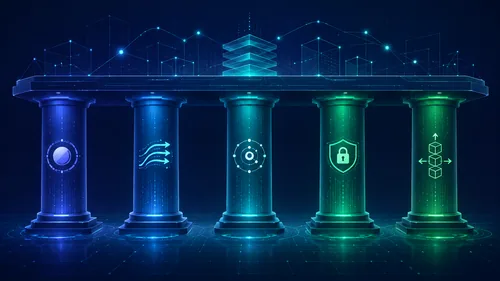
The Five Pillars of a Resilient System
A balancing act. Cost, performance, reliability, security, and scalability all matter, and trouble starts when any one gets promoted to sole objective.
Why Optimization Behaves Like System Tuning
Executives get the engine analogy: tune for raw speed with weak cooling and fragile parts, and the machine fails exactly when it's needed most. Infrastructure fails the same way. The setup worth keeping isn't the cheapest or fastest in isolation. It's the one that holds up under real load and real change.
Each pillar earns its place. Waste compounds through idle capacity, needless complexity, excess licensing, duplicated tools. Users feel latency before anyone opens an architecture diagram. Frequent incidents erase whatever savings got claimed. Shortcuts in access control, patching, segmentation, or secrets handling come back later as fire drills. A system built only for today's conditions bottlenecks once demand shifts.
Where Teams Get the Trade-Offs Wrong
The failure mode I keep seeing is overcorrection on one pillar. Cost-only programs strip redundancy, delay upgrades, leave teams running near the edge. Scale-only spending buys optionality the business may never use. Security bolted on outside delivery breeds friction. Performance pushes hide inefficiency inside oversized resources.
| Pillar | What Good Looks Like | What Failure Looks Like |
|---|---|---|
| Cost | Spend follows real demand | Spend hides idle or duplicated capacity |
| Performance | Fast, predictable response under load | Latency spikes during normal business events |
| Reliability | Small failures stay small | One bad change becomes a broad outage |
| Security | Controls fit daily operations | Teams bypass controls to ship |
| Scalability | Capacity expands without chaos | Growth exposes brittle assumptions |
Held in tension, the five produce resilience. Maximized alone, each just produces the table's right-hand column.
How to Measure What Matters
Most programs stall for the same reason: action starts before a trustworthy baseline exists.
Start with Utilization Intelligence
Utilization intelligence comes first, a baseline inventory of servers, applications, dependencies, environments, and workload patterns, built before any consolidation or automation begins.
Teams rush this. The big environments are known. Missing are the batch jobs feeding customer workflows, the integrations on legacy storage paths, the non-production systems doing release validation. An incomplete map turns later decisions into guesswork.
Anyone operating aging platforms will find software maintenance services woven straight into this work. I'd put it more strongly. Maintenance often is the optimization mechanism, the thing preserving service continuity for customers while the estate gets simplified underneath them.
A Measurement Model That Holds Up in Production
Four steps:
- Discover what exists.
- Baseline how it behaves today.
- Rationalize what stays, changes, merges, or retires.
- Monitor after each change so the next decision uses fresh evidence.
Guardrails attach to each pillar, kept few enough that people actually watch them.
Cost: spend by workload rather than one blended total, environment drift from duplicated services, run-rate visibility into budget that drains regardless of value.
Performance: response time at p95 or whatever tail metric maps to user pain, error rate because fast failures still count, saturation across CPU, memory, storage latency, disk IOPS, and network contention.
Reliability comes down to change: failed-change rate, rollback frequency, incident severity, how often change breaks things, whether recovery is real, which services actually interrupt the business.
Security: patch and config drift from standard, secrets and access hygiene, exception count. Exceptions turn into operational drag.
Scalability: provisioning lead time for safe capacity, elastic behavior versus manual rescue, queueing under load, the signal that shows where throughput breaks first.
A Practical Optimization Roadmap
No single roadmap fits every company. Smaller businesses need focus and guardrails. Enterprises need sequencing and governance, since each change lands on more teams, more standing exceptions, more inherited complexity.
What SMEs Should Do First
A small team doesn't need a transformation office standing up committees. What it needs is a handful of moves that pay off almost immediately.
Start here. Go hunting for the obvious mismatches first, the services someone sized for a peak that never really shows up, and bring them back down to earth. Sort out tagging and ownership while you're at it, because a resource with no name attached is a resource nobody will ever turn off. Put your non-production environments on a real schedule instead of letting dev and test run around the clock out of habit. Standardize how you actually ship, leaning on blue-green, canary, and feature flags to take the drama out of a release. And before any change goes out, settle the rollback plan up front. If nobody can tell you how they'd undo it, the change isn't defined well enough to run.
What Large Enterprises Need to Stage Differently
At enterprise scale the technical bar isn't usually the issue. These teams generally know what good looks like. What bites them is choreography, getting a lot of moving parts to move in the right order.
Staged execution survives at this scale: one inventory baseline for everyone, since letting each domain keep its own partial truth is how programs sink. Classify by criticality and dependency risk, since a payroll system, a checkout flow, and an archival reporting job have no business moving on the same schedule. Consolidate shared services only where quality and ownership improve. Automate repeatable work first, provisioning, policy checks, routine operational actions, and let bespoke legacy edge cases wait. Migrate in waves; the migrations that work look, in hindsight, like a string of contained moves.
Cloud migration services earn their keep on broader platform shifts through dependency mapping, cutover planning, and a real fallback plan, not just the target-state diagram.
| Priority Area | SME Focus | Enterprise Focus |
|---|---|---|
| Visibility | Basic inventory and ownership | Cross-domain dependency mapping |
| Cost control | Stop obvious waste | Align spend to business-critical workloads |
| Reliability | Standardize safer releases | Reduce blast radius across many teams |
| Automation | Remove manual ops toil | Enforce policy and consistency at scale |
| Migration | Simplify hosting choices | Sequence modernization without disrupting core operations |
Optimizing everything at once doesn't work. Chasing savings, migration, security cleanup, observability rollout, and architecture redesign simultaneously creates a backlog of half-finished change.
Real World Examples of Optimization in Action
Operating situations explain the discipline faster than slide-deck language.
Example One: Fixing Release Risk Before Chasing Savings
A team assumes the platform is too expensive. Maybe. The deeper problem is that every release is dangerous, so releases happen less often, each one gets larger, and incident review turns into blame instead of learning.
The fix is rarely cheaper infrastructure. Reduce change size, tighten validation, add rollback-triggering guardrails. Trusted releases make rightsizing, consolidation, and automation safe; anything earlier just stresses an already fragile system.
Example Two: Modernizing While Operations Stay Live
The harder case: legacy operations that cannot stop. Hospitals, utilities, plants, shipyards, large enterprise back offices never get to pause for a clean rebuild.
The U.S. Navy's Shipyard Infrastructure Optimization Program is the clearest public example. Per the Navy's SIOP planning materials, the program uses phased planning, industrial engineering analysis, modeling and simulation, and digital twins to coordinate major upgrades while submarine and carrier maintenance keeps running. Sequencing matters as much as the technology itself.
What These Examples Have in Common
Scale differs; the moves don't. Continuity comes first, before cleaner architecture. Change goes out staged: pilot, validate, expand. Dependencies get modeled, not guessed at, since guessing is expensive. Observability travels with the change, since impact you can't see fast, you can't optimize safely. The teams that pull this off skip dramatic rewrites for systems built to absorb improvement without dropping service.
Making Smart Procurement and Tooling Decisions
Buyers often ask which platform is best. That's usually the wrong question. The right question is which tool fits the way your team operates.
Build Versus Buy Is Really an Operating Model Choice
There are real reasons to build. Maybe your workflows are genuinely odd, or your compliance rules are strict enough to rule out the usual products, or you're straddling legacy and modern platforms in a way nothing off the shelf handles cleanly. Fair enough. Just go in clear-eyed that once you build your own platform, you also own it forever: the maintenance, the roadmap calls, the training, the slow accumulation of support debt.
Off-the-shelf products work best when the team is willing to adopt the product's opinionated way of working. Open-source tools can be excellent, but only if you have people who can operate them confidently in production. A tool that is "free" on paper can become expensive if every upgrade becomes a mini-project.
What to Ask Before You Sign Anything
AI-heavy operations raise the stakes here. Vendors of AI infrastructure and MLOps services lead with model orchestration features, and those demo beautifully. The scrutiny belongs on deployment safety, traceability, cost visibility, and day-two operations.
Then test operational fit. Will it support your release model or just your architecture diagram? Does it reduce manual decision-making or centralize it? How does it handle rollback, policy enforcement, and auditability? Can the current team run it without a specialist bottleneck? Will it replace existing sprawl or add another dashboard to ignore?
Feature-heavy buying cycles leave me cold, because a missing capability almost never sinks a team. What sinks them is a tool at odds with their ownership boundaries, their skills, or their release discipline.
Beyond Cost Savings: The True Goal of Optimization
Plenty of people treat infrastructure optimization as a spend-reduction exercise and nothing else. That framing is incomplete, and it steers teams toward the wrong work more often than it helps.
Look at it wider and the point of optimization is that it makes the business better at changing without getting hurt. A platform that's actually optimized lets people ship on a predictable rhythm, come back fast when something breaks, ride out a surge in demand, and keep modernizing without lurching from one emergency to the next. Set those against a line item that dropped a few percent and they're usually worth a great deal more.
The Better Question Is What the System Enables
A useful public example comes from large-scale modernization. The latest public materials on the Navy's Shipyard Infrastructure Optimization Program describe it as a 20-year, $21 billion effort focused on modernization, digital-twin development, and operational redesign tied to capacity, throughput, and maintenance readiness, not just cost reduction.
For CTOs and engineering leaders the test is short: did the program improve resilience, throughput, and confidence in change? Lower spend paired with slower releases, harder-to-contain incidents, and more brittle operations means the job isn't finished.
The work turns continuous from here: more automation, more AI assistance, tighter observability loops, still human-led. Someone has to decide what trade-offs matter, what risks are acceptable, and what the business cannot afford to interrupt.
Frequently asked questions
Infrastructure optimization rests on five pillars — cost, performance, reliability, security, and scalability — held in balance rather than maximized one at a time. Push any single pillar to the extreme and the others buckle: a cost-only program strips redundancy, a scale-only program buys optionality nobody uses. Resilience comes from keeping the five in productive tension.
A migration or rightsizing sprint ends; infrastructure optimization is the ongoing discipline of keeping compute, storage, release process, and guardrails aligned with the business. One-off projects never build the repeatable loop, which is why waste recurs — Flexera's 2025 State of the Cloud report estimates 27% of cloud spend is still wasted and budgets run 17% over limit ([Flexera, 2025](https://www.flexera.com/about-us/press-center/new-flexera-report-finds-84-percent-of-organizations-struggle-to-manage-cloud-spend)).
Judge an infrastructure optimization partner on operating fit, not feature lists. Look for a clear discover–baseline–rationalize–monitor method, real dependency mapping with cutover and rollback planning (not just a target-state diagram), transparent cost-by-workload reporting, and knowledge transfer so you aren't left with a specialist bottleneck. Ask for references on live modernizations delivered without downtime.
There's no flat price; cost scales with a few variables — estate size (servers, applications, environments), dependency complexity, how much is legacy versus cloud-native, whether the engagement is a one-time assessment or sustained management, and how fast you need results. A scoped discovery and baseline should price the actual work; be wary of fixed quotes offered before anyone has mapped your estate.
It depends on scope, but quick wins — rightsizing idle capacity, scheduling non-production environments, fixing tagging and ownership — often surface savings within the first weeks after a baseline. Structural gains like safer releases, consolidation, and migration waves compound over quarters. With 60% of organizations now leaning on managed service providers to regain control of spend ([Flexera, 2025](https://www.flexera.com/about-us/press-center/new-flexera-report-finds-84-percent-of-organizations-struggle-to-manage-cloud-spend)), many treat optimization as a continuous program rather than a fixed sprint.
Most infrastructure optimization programs stall because action starts before a trustworthy baseline exists, or because teams chase savings, migration, security cleanup, and redesign all at once and finish none of them. They also fail when every release is too risky to change safely. Fix release confidence, build one shared inventory first, then sequence everything else.
Utilization intelligence is a baseline inventory of servers, applications, dependencies, environments, and workload patterns, built before any consolidation or automation begins. It maps demand against capacity so teams target real mismatches instead of guessing. Skip it and later decisions become guesswork — the batch jobs, legacy integrations, and validation systems nobody documented are exactly what breaks under change.
Track a few guardrails per pillar rather than one blended number: cost as spend-by-workload and run-rate, performance as p95 response time and error rate, reliability as failed-change and rollback rate, security as patch and config drift plus exception count, and scalability as provisioning lead time. Keep the set small enough that people actually watch it.
SMEs should start with a short, high-value list: rightsize obvious mismatches, fix tagging and ownership, schedule non-production environments, standardize releases with blue-green, canary, and feature flags, and define rollback before every change. Large enterprises need choreography instead — one shared inventory baseline, workloads classified by criticality and dependency risk, and migration in contained waves rather than one heroic cutover.
Comments