

Enterprise application development has a reputation problem. Slow, expensive, everyone knows the story. The fix is organizational as much as technical: line up architecture, governance, and team design, and the business can shift priorities without breaking delivery. Below: strategic value, architecture, delivery lifecycle, legacy modernization, AI.
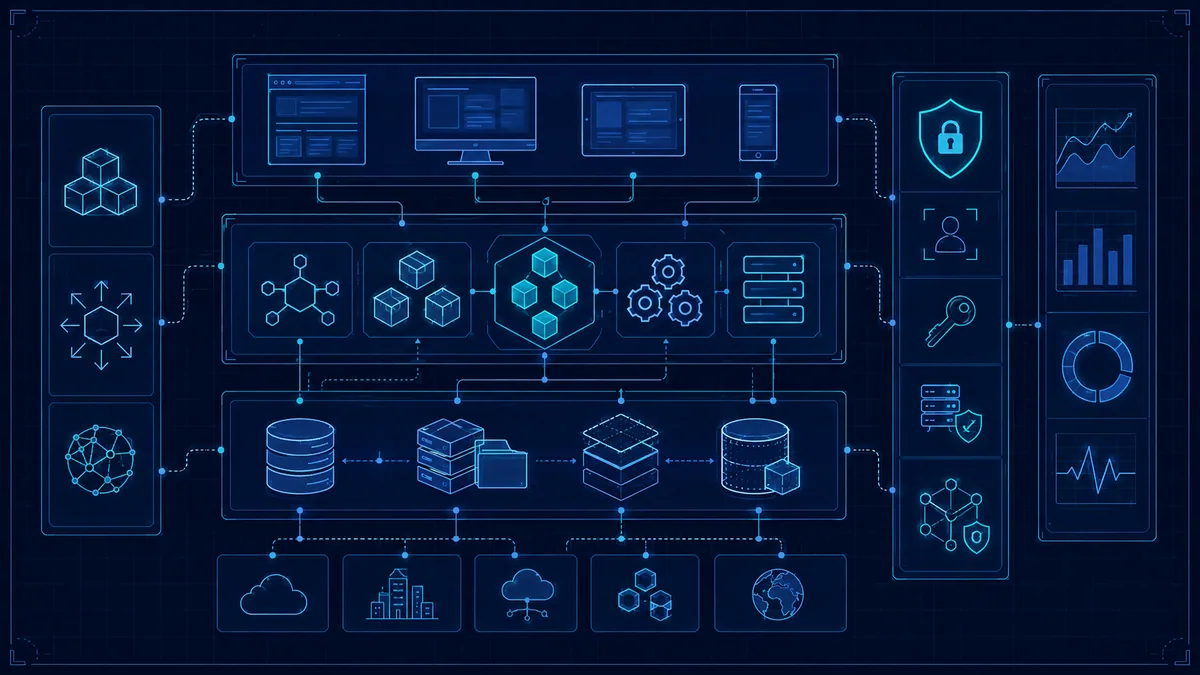
Rethinking Enterprise Application Development
Leaders describe enterprise development as if the pain comes with the territory: requirements change mid-build, integrations break, security review holds things up, releases go political. Some of that is real. Most traces to fragmented ownership and delivery design nobody thought through.

A more useful frame is the application as a business execution system. It governs how work moves across finance, operations, sales, customer support, and compliance. When it is modular and well-governed, the company can change direction without breaking; when it is brittle, so is the business.
That reframing shifts the questions. Beyond build cost, leaders weigh which capability the system controls, where release risk originates, which decisions stay central versus moving to product teams, and how much change the organization can absorb safely.
In the strongest programs we have worked with, technology came last. Business model, decision rights, risk tolerance, and integration environment settled first; modular monolith, service-oriented, or event-driven followed from there.
Defining the Strategic Value of Your Application
Plenty of initiatives open on a weak objective: automate this process. Automation trims effort. It says nothing about whether the application should differentiate the company, improve resilience, or standardize execution across departments. Skip that call and the delivery team fills the gap one feature request at a time, until what ships is a treaty between departments rather than an asset.
Start with the Business Constraint
A useful way to frame the problem is to ask what constraint the application is supposed to remove. In most enterprises, that constraint falls into one of a few buckets:
| Constraint Type | Description |
|---|---|
| Revenue Friction | Sales teams can't price quickly, onboard customers cleanly, or assemble a reliable view of account activity. |
| Operational Inconsistency | Different departments run the same process in different ways, which creates delays, rework, and reporting conflicts. |
| Decision Latency | Critical data exists, but leaders can't trust it or access it fast enough to make decisions with confidence. |
| Control and Compliance Gaps | The organization can't prove what happened, who approved it, or whether the right policy was enforced. |
Name the constraint and the purpose tends to follow. A digital factory that standardizes execution. A data refinery turning fragmented records into usable operational intelligence. A control layer that takes risk out of complex workflows.
A useful way to pressure-test the idea is to write one sentence: “This application will let the business do X with less delay, less variance, or less risk.” If leaders can't agree on that sentence, they're not ready to fund architecture decisions.
Treat the Application as an Operating Asset
Enterprise applications create value over time, not at launch. That means leaders should define value in terms of capabilities the system will enable and sustain.
A practical value model often includes:
| Value Aspect | Description |
|---|---|
| Process Efficiency | Which manual approvals, reconciliations, or handoffs disappear because the workflow is encoded in software? |
| Decision Quality | Does the application improve the consistency and accessibility of operational data? |
| Change Capacity | Can teams modify business rules, integrations, or user journeys without destabilizing the whole platform? |
| Resilience | If one function changes, does the rest of the system keep operating predictably? |
Here's where many teams go wrong. They define scope in terms of screens and workflows, but not in terms of business capability. That leads to large systems with unclear ownership. The better approach is to map business outcomes first, then derive application boundaries from those outcomes.
Practical rule: If your application strategy can't be explained without listing technologies, the strategy isn't mature yet.
A strong enterprise application should answer three hard questions before engineering ramps up:
| Decision Area | Weak Answer | Strong Answer |
|---|---|---|
| Strategic Role | “Digitize the process” | “Reduce execution friction in a business-critical workflow” |
| Primary User Value | “More features” | “Fewer handoffs, better visibility, faster decisions” |
| Long-term Purpose | “Replace legacy software” | “Create a controllable platform for business change” |
Choosing the Right Architectural Blueprint
Architecture debates run on fashion. Microservices, because that's what modern teams use. One deployable unit, because distributed systems hurt. Both instincts have merit. Both get expensive when misapplied.
“Advanced” is the wrong test. The pattern has to fit the business rate of change, team maturity, integration load, and whatever operational discipline actually exists.
Enterprise platforms unify heterogeneous systems through APIs across domains like ERP, CRM, and HR. High transaction volumes and dense integrations mean the choice lands directly on data consistency and release risk. Serverless tooling such as AWS Lambda and IBM Cloud Functions shapes the decision as well.
What Each Architecture Optimizes For
Real estate analogy: a single high-rise, a campus of connected buildings, or utilities you switch on when needed.
| Architecture | What it Helps With | What it Makes Harder | Best Fit |
|---|---|---|---|
| Monolith | Fast early delivery, simple local development, centralized governance | Independent scaling, isolated releases, domain-level autonomy | Stable domains with tight coupling and a small platform footprint |
| Microservices | Team autonomy, targeted scaling, independent deployments | Observability, data consistency, platform overhead, contract management | Large organizations with mature engineering and strong platform operations |
| Serverless | Event handling, bursty workloads, managed infrastructure | Runtime constraints, debugging complexity, distributed governance | Specific workflow steps, integrations, and event-driven extensions |
A monolith is not obsolete. In many enterprise environments the modular monolith is the most responsible starting point: transactions stay easy to reason about in one process while domains separate in code. Without strong API governance and monitoring, that beats decomposing early.
Microservices earn their keep once teams genuinely need release independence and domain separation. They also tax you: each service adds deployment logic, logging, dependency management, and new failure modes. Split too soon and one knot becomes twenty joined by contracts nobody trusts.
Where Architecture Decisions Usually Fail
The worst failures we have seen came from ignoring operational consequences. The pattern on paper was rarely the problem. Common culprits:
| Failure Point | Description |
|---|---|
| Unclear Service Boundaries | Teams split by technical layer instead of business capability. They end up with services that can't evolve independently. |
| Weak API Contracts | Developers change payloads casually, downstream consumers break, and release coordination returns through the back door. |
| Shared Databases Disguised as Services | The code is distributed, but the data model is still tightly coupled. That removes most of the benefits and keeps the failure risk. |
| No Ownership Model for Cross-domain Data | Everyone consumes the data. Nobody owns its meaning. |
One transformation program turned when the team stopped asking how many services it should have and asked which business decisions needed to change independently. Boundaries followed from real operational autonomy.
If a service can't be owned, monitored, deployed, and versioned independently, it isn't buying you much autonomy.
Implementing a Modern Development Lifecycle
Traditional enterprise delivery ran on gated phases: requirements, design, build, test, deploy, support. That looked like control but delayed feedback until corrections got expensive.
The modern approach compresses those loops to catch misread requirements, integration defects, and operational risk while fixes are still cheap. Industry guidance keeps landing on CI/CD and automated testing to cut manual error, and since even a moderately complex enterprise application takes months to build, small safe changes beat large infrequent releases. GitHub Actions and Jenkins usually supply the plumbing.
Why Smaller Changes Win
Waterfall failed enterprise teams not over documentation but because assumptions aged too fast: requirements moved, dependencies shifted, production integration ignored the diagrams. A modern lifecycle blends Agile planning, DevOps practice, and quality engineering.
| Practice | What it does |
|---|---|
| Continuous integration | Keeps code changes small enough to merge and test frequently |
| Automated test layers | Catch regressions before they turn into release events |
| Environment parity | Reduces surprises as code moves toward production |
| Deployment automation | Removes the manual release steps that introduce inconsistency |
| Monitoring and rollback | Give teams a safe path when something still goes wrong |
CI/CD earns its place by rewriting the economics of release risk.
What Changed in a Real Delivery Environment
Teams kept telling us their quarterly cycle was the price of complexity. It was not. The quarter survived because everything shipped bundled: features, integration changes, infrastructure updates, manual test coordination.
One anonymized case: a multi-location retail organization shipping in large batches with the anxiety to match. It changed three things first: smaller batches, a real CI/CD pipeline, and critical regression coverage moved into automation. Fewer variables per release, so defects got isolated fast; product owners saw feedback earlier because work moved in slices; repeatable releases ended the operations fire drills.
The certainty of a big release is an illusion. All the uncertainty is still in there, waiting for the most expensive possible moment to surface.
Shared ownership holds the whole thing together. DevOps has never really been a tooling package; it's an operating agreement binding product, engineering, QA, security, and operations. Let one group write the code while another inherits the risk and the incentives stay broken no matter which pipeline you install.
The strongest teams run on a short rule set:
- Ship in small increments.
- Automate any quality gate you would otherwise repeat by hand.
- Feed production signals back into development instead of filing them away as post-launch noise.
- Design the release so rollback and recovery are already built in.
Follow those and shipping faster stops being a gamble on business continuity.
Engineering for Scale, Security, and Observability
Enterprise software turns fragile when scale, security, and observability get treated as polish for later. By then the architecture is fixed, the risky data flows exist, and the shortcuts are expensive to unwind. It is a portfolio problem too: a large enterprise runs too many applications to patch integration, security, and release management one team at a time. Those belong at the architecture level.
Design for Operational Reality
The first engineering mistake is designing only for functional success: a workflow passes in testing and the team calls the system ready. Enterprise environments do not fail that neatly. They fail under concurrency, partial outages, bad upstream data, expired credentials, delayed events, and permission mismatches.
A practical enterprise design should settle these early:
| Consideration | Description |
|---|---|
| System Scaling | How does the system scale by workload type? Read-heavy dashboards, batch jobs, and transaction processing rarely need the same scaling pattern. |
| Dependency Failures | What happens when a dependency fails? Can users retry, continue partially, or queue work safely? |
| Problem Identification | How will operators find the problem? Logs alone won't save a distributed system with multiple integration points. |
| Auditable Actions | Which actions require auditability? If approvals, status changes, or data corrections matter to the business, they need traceable records. |
Architecture and operations meet here. A monolith is easy to inspect in one process but hard to scale selectively; microservices hand you finer-grained control and, in return, demand correlation IDs, tracing, service-level alerts, and stricter runbooks.
Build Trust into the Platform
Security has to live in the design language. On enterprise platforms that means multilayer authentication, authorization keyed to role and context, secure integration patterns by default, and audit trails tied to business events rather than bare system logs.
A strong baseline covers:
| Security Aspect | Description |
|---|---|
| Identity Controls | SSO, role mapping, and clear separation between human access and service access. |
| Data Controls | Encryption strategy, retention policy, and access boundaries around sensitive records. |
| Release Controls | Approval paths for production changes, artifact integrity, and environment-level guardrails. |
| Observability Controls | Metrics, logs, traces, dashboards, and alerts designed around business-critical journeys. |
Infrastructure-as-code earns its place for the same reason. Manual environment drift is a reliability risk and a compliance risk at once. Define infrastructure, permissions, and policies declaratively, and every change becomes reviewable and reproducible.
A simple model we use with teams:
| Pillar | What to Design For | What Usually Breaks When Ignored |
|---|---|---|
| Scale | Load patterns, dependency behavior, selective elasticity | Queue buildup, slow recovery, broad performance degradation |
| Security | Identity, authorization, auditability, change control | Unauthorized access, weak accountability, compliance exposure |
| Observability | Traceability across services and workflows | Long incident resolution, finger-pointing, poor root-cause analysis |
Integrating AI and Modernizing Legacy Systems
Most enterprises run legacy modernization and AI adoption as separate programs. They shouldn't. Both change how decisions get made, how workflows are governed, and who is allowed to touch production behavior.
“How fast can we modernize?” and “Which AI tools should we buy?” get you nowhere. The question with cutting power: which business capabilities need to become easier to change?
Modernize by Business Capability
Legacy systems survive for a reason: complex rules, critical integrations, institutional memory. Rip one out wholesale and you often buy more disruption than value. Most modernization decisions land on one of three paths.
| Path | Use it when |
|---|---|
| Refactor | The core architecture is still viable and the codebase needs cleanup, better testing, or modularization. |
| Rebuild | The application can't support the target operating model and the domain is stable enough to redefine cleanly. |
| Strangle | Behavior has to be replaced incrementally, routing capabilities into newer services while the legacy core keeps running. |
The strangler pattern usually wins because it limits organizational shock: isolate a capability like pricing, approvals, account setup, or reporting, move that slice behind a stable interface, skip the bet-the-company cutover. Modernization stalls when leadership chases a total technical reset; reframed around business capabilities and dependency seams, the roadmap sharpens.
Treat AI and Low-Code as Governance Questions
The same lens fits AI and low-code. The pitch opens on speed, and some low-code claims deliver it. The bigger issue is governance: adoption is an operating-model problem tied to maintainability, security, and control.
Once non-technical users can automate workflows, build internal apps, or configure AI-assisted decisions, someone has to own:
| Responsibility Area | Description |
|---|---|
| Application Lifecycle Management | Define workflows, decision rules, and practical success criteria |
| Access Policy | Set guardrails, integration standards, and production controls |
| Data Usage Rules | Approve usage boundaries, audit requirements, and ownership policy |
Absent that ownership, low-code becomes shadow IT with a nicer interface, and AI becomes a decision layer nobody can explain once something breaks.
Building Teams and Measuring True Success
Team structure decides outcomes as much as code quality does. We have watched capable engineers stuck inside broken delivery systems: product managers cut off from architects, QA isolated from developers, operations pulled in only on release day, vendors scored on activity while outcomes go unmeasured. That manufactures delay even when everyone is competent.
Choose a Team Model Based on Risk and Ownership
No staffing model is right in the abstract. Three questions settle it: is the application a strategic differentiator, does the build capability exist in-house, and where do decision rights need to sit?
A simple way to think about the options:
| Team Model | Best Use Case |
|---|---|
| In-house Core Team | Best when the application encodes proprietary workflows or strategic IP. It preserves context but requires strong leadership and hiring discipline. |
| Staff Augmentation | Useful when leadership and architecture stay internal, but the delivery load exceeds available capacity. It works poorly when external contributors receive tasks without enough business context. |
| End-to-End External Delivery | Can work for contained scopes, modernization initiatives, or platform setup. It usually fails when the client outsources decisions it still needs to own. |
Measure Outcomes that Matter After Launch
Many enterprise teams still grade success on delivery-era metrics alone: on time, on budget, scope delivered. Those count for something, but they say nothing about whether the application improved the business. A more useful scorecard reaches into operational and financial signals:
| Metric Type | Weak Metric | Better Metric |
|---|---|---|
| Delivery | Story points completed | Business capability released and adopted |
| Cost | Initial build budget | TCO over the application lifecycle |
| Quality | Defects logged | Production stability and recovery effectiveness |
| Value | Features shipped | Process improvement and operational leverage |
Hitting a vanity target is easy. Whether the business got easier to run is the question that actually matters.
The strongest enterprise programs run one chain of accountability from strategy to production: the business defines value, engineering turns it into architecture and delivery decisions, operations and support feed production reality back into the roadmap. Keep that loop intact and enterprise application development stops being a cost-center exercise and becomes a practical engine for agility.
Frequently asked questions
Enterprise application development is priced by scope, not a list price, so the honest answer is a set of cost drivers rather than a number. The biggest variables are how many business capabilities the system owns, integration load across ERP, CRM, and HR systems, security and compliance requirements, data-migration effort, target architecture, and team model. Because ambition compounds risk, phasing scope into smaller releases usually protects both budget and outcome — a large all-at-once build is the most expensive way to discover a wrong assumption late.
Plan enterprise application development in months, not weeks, and let scope set the range. Timeline is driven by how many capabilities the system encodes, the number and fragility of integrations, data-migration complexity, compliance gates, and the delivery team's maturity — not raw team size. A tightly scoped modernization slice can ship in a quarter, while a multi-domain platform runs across several. The faster path is smaller, safer increments: [Google's DORA research](https://dora.dev/research/2019/dora-report/) (2019) found elite teams deploy 208 times more frequently and ship changes 106 times faster than low performers by releasing small batches behind CI/CD rather than saving up large ones.
Choose a partner on architecture reasoning, integration track record, and ownership clarity — not headcount or hourly rate. Ask how they would decide between a modular monolith and microservices for your rate of change, how they handle ERP and CRM integration and data consistency, their security and compliance experience in your industry, and what post-launch support looks like. The strongest signal is a partner who insists on clarifying your business model, decision rights, and success metrics before proposing technology. At Silicon Prime, a US-based team, we treat that discovery as a required first step and frame IP ownership per engagement so the capability you fund stays yours.
Most enterprise software projects fail on people and process, not technology. In the [Standish Group 2015 CHAOS report](https://www.scrum.org/resources/blog/key-lessons-standishs-2015-chaos-report), only about 29% of projects succeeded while 52% were challenged and 19% failed outright, and small projects succeeded far more often than large ones. The recurring culprits are fragmented ownership, scope that outruns the organization's capacity to absorb change, unclear decision rights, and weak requirements — rarely the framework or language chosen. Phasing delivery into smaller, individually owned increments is the most reliable countermeasure.
It depends on where strategic IP and decision rights need to sit. Build in-house when the application encodes proprietary workflows or strategic IP you must keep close; use staff augmentation when leadership and architecture stay internal but delivery capacity is short; outsource end-to-end for contained scopes, modernization, or platform setup. Staff augmentation breaks down when contributors get tasks without business context, and full outsourcing breaks down when a client hands off decisions it still needs to own. Match the model to risk and ownership, not just cost.
Default to a modular monolith unless you have concrete evidence you need otherwise. It keeps transactions easy to reason about in one process while separating domains in code, and it avoids the operational tax microservices impose — per-service deployment, logging, tracing, and new failure modes. Microservices earn their keep only once teams genuinely need independent releases and domain autonomy and you have the platform maturity to run them. Splitting too early trades one clear system for many linked by contracts nobody trusts. Let your business rate of change, team maturity, and integration load decide.
For most enterprises the strangler pattern is the safest way to modernize a legacy application: isolate one capability — pricing, approvals, account setup, reporting — move it behind a stable interface, and replace behavior incrementally instead of a bet-the-company cutover. Refactor when the core architecture is still viable, rebuild when it can't support the target operating model, and strangle when you need continuity during the transition. Modernization stalls when leaders chase a total technical reset; this echoes [MIT CISR's case](https://cisr.mit.edu/publication/2020_0701_Replatforming_WeillWoernerHarte) for replatforming around modular business capabilities rather than wholesale technical resets.
Define strategic value by naming the business constraint the application removes — revenue friction, operational inconsistency, decision latency, or a control and compliance gap — and by agreeing on one sentence: "this application lets the business do X with less delay, variance, or risk." Enterprise applications create value over time, not at launch, so frame that value as durable capability: process efficiency, decision quality, change capacity, and resilience. If leaders can't agree on the sentence, they aren't yet ready to fund architecture decisions.
Measure success on business outcomes, not delivery-era vanity metrics. On-time and on-budget say nothing about whether the system improved operations. A stronger scorecard tracks business capability released and adopted, total cost of ownership across the lifecycle, production stability and recovery effectiveness, and process improvement rather than raw feature count. Keep one chain of accountability from strategy to production — business defines value, engineering turns it into architecture, operations feeds production reality back into the roadmap — and re-measure after launch, not only at go-live.
Further Reading
- Maturity Matters: How Firms Generate Value from Enterprise Architecture | MIT CISR
- Replatforming the Enterprise | MIT CISR
- The State of Enterprise Architecture Report 2023 - Enterprise Architecture Professional Journal
Ready to Build with AI?
Contact Silicon Prime — we help companies design and ship production-grade AI products.
Comments