

AI customer support deflection has become the number CX leaders lead the board deck with, but a ticket that never reached a human isn't the same thing as a customer whose problem got solved. On LinkedIn, Ryan Wang pushed back on a wave of "80% deflection" victory posts with a line that's stuck with us: "Every deflected customer is likely a future ex-customer." That's the gap this piece maps: the space between a ticket that disappeared and a problem that actually closed. Last updated: July 7, 2026.
Our analysis at Silicon Prime starts from a simple observation: deflection rate is a cost metric dressed up as a quality metric. It answers "did this avoid an agent" and stays silent on "did this fix anything." We don't think the fix is throwing deflection out. Support leaders still need to know what automation is handling. The fix is refusing to report it alone, and pairing every AI customer support deflection rate with a resolution signal that can't be inflated by an abandoned chat window.
What Deflection Rate Actually Measures
Deflection counts any interaction that avoided a human agent, whether the bot solved the problem or the customer simply gave up and closed the tab. Both outcomes register as identical wins in most dashboards. That single design flaw explains why customer support deflection metrics keep climbing at the same companies where complaint volume is quietly rising in the background.
Here's the mechanism. A conversational AI system logs a session as deflected the moment no ticket gets routed to a human, full stop. It doesn't matter if the customer got a correct answer, a wrong answer, or no answer at all. Gartner's February 2026 survey found 91% of customer service leaders are under pressure to implement AI in 2026, and deflection is the easiest number to point to when that pressure lands on your desk. It moves fast, it's cheap to compute, and it flatters whoever built the bot.
The people closest to the queue see the failure mode first. Ish Jindal, who has spent a decade building AI-driven support operations, walks through exactly where deflection breaks down in practice in this video. His argument tracks with what shows up in the data: teams that optimize for the deflection number in isolation end up optimizing for silence, not for solved problems.
Vendor benchmarking splits containment performance into three rough bands, and the spread matters more than any single average:
| Deployment tier | Typical containment | What drives the gap |
|---|---|---|
| Rule-based bots, no AI | Below 35% | Rigid decision trees fail on any query outside the script |
| Average AI deployments | 40-55% | Retrieval works for FAQs, breaks on account-specific issues |
| Best-in-class deployments | 70-80% | Tight scoping to a narrow set of resolvable intents |
Those numbers come from Alhena's containment benchmarking, a vendor analysis rather than an independent audit, so treat the exact cutoffs as directional. The pattern underneath them (narrower scope beats broader ambition) holds up across every deployment we've looked at.
Containment Rate vs Resolution Rate: The Metric Gap
Containment rate measures whether a conversation avoided escalation. Resolution rate measures whether the customer's actual issue got fixed. Every resolved conversation is contained, but plenty of contained conversations were never resolved at all, which is exactly the trap that makes true deflection vs resolution in AI chatbots such an easy blind spot for CX teams to fall into.
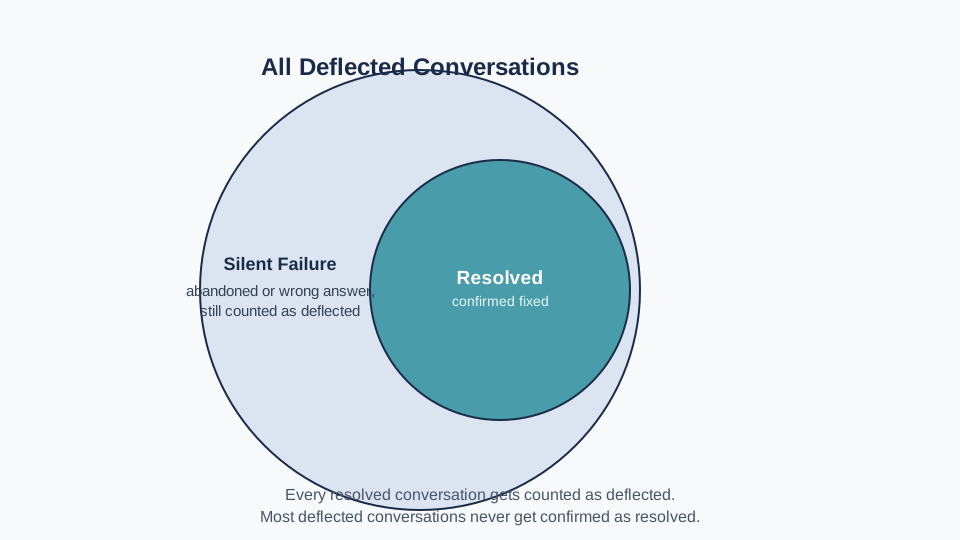
Resolved conversations are always a subset of deflected ones, and the gap between the two circles is where complaints quietly build.
Some vendors use "containment rate" where others say "deflection rate" or "automation resolution rate," and the terms get used loosely enough that a leadership team can compare two tools' numbers and think they're looking at the same thing when they aren't. Zendesk's Forrester Total Economic Impact study, published in July 2025, is a useful anchor here precisely because it separates the two. The composite organization in that study saw contact rate drop from roughly 21 to 13 per thousand subscribers over three years, a 25% reduction, while one interviewed customer reported that "thirty-five percent of all our inquiries are automatically resolved." Read those two numbers side by side and the difference between fewer contacts and more resolutions becomes concrete instead of abstract.
That Forrester engagement was commissioned by Zendesk, and TEI studies are built from customer interviews the vendor selects, so the composite organization skews toward accounts where the product already works well. It's still one of the more transparent public breakdowns of contact reduction against resolution we found, which says as much about the state of public reporting on this metric as it does about the study itself.
Self-service deflection sits in a related but distinct bucket. A customer who searches a help center, finds an answer, and never opens a ticket counts toward self-service deflection but not toward containment, because containment is scoped to conversations that started inside a chat interface. Gartner's compiled figures, relayed through Lorikeet's 2026 statistics roundup, put the number bluntly: "only 14% of issues fully resolve through traditional self-service channels." We couldn't trace that figure back to a standalone Gartner report page (Gartner's press site blocks direct crawling), so we're citing it as Lorikeet's compilation of Gartner data rather than a primary Gartner link. Take it as directionally credible, not as a number you'd cite in a board deck without your own audit behind it.
What Is a Good AI Customer Support Deflection Rate?
There's no single good AI customer support deflection rate. A number that's healthy for a SaaS product with a narrow support surface (password resets, plan changes, billing questions) is dangerous for a bank or an airline handling disputes and rebookings. The honest answer is that the number only means something next to a resolution rate and a re-contact rate measured on the same population of conversations.
That said, the industry has settled on rough bands worth knowing before a vendor quotes you one:
| Metric | Weak signal | Reasonable | Strong, but verify resolution alongside it |
|---|---|---|---|
| Containment / ticket deflection rate | Below 40% | 40-55% | 70%+ |
| Resolution rate (issue actually fixed) | Below 25% | 25-45% | 55%+ |
| Re-contact within 7 days | Above 20% | 10-20% | Below 10% |
Gartner's own long-range prediction is that agentic AI will autonomously resolve 80% of common customer service issues without human intervention by 2029. Notice the verb Gartner chose: resolve. That's a forecast for a system that closes issues, three years out from now, built on assumptions about agentic reasoning that hasn't shipped at scale yet. Treat it as a target to design toward, not a number any team is hitting on a live production system in 2026.
Enterprise AI customer support deflection benchmarking gets harder the bigger the org gets, because a single blended number across ten product lines hides which lines are dragging the average down. Break it out by intent category before you trust the topline figure.
Building an AI Customer Service ROI Framework
Here's the decision CX leaders actually have to make: what goes in the numerator and denominator of the ROI calculation you bring to the CFO. Cost saved per deflected ticket is trivial to compute and almost always overstates the win, because it assumes every deflected ticket would otherwise have cost a full agent-handled contact, and it assumes zero downstream cost from customers who left frustrated.
McKinsey's operations research on generative AI in service functions found total call volume falling by around 30% alongside first-call resolution rates rising by 10 to 20 percentage points in the deployments they studied, in their analysis of gen AI results in service operations. That combination, fewer total calls alongside more issues actually closed on the first contact, is what a real AI customer service ROI framework should be built around instead of a shrinking call count by itself.
A workable AI customer service ROI framework needs four inputs, and skipping any one of them is how deflection-only reporting sneaks back in:
- Cost per contact by channel (self-service, bot, human agent), so the savings side of the equation isn't inflated by comparing bot cost to the most expensive escalation path only.
- Resolution rate measured against the same conversation set used for the deflection number, not a separately sampled batch.
- Re-contact rate within a fixed window, because a customer who comes back in three days for the same issue erases most of the original savings.
- CSAT or DSAT collected after the interaction closes, not immediately after the bot's last message, since satisfaction measured mid-conversation misses abandonment entirely.
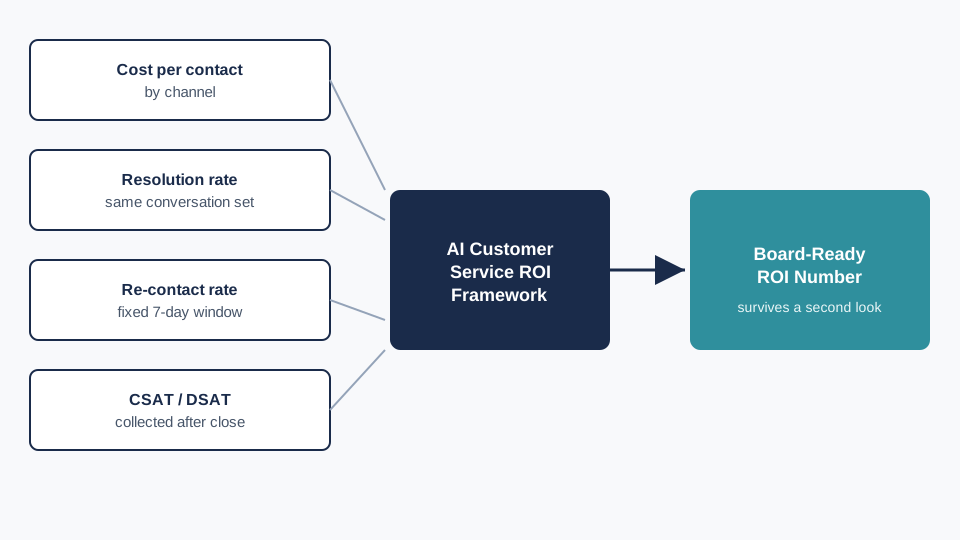
A cost-saved-per-ticket number skips three of these four inputs, which is exactly why it overstates the win.
Our published research on AI cost estimation (read it here) runs into a version of this same trap from the build side: teams price an AI system by its per-query compute cost and miss the cost of the queries it answers wrong. The support deflection version of that mistake is pricing a chatbot by tickets avoided and missing the cost of the ones it mishandled. We use our patent-pending Aegis AI methodology internally to score conversational systems against exactly that blind spot, checking resolution quality against a held-out set of real customer conversations rather than trusting the vendor's own dashboard.
AI customer service ROI metrics that survive a second look almost always include a cost-of-failure line item. Skip it and the framework only ever proves what you already wanted to believe.
How to Measure True Resolution Rate in Conversational AI
Conversational AI accuracy measurement starts with a question most dashboards never ask: did the customer confirm the issue was closed, or did the conversation just end? Confirmed resolution (an explicit "yes, that fixed it" or a re-contact-free window) is a materially different signal than a bot simply reaching its final scripted message.
Three checks catch most of the gap:
- Sample transcripts where the bot's last message was a question, and check how many customers never answered before leaving. Silent drop-off after an unanswered bot question is disguised failure.
- Track re-contact on the same account within seven days, tagged to the original intent category rather than counted as a fresh, unrelated contact.
- Run a periodic human audit against a random sample of "resolved" conversations, scoring conversational AI accuracy rate against what a trained agent would judge as actually solved.
None of these require new tooling most support platforms don't already have. They require someone deciding that the resolution rate number matters enough to build, which is a staffing and priority decision more than a technical one.
Chatbot resolution rate benchmarks are still thin in public research, which is itself a signal. Vendors publish deflection and containment because those numbers make the product look good. Independent, audited resolution rate benchmarks that would let a buyer compare two vendors on equal footing barely exist yet.
Where This Is Still Uncertain
We don't have a clean, independently audited industry average for chatbot resolution rate the way we do for containment. Every specific resolution percentage in this piece traces back to a vendor case study, a vendor-commissioned TEI report, or a compiled secondary source, not an unbiased third-party dataset. Gartner's 2029 agentic resolution prediction is a forecast, not a measurement of anything running today, and should be read that way.
The re-contact and CSAT thresholds we've laid out reflect what we see functioning as reasonable targets across support engagements, not a peer-reviewed standard. If your product has unusually high-stakes support conversations (financial disputes, medical scheduling, safety issues) the acceptable resolution floor is higher than anything in the tables above, and no benchmark in this piece should override your own team's judgment on that.
Frequently asked questions
There is no single good AI customer support deflection rate in isolation. The number only means something paired with a resolution rate and a re-contact rate measured on the same conversations. A 70%+ containment rate with resolution under 25% is a worse outcome than 45% containment with 45% resolution. For context, independent 2026 benchmarks from [Notch](https://www.notch.cx/post/ai-customer-support-resolution-rate-benchmarks) put standard AI assistants at 40-60% resolution and agentic platforms at 70-85%. Judge the pair, not the deflection figure alone.
Deflection counts whether a ticket avoided a human agent. Containment counts whether a chat conversation never escalated. Resolution counts whether the customer's actual problem got fixed. Vendors conflate all three, but only resolution reflects a solved issue. A single conversation can be deflected, contained, and still unresolved at the same time, which is exactly how deflection dashboards keep climbing while complaint volume quietly rises.
Combine three checks: confirmed customer acknowledgment (an explicit "yes, that fixed it"), re-contact tracking on the same account within a fixed window (typically 7 days) tagged to the original intent, and periodic human audits of a random sample of "resolved" conversations. Each catches a failure the others miss, especially silent drop-off after an unanswered bot question, which most dashboards quietly log as a success.
Not by itself. Deflection assumes every avoided ticket would have cost a full agent contact and that abandoned conversations cost nothing downstream, and both assumptions are usually false. A frustrated customer often re-contacts through a pricier channel or churns. McKinsey's 2025 service-operations research found the real wins came from roughly [30% lower call volume paired with a 10-20 point rise in first-contact resolution](https://www.mckinsey.com/capabilities/operations/our-insights/from-promising-to-productive-real-results-from-gen-ai-in-services), not deflection alone.
Ask exactly how the vendor defines a billable or logged resolution, and whether you can audit raw transcripts and their resolution labels yourself. A tool that files an abandoned chat as a resolution will quote a flattering number. Also ask how it tracks re-contact within a fixed window, and whether pricing is per-conversation or per-outcome, since that choice decides what you actually pay for versus what actually got solved.
It changes what you pay for. Per-conversation pricing bills every chat the bot touches; per-resolution (per-outcome) pricing bills only when the AI actually closes an issue. Below roughly an 80% resolution rate, per-outcome typically costs less, because you stop paying for conversations the bot failed. Fin, for example, publishes [per-outcome pricing at $0.99 per resolution](https://fin.ai/learn/per-resolution-vs-per-conversation-ai-pricing). Model both against your real resolution rate before you sign.
Most stall on cost and unclear value, not model quality. Gartner predicts [over 40% of agentic AI projects will be canceled by the end of 2027](https://www.gartner.com/en/newsroom/press-releases/2025-06-25-gartner-predicts-over-40-percent-of-agentic-ai-projects-will-be-canceled-by-end-of-2027) due to escalating costs, unclear business value, and inadequate risk controls. A support pilot that reports only deflection rarely proves ROI to a CFO, so budget evaporates before production. Tie the pilot to resolution rate and cost-of-failure from day one.
Report the pair, never deflection alone. Bring cost per contact by channel, resolution rate and re-contact rate measured on the same conversations, and a cost-of-failure line for mishandled tickets. A single deflection number invites the exact misread this piece is about: fewer tickets can still mean more churn. Frame ROI as resolved issues at a lower blended cost, not tickets avoided.
Ready to Build with AI?
Contact Silicon Prime — we help companies design and ship production-grade AI products.
Comments