When discussing the role of AI in our teams, we often face questions about whether AI is replacing human roles. Our diagram clarifies this by showing a workflow where AI assists with tasks, while humans make the key decisions. This approach has proven effective in aligning expectations and responsibilities.
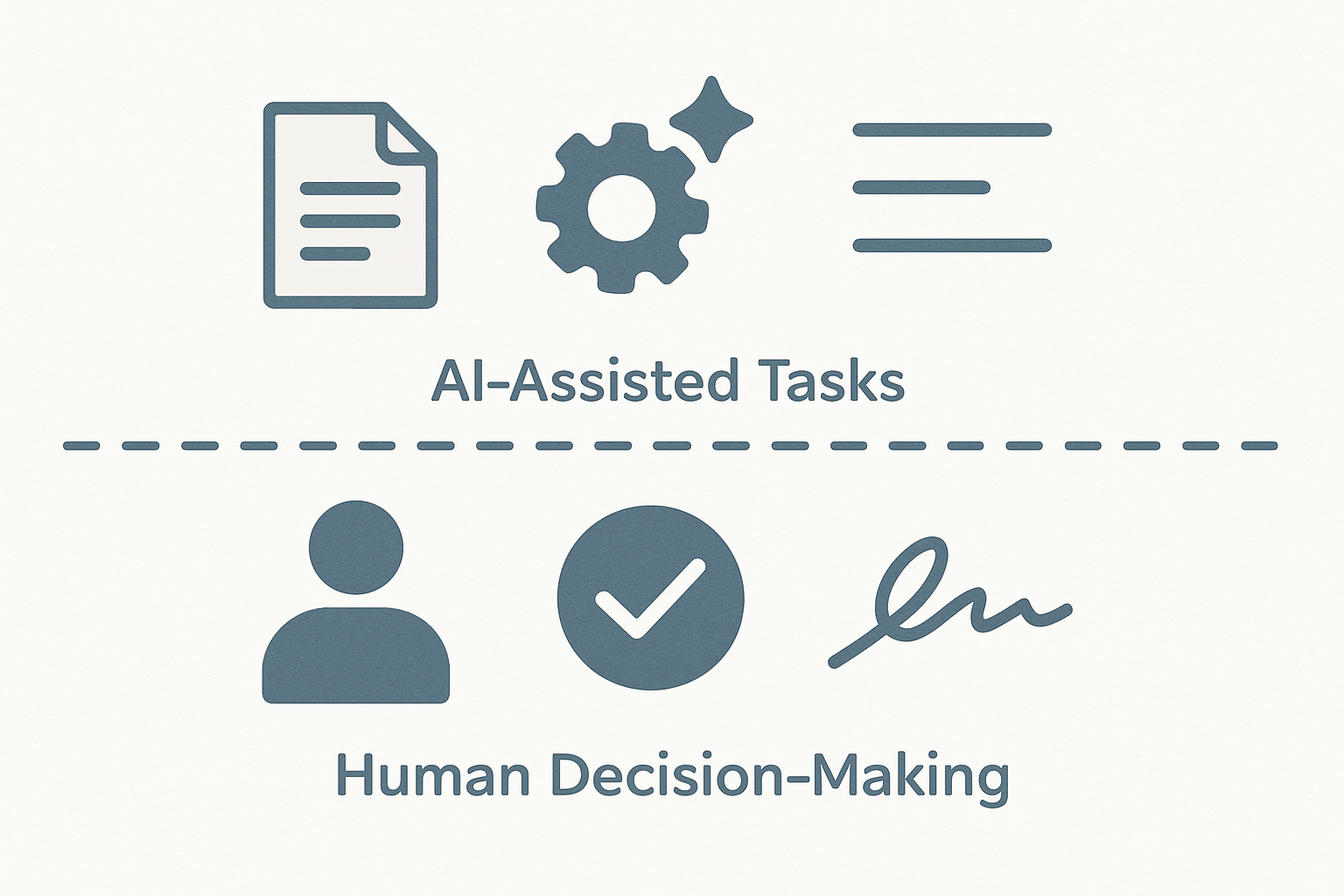
✍️ The line in the middle.
The dashed line in our diagram represents the division of tasks. Above the line are tasks like drafting, generating, and watching, which we delegate to AI. Below the line are decisions that humans handle. The workflow crosses this line twice, emphasizing human intervention at critical points.
🤝 Why this settles the debate.
The primary concern for executives is accountability, not AI itself. Our diagram clarifies this by highlighting:
- Every assist task feeds a decide task. AI never completes a loop independently.
- Every decision has a named owner. Responsibilities are assigned to individuals, not processes.
- The rollback loop is rare. While rollbacks occur, they are exceptions, not the norm.
Competitor tools like Microsoft Power Automate and IBM Watson can also assist in similar workflows, ensuring human oversight remains integral.
📉 What it does not say.
AI's role is crucial but not all-encompassing. While AI handles many keystrokes, the ultimate judgment and decision-making lie with humans. This ensures that our approach remains workforce-first, even as we integrate AI into more processes. Alternative approaches, such as using Google's AutoML, can also automate tasks while maintaining human oversight.
🎬 Related Video
Further Reading
🚀 Ready to Build with AI?
Contact Silicon Prime — we help companies design and ship production-grade AI products.
Comments