SPrime AI
Book a call

Drift vs regression — two failures, two evals.

AI systems can fail in two distinct ways: regression and drift. Regression occurs when something within the system changes and breaks, while drift happens when

AI systems can fail in two distinct ways: regression and drift. Regression occurs when something within the system changes and breaks, while drift happens when external changes in the world affect the system. Identifying these failures requires different evaluation methods.
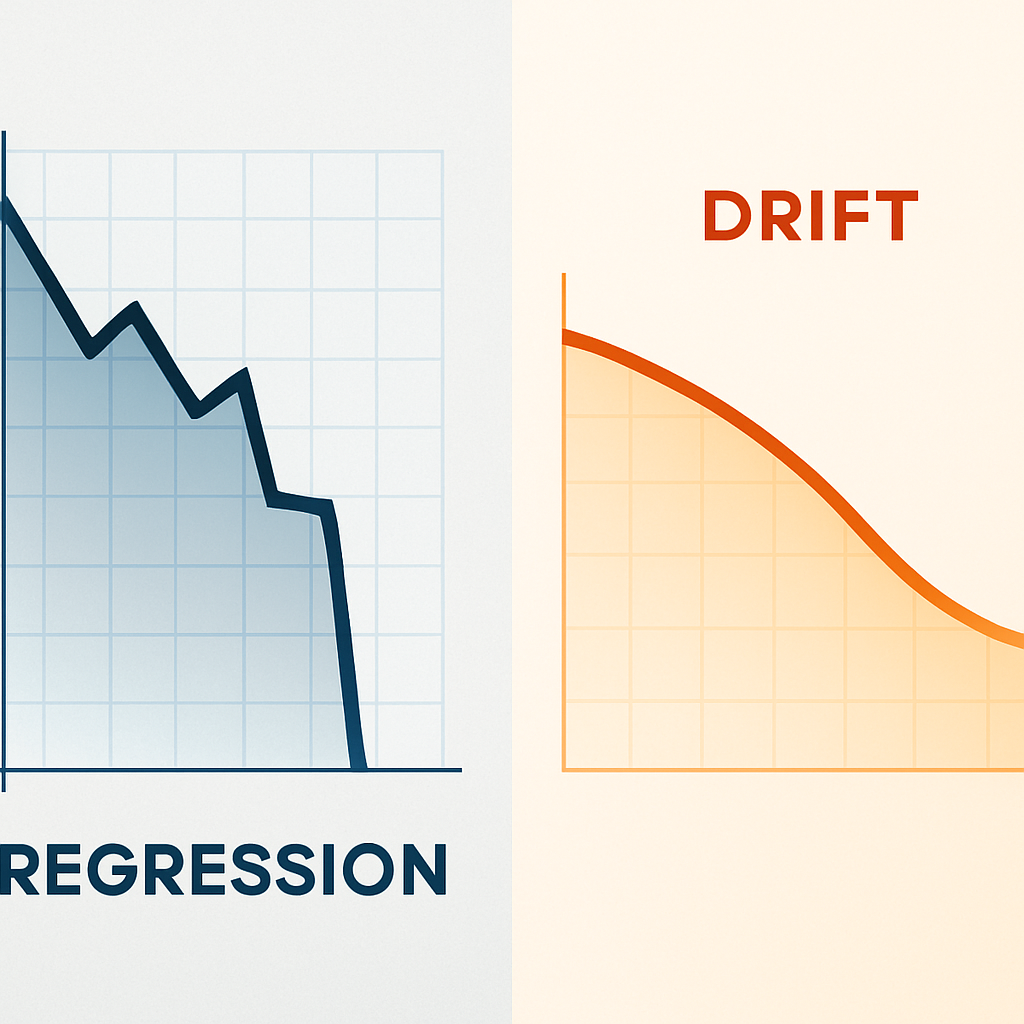
Graph illustrating regression as a cliff and drift as a slope, highlighting AI system failures

Regression is an event. 📉

A regression has a timestamp. Someone changed a prompt, a retrieval index, a model version, or a downstream parser — and the system that worked on Tuesday is wrong on Wednesday. The shape on the graph is a cliff. The cause is inside your repository.

The eval for this is a gate. You run a fixed, frozen test set against every candidate release and block the deploy if the score drops. The set never changes, because the whole point is to detect that you changed. A frozen suite is a feature here, not a flaw.

Drift is a process. 🌊

Drift has no timestamp. Nobody touched the system. The inputs changed — new slang, a new product line, a regulation that reworded the forms your model reads, or a vendor who quietly retired an upstream model. The shape on the graph is a slope. The cause is outside your repository.

A frozen test set is blind to this. It still passes, every day, while real accuracy bleeds out in production. To catch drift you need a living signal — sampled production traffic, scored on a rolling window, watched for slow movement rather than a single bad commit.

Regression asks "did we break it?" Drift asks "is it still the right tool for a world that moved?" Same symptom, opposite questions.

Two failures, two evals. ⚖️

Failure TypeDetectionEvaluation MethodFix Complexity
RegressionAt releaseFrozen gateCheap
DriftIn productionRolling monitorExpensive

The trap is using one eval and assuming it covers both. A team with a strong release gate and no drift monitor feels safe right up until a quiet six-week decline nobody deployed. A team watching only production trends can't tell a bad commit from a bad week.

We run both, and we keep them labelled. Boring, redundant, and the reason a regression never reaches a customer and a drift never surprises us for long.

Further Reading

Play video

🚀 Ready to Build with AI?

Contact Silicon Prime — we help companies design and ship production-grade AI products.

 FAQ

Frequently asked questions

Regression is an event with a timestamp: someone changed a prompt, retrieval index, model version, or parser, and a system that worked Tuesday is wrong Wednesday—the cause is inside your repository and looks like a cliff on the graph. Drift is a process with no timestamp: nobody touched the system, but the inputs changed and accuracy slowly bleeds out—the cause is outside your repository and looks like a slope.

A gate. You run a fixed, frozen test set against every candidate release and block the deploy if the score drops. The set never changes, because the whole point is to detect that you changed something. As the post notes, a frozen suite is a feature here, not a flaw—it gives you a stable reference to prove the system still behaves as before.

Because drift comes from the world changing, not your code. A frozen set still passes every day while real accuracy bleeds out in production—new slang, a new product line, a reworded regulation, or a quietly retired upstream model. To catch drift you need a living signal: sampled production traffic, scored on a rolling window, watched for slow movement rather than a single bad commit.

Assuming one eval covers both. A team with a strong release gate and no drift monitor feels safe right up until a quiet six-week decline nobody deployed. A team watching only production trends can't tell a bad commit from a bad week. Regression and drift are the same symptom asking opposite questions—'did we break it?' versus 'is it still the right tool for a world that moved?'—so they need two evals.

Regression is detected at release via a frozen gate and is cheap to fix because the cause is a specific change inside your repository. Drift is detected in production via a rolling monitor and is expensive to fix because the world moved and the system must be re-fitted to new inputs. The article summarizes this in a table contrasting detection point, evaluation method, and fix complexity.

They run both evals and keep them clearly labelled—a frozen release gate plus a rolling production monitor. The post calls this boring and redundant, and that's the point: it's the reason a regression never reaches a customer and a drift never surprises them for long. Each eval answers a different question, so neither substitutes for the other.

Changes outside your repository that shift the inputs: new slang in user language, a new product line the model hasn't seen, a regulation that reworded the forms your model reads, or a vendor who quietly retired an upstream model. Nobody touched your system, yet accuracy slowly declines. Because there's no deploy event to point at, only a rolling production monitor reveals the slope.

Thirty minutes · No pitch deck

Ready to turn AI experiments into measurable ROI?

Bring one outcome you'd like AI to move. We'll help you scope a pilot you can actually measure — and tell you honestly if it's not worth doing yet.

Comments