Your roadmap didn't slip because your team got weaker. It slipped because the work got broader, the stack got messier, and the skills you need right now don't match the people you already have. Your senior engineers are stuck on legacy support, platform maintenance, release coordination, and production issues. Meanwhile, the initiatives that drive the business forward keep waiting for capacity that never appears.
That's why software team augmentation matters now. Not as a procurement trick. Not as a cheaper way to buy labor. As a way to add execution power without dragging your company through another slow hiring cycle or handing away control of your product.
The smart move is to treat augmentation as a growth lever. Done well, it gives you specialists who plug into your team, work inside your stack, and help you ship with less operational drag. Done poorly, it becomes expensive theater. The difference is integration, governance, and whether your partner brings more than résumés.
Your Roadmap Is Stuck You Need a Force Multiplier
The pattern is familiar. Product has commitments. Sales needs delivery dates. Engineering is carrying platform debt, customer escalations, and a backlog that keeps expanding. You're not dealing with a motivation problem. You're dealing with a capacity problem.
That distinction matters because most companies still respond the wrong way. They open permanent roles, wait for recruiting to catch up, and hope the market produces the exact engineers they need. In practice, that burns time. It also locks leadership into long-term headcount decisions when the actual need may be immediate, specialized, or temporary.

Why this isn't a niche model
The market has already made the call. The global IT staff augmentation market was valued at $299.3 billion and is projected to reach $857.2 billion by 2031, growing at a 13.2% CAGR, according to eSparkBiz's staff augmentation market synthesis. That scale matters because it tells you this isn't a temporary workaround. Companies are changing how they build software teams.
That shift reflects a practical reality. Internal teams can't carry every skill, every spike in demand, and every transformation initiative at once. Modern delivery requires a blended model. Internal leaders set direction, own architecture, protect product context, and drive priorities. External specialists add throughput where the roadmap would otherwise stall.
Software team augmentation works best when leadership uses it to protect roadmap velocity, not when procurement treats it like interchangeable labor.
What executives should do next
If your core team is overloaded, don't ask whether you need more people in the abstract. Ask three sharper questions:
- What work is slipping: Identify the roadmap items losing momentum because your best people are tied to maintenance, support, or low-impact execution.
- What skills are missing: Separate capacity gaps from capability gaps. You may need backend throughput, or you may need one specialist in AI, cloud migration, QA automation, or integration.
- What must stay internal: Keep product judgment, architectural ownership, and sensitive decision-making with your internal leads. Augment around that core.
The companies that get this right don't “outsource engineering.” They build a stronger delivery system around the engineering leadership they already have.
What Is Software Team Augmentation Really
Most explanations are too soft. Software team augmentation is simple. You bring in external engineers or specialists who work inside your delivery system, under your direction, against your priorities. They join your standups, use your tools, follow your code review standards, and ship as part of your team.
That's why the model is often misunderstood. People lump it together with outsourcing, staffing, and managed services. They're not the same thing, and the differences matter when delivery risk is high.
It wears your jersey
The easiest analogy is sports. You're not selling the season to another franchise. You're bringing in a proven specialist for a specific run. They wear your jersey, follow your playbook, and answer to your coach.
That also lines up with how strong operators approach the model. nCube's guide to software development staff augmentation frames augmentation as an integration problem, not a pure hiring problem. That's the right lens. If the external engineers work as a separate stream, coordination costs rise and velocity drops. If they embed into your operating model, they add real capacity.
Engagement Model Comparison
| Dimension | Team Augmentation | Project Outsourcing | Staff Augmentation (Traditional) | Managed Services |
|---|---|---|---|---|
| Who directs the work | Your internal product and engineering leads | Vendor directs delivery against agreed scope | Usually your internal leads | Vendor manages service delivery |
| Where people work | Inside your tools, rituals, and workflow | Mostly inside vendor workflow | Often inside your workflow, but may feel transactional | Inside vendor-defined operating model |
| Primary goal | Add integrated capability and capacity | Delegate a defined body of work | Fill seats quickly | Transfer ongoing operational responsibility |
| Best fit | Roadmap acceleration with retained control | Well-bounded initiatives | Immediate staffing coverage | Repeatable support, operations, or service outcomes |
| Knowledge stays with | Your team, if onboarding is done properly | Vendor unless transfer is explicit | Mixed | Vendor by default |
| Management burden | Shared, with you still owning direction | Lower day-to-day oversight from you | High on your side if the provider only supplies people | Lower on your side, higher vendor control |
| Risk if done badly | Integration friction | Misaligned deliverables | Low productivity from poor management | Loss of visibility and flexibility |
What it is not
A few blunt distinctions help:
- It's not project outsourcing: You don't hand over the roadmap and wait for deliverables to come back.
- It's not pure staffing: Sending a résumé and calling it support isn't enough.
- It's not managed services: You're not buying a black-box function run by someone else.
If you want control, shared context, and direct collaboration, software team augmentation is the right shape. If you want to hand off an isolated scope, choose a different model.
The best use case is clear. You already have a product and engineering function. You need more delivery power without losing control of the work.
The AI-Augmented Advantage A Hands-Free Partnership
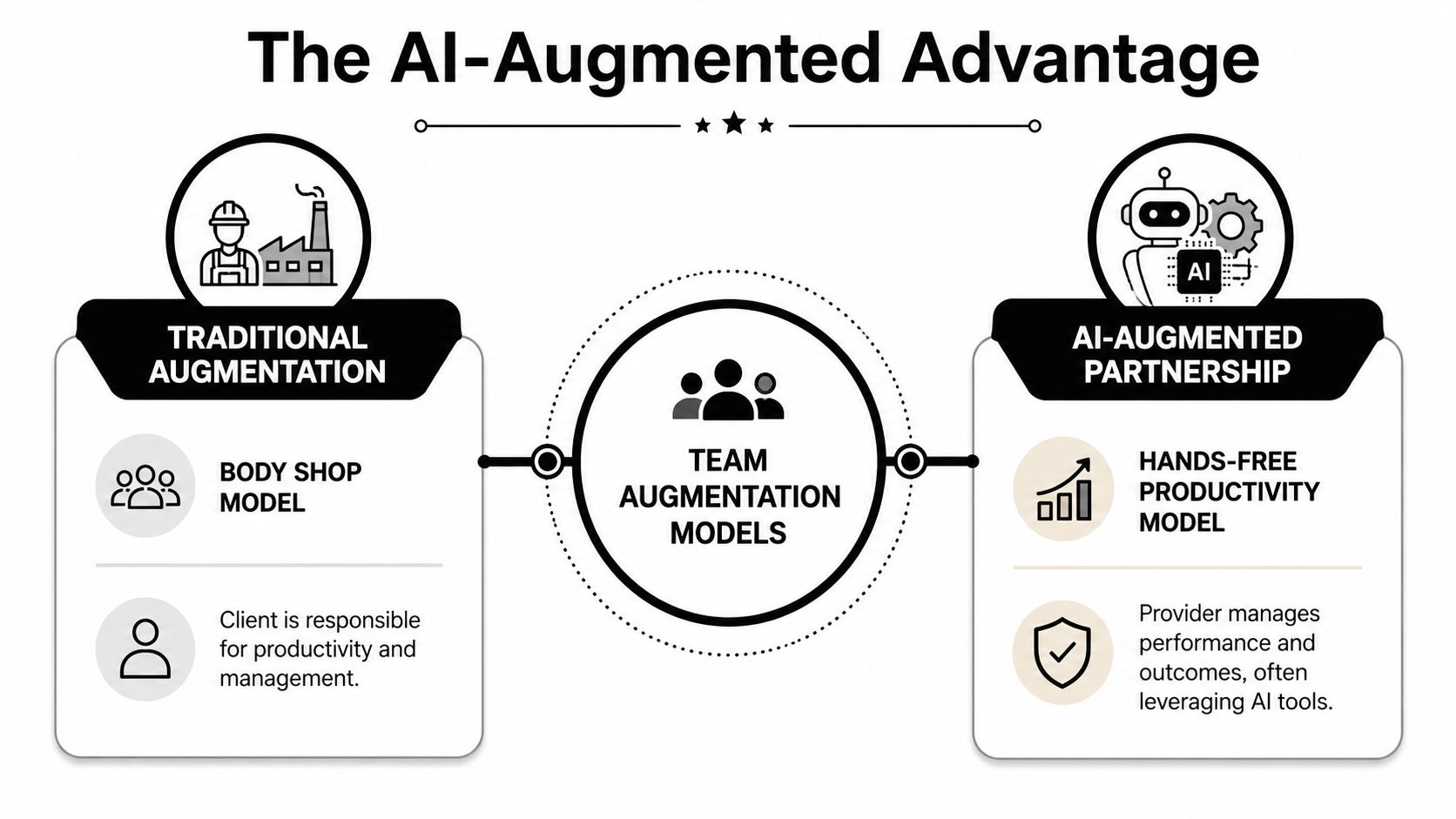
Traditional augmentation has a weakness that buyers rarely say out loud. It often gives you headcount, then leaves you holding the bag on productivity. You still have to onboard people, structure the work, enforce quality, manage communication, and make sure output matches standards. That's not a partnership. That's leased capacity.
An AI-augmented model should do more than provide engineers who happen to use modern tools. It should improve how the work gets done. That means tighter planning, faster implementation cycles, stronger QA, better documentation, and cleaner feedback loops across the team.
Traditional augmentation gives you labor
The old model is basically a body shop. You buy time. The provider sources people. Your managers do the hard part.
That approach can work, but it scales management burden right when your leaders are already overloaded. Every unclear requirement, every missed handoff, every weak PR review, every testing gap lands back on your internal team.
A better model behaves differently:
- The partner brings operating discipline: planning standards, delivery rituals, QA habits, and escalation paths.
- The specialists know how to work with AI inside real engineering teams: not as gimmicks, but inside backlog grooming, coding, testing, and release workflows.
- Your team keeps strategic control: priorities, product judgment, architecture, and business tradeoffs stay with you.
AI changes the operating model
The upside becomes concrete. One industry analysis says staff augmentation can provide pre-vetted candidates within days, not months, and reports that companies using IT staff augmentation can bring new products to market 20% faster. The same analysis says that by 2021, about 37% of IT leaders in the US were already using augmentation services, according to N-iX's review of IT staff augmentation trends.
That matters, but speed alone isn't the point. The key advantage comes when AI is embedded into the delivery model itself. Teams can tighten spec refinement, accelerate code generation, improve test coverage discipline, support faster QA cycles, and reduce routine coordination load. Used properly, AI doesn't replace your senior engineers. It clears away low-impact work so senior engineers can make better decisions faster.
A strong example of this model is AI staff augmentation services from Silicon Prime AI, where the emphasis is a hands-free partnership rather than a résumé pipeline.
Here's a useful benchmark for what that partnership should feel like in practice:
Buy outcomes, not hours. If the provider can't explain how its people become productive inside your team, you're just renting time.
When to Choose Augmentation A Decision Framework
Most companies wait too long to augment. They keep trying to solve a delivery bottleneck with hiring plans, internal heroics, or priority reshuffling. By the time they act, the launch window is tighter, the backlog is uglier, and the internal team is frustrated.
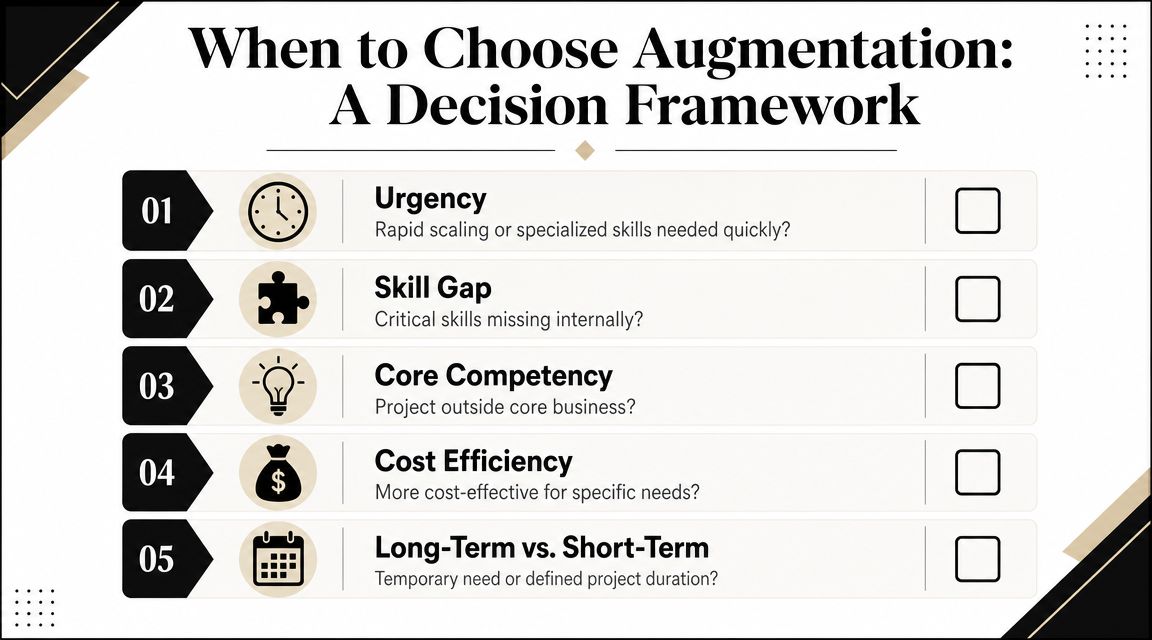
Use a cleaner decision framework. Choose augmentation when the business problem is immediate and permanent hiring is the wrong instrument.
Choose augmentation when speed matters more than ownership
Here are the right triggers:
- A major release is falling behind
Your current team can deliver, but not on the timeline the business needs. - You need a specialist you can't hire fast enough
This is common with AI implementation, cloud modernization, platform migration, data engineering, and specialized QA. - You're testing a new capability
You want to explore a new product line, automation initiative, or technical direction without adding permanent headcount before the model is proven. - Your senior team is doing work below its strategic value
If principal engineers are buried in execution details, augmentation can free them to focus on design, risk, and business-critical choices. - You need controlled scale, not a giant reorg
Augmentation lets you add capacity without redesigning the org chart.
The broader labor context reinforces this. CodersLink's analysis of IT staff augmentation cites U.S. Bureau of Labor Statistics projections showing software developers, QA analysts, and testers are projected to grow by 17% from 2023 to 2033, with about 288,000 openings each year on average. The same source says the World Economic Forum reports 39% of workers' core skills will change by 2030 and 86% of employers expect AI and information-processing technologies to transform their business by 2030. That's exactly why build-vs-augment decisions now need to account for AI readiness, not just hiring speed.
If you're weighing delegation against embedded capacity, compare augmentation with software outsourcing engagement options before you commit. The right decision depends on how much control and internal knowledge retention you need.
Don't use augmentation to avoid management
There are also bad reasons to augment:
- You haven't defined priorities
- Your architecture is unstable
- Your internal leads don't have time to guide the work
- You want outsiders to absorb team dysfunction
Augmentation magnifies whatever operating discipline already exists. If your engineering management is unclear, adding more people won't rescue delivery. It will spread confusion faster.
Augment when the strategy is clear and capacity is the constraint. Don't augment when leadership is the bottleneck.
Finding and Vetting the Right Augmentation Partner
The provider matters as much as the model. A weak partner sends profiles fast and disappears. A strong one understands delivery, screens for fit, supports onboarding, and stays accountable after the kickoff call. That difference shows up in morale, code quality, and how much management overhead lands back on your internal team.
If you only compare rates and résumés, you'll make the wrong decision.
What to ask before you sign
Use these questions to separate serious partners from broker-style vendors:
- How do you match people to a live team environment: Ask how they evaluate communication style, tool familiarity, and ability to work inside an existing SDLC.
- What does onboarding support look like: Good partners help structure access, ramp-up, expectations, and early checkpoints.
- How do you manage performance after placement: If the answer is vague, you're buying a seat, not a service.
- How do you handle replacement risk: You need a clear process if a fit issue appears.
- What do you require from the client for success: Mature firms won't pretend augmentation is magic. They'll talk about decision rights, workflows, and governance.
- How do you protect continuity: Ask how they handle documentation, shadowing, handoffs, and knowledge transfer.
- How do you handle security and confidentiality: This should be operational, not hand-wavy.
A useful reference point is Silicon Prime AI's IT staff augmentation approach, which positions augmentation as an embedded delivery model rather than a staffing transaction.
Red flags that kill delivery
You can spot bad partners early if you know what to look for.
| Red flag | What it usually means | Likely outcome |
|---|---|---|
| They only talk about speed of hiring | They optimize for placement, not delivery | Fast start, weak integration |
| They can't explain onboarding | They expect your team to absorb all ramp-up work | Managers lose time, not gain it |
| They avoid questions about governance | They don't have a mature operating model | Quality drifts and issues surface late |
| They oversell “plug and play” talent | They underestimate context and collaboration | Friction with your internal team |
| They have no plan for knowledge transfer | They treat the engagement as temporary labor only | Knowledge walks out at exit |
The partner should feel like an extension of leadership
This is the standard I recommend. The right augmentation partner reduces load on your engineering managers instead of increasing it. They prepare people properly. They communicate issues early. They coach their talent. They respect your team's standards. They don't force your organization to become their project manager.
A partner worth keeping will talk as much about integration, communication, and accountability as they do about technical skills.
That's the difference between buying help and buying drag.
Onboarding and Governance for Seamless Integration
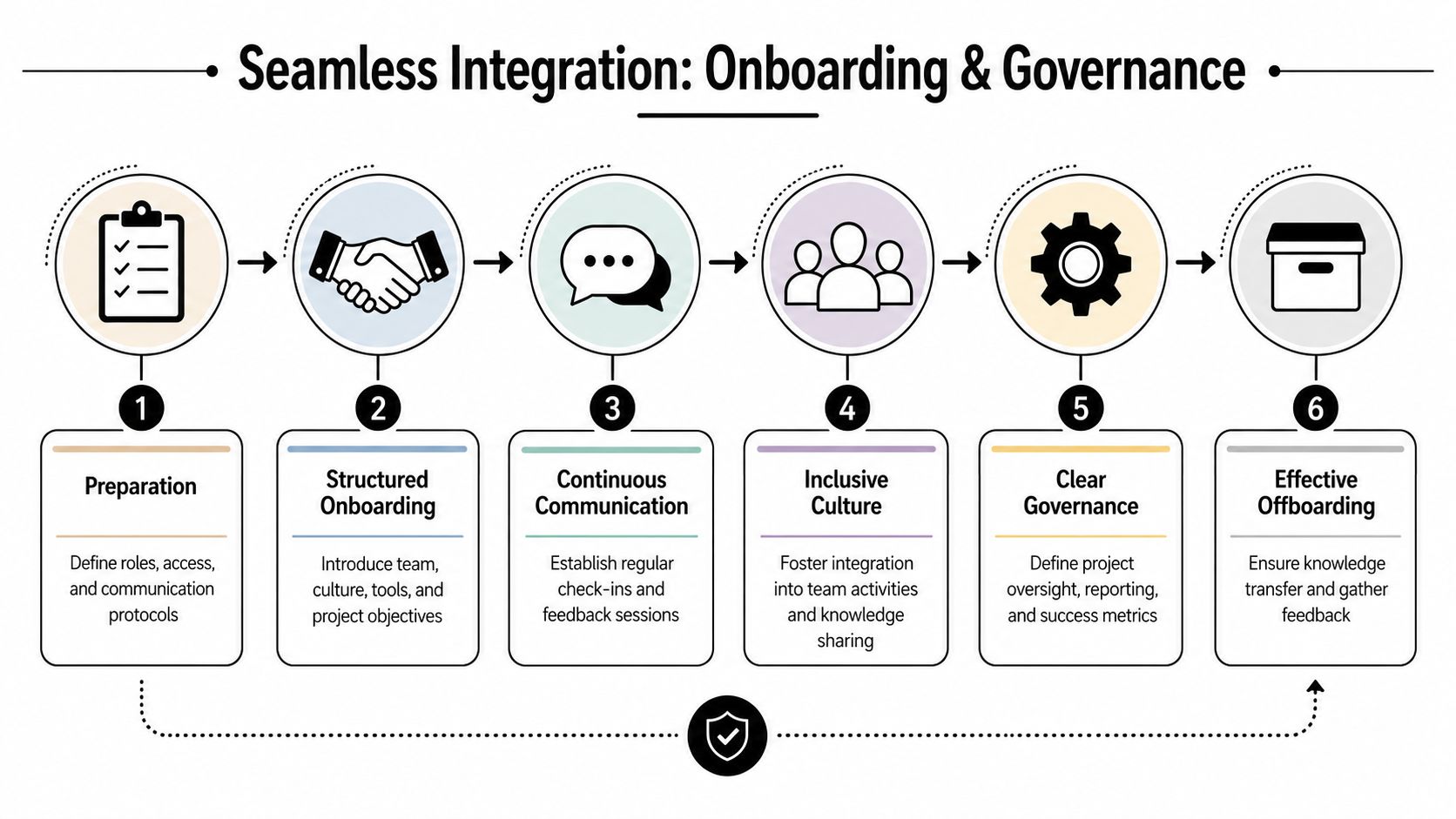
Most augmentation failures happen after the contract is signed. The engineers may be capable, but the integration is sloppy. Access is delayed. The role is fuzzy. Internal leads treat external contributors like a side queue. Rituals are inconsistent. Nobody owns feedback. Productivity drops, and leadership blames the model instead of the execution.
That's avoidable if you treat software team augmentation as an operating system issue. The external team members need the same clarity, context, and accountability as any internal hire.
Start with role clarity and access
Before day one, lock down the basics:
- Scope of responsibility: Define what this person owns, supports, or advises on.
- Decision boundaries: Be explicit about what they can decide independently and what needs internal approval.
- System access: Repos, tickets, environments, docs, communication tools, and security protocols should be ready.
- Success criteria: Tie the role to real delivery outcomes, not generic availability.
Many teams grow lazy. They assume a senior engineer will “figure it out.” Strong people do adapt, but that doesn't excuse weak onboarding. You still pay for every day of ambiguity.
A practical model for this kind of ramp is the enterprise delivery pod onboarding approach described by Silicon Prime AI, which emphasizes structured integration rather than ad hoc handoffs.
Run one team not two
Once the engagement starts, don't create an internal team and an external team. Create one team.
That means augmented engineers should join:
- Daily standups
- Sprint planning
- Backlog refinement
- Code reviews
- Retrospectives
- Architecture discussions when relevant
Include them in the actual conversation, not just the ticket stream. If they only receive tasks, they won't build context. If they don't build context, quality suffers.
The fastest way to waste an augmentation engagement is to treat external engineers like task executors instead of integrated contributors.
Governance keeps quality from drifting
Governance isn't bureaucracy. It's how you keep speed from turning into chaos.
One practical summary from Spiral Scout's guidance on software development staff augmentation gets this right: effective augmentation should be treated as an integration problem, not a hiring problem. The same guidance says clients need strong governance through clear communication, collaboration tooling, and continuous evaluation to prevent productivity loss.
Translate that into operating habits:
- Weekly delivery review
Review output, blockers, and quality signals with both your internal lead and the partner. - Shared tooling discipline
Use one source of truth for tasks, code, and decisions. Jira, GitHub, GitLab, Slack, Confluence, Linear, and similar tools only help if everyone uses them consistently. - Fast feedback loops
Don't save corrections for monthly reviews. Fix misunderstandings in real time. - Documentation as part of delivery
Require notes, decisions, and implementation context to live in shared systems. - Planned offboarding
Endings matter. Capture knowledge, hand off ownership, and close gaps before the last week.
If you don't run governance deliberately, your team won't become more effective. It will gain coordination debt.
Measuring Success KPIs ROI and Avoiding Pitfalls
Too many leaders judge augmentation with the wrong metric. They ask whether the hourly cost looked reasonable or whether the partner filled roles quickly. Neither tells you whether the engagement improved delivery.
Measure success by business movement. Did the roadmap unblock? Did internal leaders regain focus? Did quality hold? Did the team retain useful knowledge after the engagement?
Measure business movement not contractor activity
Use a balanced scorecard:
- Delivery flow: Are stories moving cleanly through development, review, QA, and release?
- Senior engineer focus: Are senior internal engineers spending more time on architecture, product decisions, and risk?
- Quality signals: Review defect patterns, rework frequency, testing discipline, and production stability qualitatively if you don't have a mature metrics stack.
- Knowledge retention: Can your internal team maintain what the augmented team helped build?
- Team health: Did collaboration improve, or did the extra capacity create more coordination friction?
A useful governance lens for this is the CIO governance memo from Silicon Prime AI, which focuses on accountability and control rather than superficial staffing metrics.
Common failure modes and the fix
| Pitfall | What causes it | Fix |
|---|---|---|
| Poor communication | Unclear rituals, weak documentation, delayed feedback | Set explicit channels, meeting cadence, and decision logs |
| Cultural mismatch | Skills matched, working style ignored | Vet for collaboration style and embed people in the team early |
| Scope creep | Augmented capacity gets treated as infinite | Define ownership and change rules up front |
| Ticket-queue behavior | External team gets tasks but no context | Include them in planning and technical discussion |
| Knowledge loss at exit | No handoff discipline | Make transfer and documentation part of the engagement |
The biggest mistake is passive management. Software team augmentation doesn't fail because external engineers can't code. It fails because leaders assume added capacity will manage itself.
Silicon Prime AI helps enterprises and growth-stage teams use augmentation the right way. You set strategy. We carry the delivery weight with AI-augmented engineering, disciplined onboarding, and governance that keeps speed under control. If you need software team augmentation that strengthens your roadmap instead of creating more management overhead, talk to Silicon Prime AI.
Comments