You're probably dealing with one of two situations right now. Either a software initiative is already in motion and slipping, or you're screening a software development company in Torrance, CA and trying to avoid buying a polished sales process instead of a reliable delivery system.
Most failed projects don't fail because the engineers can't code. They fail because nobody controlled scope tightly enough, nobody made risk visible early enough, and nobody built an operating model that could absorb change without breaking quality. I've seen strong teams ship late because they treated project management as status reporting instead of decision-making. I've also seen smaller teams outperform larger ones because they ran tight discovery, short feedback loops, disciplined QA, and production-aware release practices.
That distinction matters in Torrance. The city has a documented software-development presence with firms founded as early as 1994, and that mix of legacy and newer firms is a useful proxy for a market that has sustained demand across multiple business cycles, which is often what buyers want when they're judging delivery stability (Torrance software development market overview). If you're choosing a partner here, location matters less than most vendor directories suggest. The operating model matters more.
Why Project Success Hinges on More Than Code
A feature can be complete in Jira and still be unshippable.
One anonymized program still sticks with me. The client had smart engineers, a reasonable stack, and a product backlog full of high-value work. They also had fuzzy requirements, no meaningful definition of done, manual regression testing that lagged development, and release decisions made by calendar pressure instead of readiness. The result was predictable. The team delivered a lot of code, but not a reliable outcome.
That's the core mistake buyers make when evaluating a software development company in Torrance, CA. They focus on programming languages and portfolios first. Those matter, but they're secondary. The primary question is whether the vendor runs software delivery as a risk management system.
Delivery quality is mostly process quality
Strong project execution depends on a few disciplines that aren't glamorous:
- Scope control: Teams need a way to reject ambiguous work before it enters a sprint.
- Dependency management: External APIs, data migrations, approvals, and infrastructure bottlenecks have to be surfaced early.
- Feedback speed: Design, engineering, QA, and stakeholders need short review loops.
- Release discipline: A team should know what changed, what was tested, and how to roll back.
When those controls are weak, talent gets wasted. Senior engineers end up compensating for process gaps with heroic effort. That never scales.
Practical rule: If a vendor talks more about tools than decision rights, escalation paths, and release criteria, you're probably hearing a capability pitch rather than a delivery plan.
Operating model beats raw headcount
CTOs sometimes assume project risk drops when they add more developers. In practice, adding people to a weak system usually increases coordination cost. More meetings, more assumptions, more partial handoffs. Fewer clear decisions.
What works is tighter orchestration. Product sets the priority. Architecture constrains complexity. Engineering builds in small units. QA validates continuously. Delivery leadership resolves blockers fast. That's the machine.
The Torrance market is useful here because it shows signs of staying power, not just activity. Long-running firms and newer consultancies coexisting in one local ecosystem suggest buyers have been rewarding reliability and continuity over time, not just low-cost coding capacity. If you're comparing local firms, ask how they control variance. That's where project outcomes are won or lost.
The Software Project Lifecycle From Idea to Impact
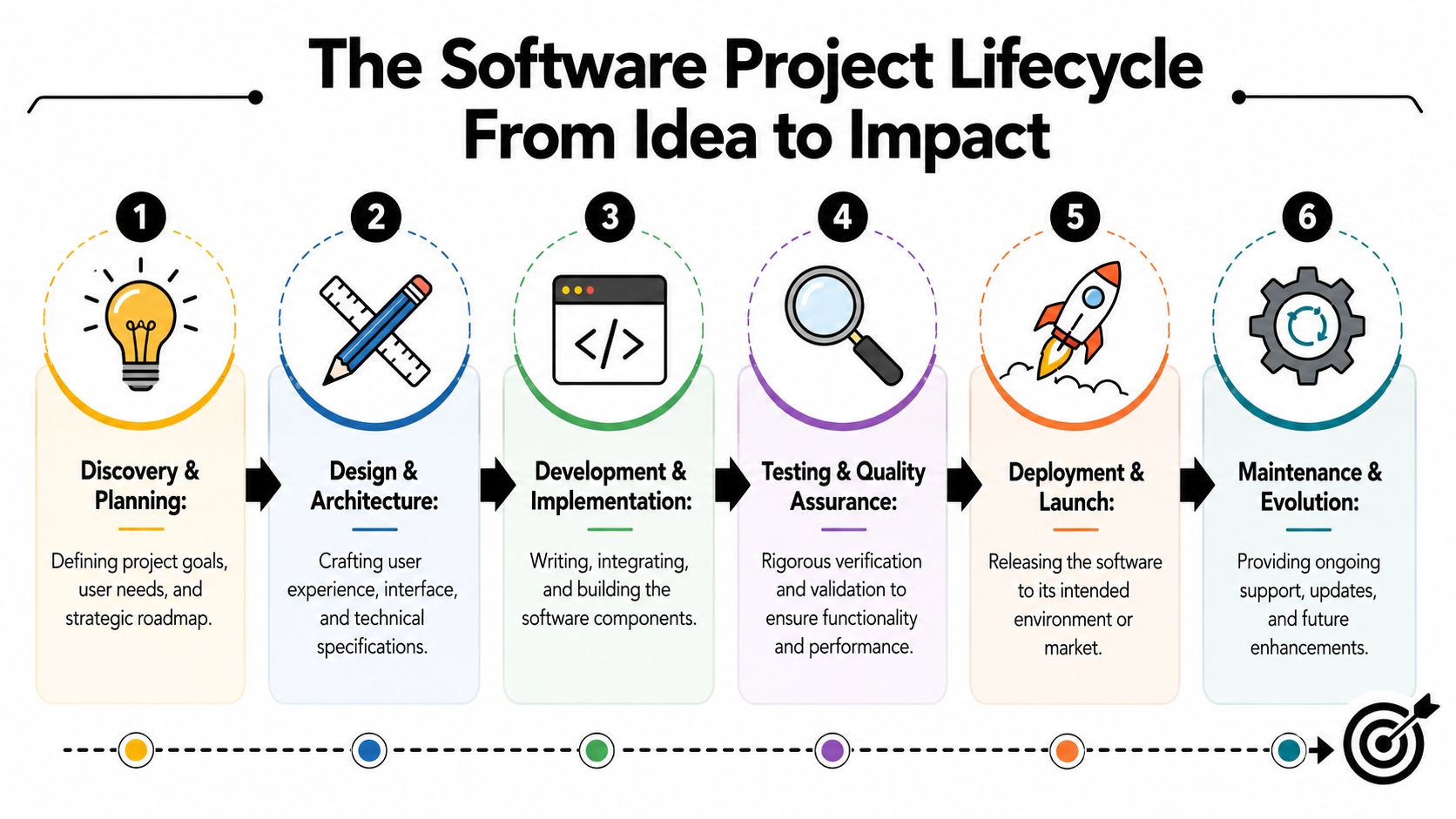
Most software programs look chaotic from the outside because people collapse the lifecycle into one word: development. That hides the actual work. Building software is closer to constructing a facility than writing a document. You don't start by pouring concrete. You start by deciding what you're building, why it matters, and what failure would look like.
Discovery creates the economic case
A well-run project starts with initiation and discovery. This phase isn't about collecting wish lists. It's about identifying the business constraint, the user problem, the critical workflows, and the fundamental risks. The output should be a decision document. Everyone should understand what gets built first and what gets deferred.
A structured discovery sprint often surfaces more risk than a month of status meetings. A useful example of what that early alignment can look like is this write-up on what happens after a two-day discovery sprint.
After discovery comes planning. The deliverable here isn't a pretty timeline. It's a shared operating plan that covers scope boundaries, staffing assumptions, acceptance criteria, architecture constraints, and a release path. If a vendor can't explain those pieces clearly, the project isn't planned.
Then comes design and architecture. Design defines user flows, edge cases, and interaction patterns. Architecture defines system boundaries, interfaces, data movement, observability, and failure handling. Good teams do both before implementation goes deep.
Execution only works when handoffs are explicit
Execution is where code gets written, integrated, reviewed, and verified. But coding is only one part of it. A healthy execution phase has branch discipline, peer review, test coverage expectations, and visible progress tied to deployable increments, not vanity milestones.
Quality assurance should run alongside development, not after it. Mature teams validate acceptance criteria continuously. They test risk-heavy paths first, automate what should never regress, and keep exploratory testing focused on unknowns rather than rerunning the same checklist manually.
A lifecycle without a clean path to production creates expensive surprises. So deployment needs its own rigor: environment readiness, migration steps, rollback plans, logging, alerting, support ownership, and communication. Launch is an operational event, not a button click.
Finally, there's maintenance and evolution. That includes bug triage, performance tuning, security patching, telemetry review, and follow-on improvements informed by real usage.
A concise way to evaluate any vendor is to ask for the artifact that closes each phase:
- Discovery: problem statement and priorities
- Planning: scope, delivery model, and risk register
- Design: UX flows and technical architecture
- Execution: working increments with review history
- Deployment: release checklist and rollback plan
- Maintenance: support workflow and improvement backlog
Software projects rarely break in the coding phase alone. They usually break at the seams between phases.
Choosing Your Operating Model Methodologies Compared
Methodology discussions often get reduced to ideology. That's a mistake. Waterfall, Agile, and DevOps are not identity labels. They're operating choices with different failure modes.
The useful question isn't which one is modern. The useful question is which one best fits your uncertainty, compliance burden, architecture, and release tolerance.
Waterfall buys certainty at the cost of adaptability
Waterfall works when requirements are stable, change is expensive, and approvals need heavy documentation. It's still viable for tightly bounded migrations, fixed-scope integrations, and programs with rigid audit gates.
Its weakness is late learning. If users, data conditions, or technical assumptions shift midstream, Waterfall absorbs that badly. Problems discovered near the end are expensive because the system was optimized for planned sequence, not frequent correction.
Agile improves learning but can blur accountability
Agile is better for product discovery, iterative feature work, and environments where stakeholder feedback should shape scope over time. It shortens the path between assumption and validation. That's why it displaced heavier methods in many software teams.
But Agile is often implemented poorly. Teams run ceremonies, maintain a backlog, and still fail to improve throughput or quality. The common issue is that Agile becomes a planning ritual without strong engineering discipline. Scope keeps moving, architecture gets deferred, and nobody owns the cumulative effect on maintainability.
DevOps turns delivery into a systems problem
DevOps is less a project method than an operating model for shipping safely and repeatedly. It combines engineering, infrastructure, test automation, observability, and release practice so the team can make smaller changes more often with less disruption.
That shift matters more now because AI-assisted development accelerates code generation, but it also raises the need for stronger review, testing, traceability, and production feedback. Faster code creation without stronger delivery controls just creates faster instability.
Here's the trade-off in a format most buying teams can use:
| Attribute | Waterfall | Agile | DevOps |
|---|---|---|---|
| Planning style | Front-loaded | Iterative | Continuous |
| Best fit | Stable requirements | Evolving product work | High-frequency operational delivery |
| Strength | Predictability | Adaptability | Speed with release discipline |
| Main risk | Late discovery | Scope drift | Tooling and process complexity |
| Release pattern | Larger milestones | Regular increments | Small, frequent, automated changes |
| Leadership challenge | Change control | Prioritization discipline | Cross-functional accountability |
One outsourcing lens that helps here is whether a partner can explain how methodology changes with project shape rather than selling a single template. That's one of the practical issues behind software outsourcing decisions.
A real operating model shift
On one enterprise modernization effort, the team started with a conventional Agile setup. Two-week sprints, end-of-sprint QA compression, and release coordination that felt orderly on paper and brittle in practice. Work piled up near the release boundary. Testing became a bottleneck. Small defects sat around long enough to become customer-visible defects.
The turnaround didn't come from replacing developers. It came from changing the system. We tightened story sizing, moved QA earlier, introduced stronger pre-merge checks, treated deployment scripts as production code, and made release readiness visible every day instead of at sprint end. The organization moved from biweekly to twice-weekly releases without defect spikes. That kind of result only happens when the method and the engineering mechanics line up.
One current example of that model in the market is Silicon Prime AI, which describes an AI-assisted delivery approach built around smaller, safer releases and human-led operational oversight. That's useful as a category signal, not because one model fits every team.
Key Roles and Responsibilities on a High-Performing Team
A project doesn't become predictable because everyone is talented. It becomes predictable because accountability is unambiguous.
The fastest way to spot a weak vendor team is to ask who owns a late requirement change, who approves architecture exceptions, who can stop a release, and who answers for production quality after launch. If the answers are vague or spread across too many people, delivery risk is already high.
Who owns the what and who owns the how
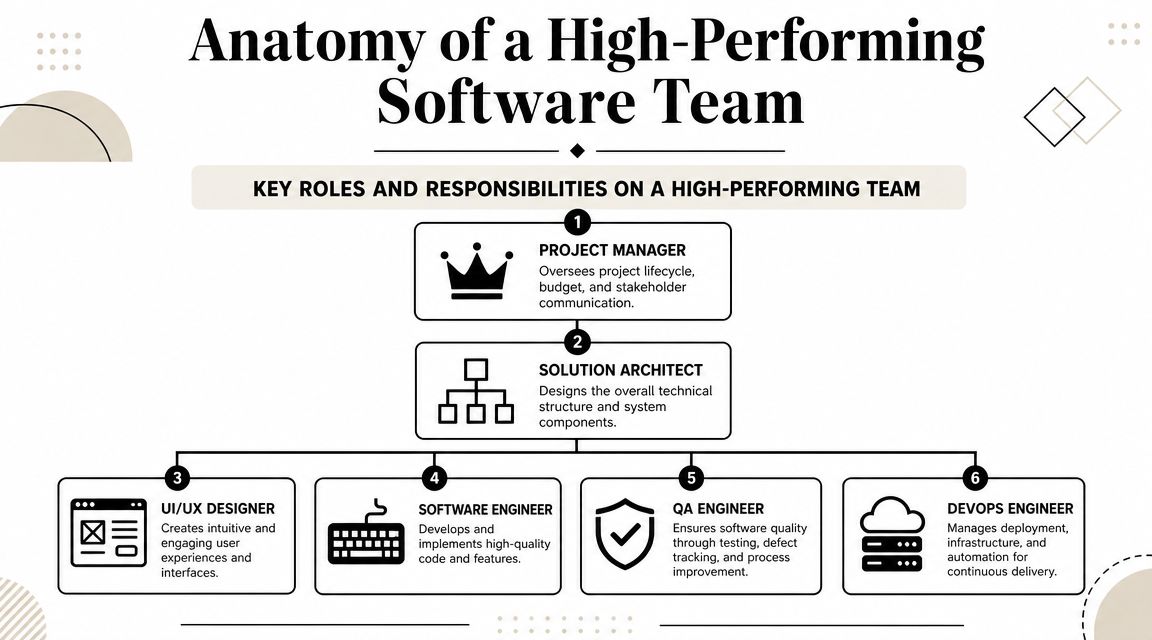
A high-performing team usually needs the following roles, even if one person covers more than one function.
- Product Owner: Owns priorities, user outcomes, and scope decisions. This person decides what matters now and what can wait.
- Delivery Lead or Project Manager: Owns execution flow, blocker removal, stakeholder communication, and schedule realism.
- Architect or Tech Lead: Owns system design, technical constraints, integration choices, and long-term maintainability.
- Engineer: Implements features, reviews code, writes tests, and participates in design decisions close to the code.
- QA Engineer: Validates acceptance criteria, improves test strategy, and keeps release quality from becoming subjective.
- DevOps or Platform Engineer: Owns CI/CD, environment consistency, deployment automation, runtime visibility, and rollback readiness.
If you're scaling with external support, the staffing pattern matters as much as the individual resumes. This overview of software team augmentation models is useful because it frames augmentation as a system design problem, not just a hiring shortcut.
Good teams reduce handoff loss
What matters most is the interaction model.
The Product Owner shouldn't prescribe implementation details. The Architect shouldn't unilaterally redefine product scope. QA shouldn't be the team's first real exposure to acceptance criteria. Delivery leadership shouldn't act as a note taker. Each role exists to reduce a specific category of failure.
A clean team structure usually looks like this:
| Role | Primary accountability | Common failure when missing |
|---|---|---|
| Product Owner | Priority and business decisions | Teams build low-value work |
| Delivery Lead | Coordination and risk visibility | Slippage is discovered too late |
| Architect | Technical coherence | Systems become fragile and expensive to change |
| Engineer | Implementation quality | Features exist but aren't reliable |
| QA | Verification and release confidence | Defects escape to production |
| DevOps | Deployment and runtime stability | Releases become manual and risky |
Field note: The best teams I've worked with didn't eliminate disagreement. They made disagreement show up early, with a clear owner responsible for the final call.
When you evaluate a software development company in Torrance, CA, don't just ask for org charts. Ask for decision paths. Good teams can explain who decides, who advises, and who executes without hesitation.
Measuring What Matters Essential Processes and KPIs
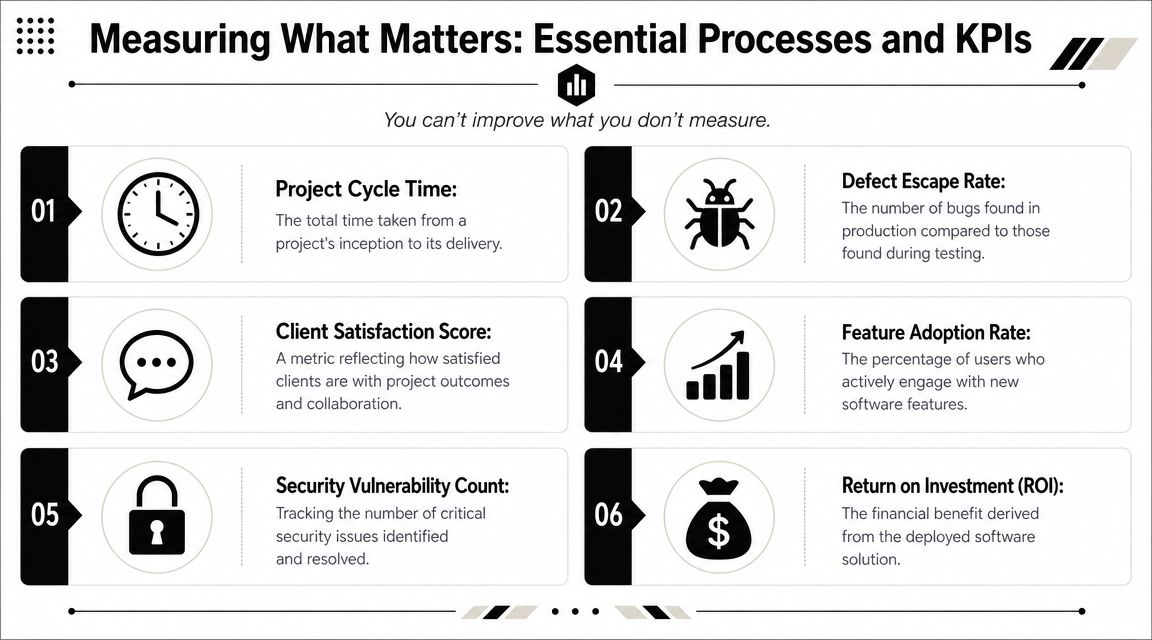
If a vendor says they care about quality, ask how they measure it. If they say they move fast, ask what “fast” means operationally. Most software delivery problems persist because teams measure effort, not outcomes.
Counting story points, hours burned, or tickets closed won't tell you whether a system is getting more stable or more fragile. Useful metrics connect engineering behavior to business consequences like release cadence, production defects, and rework load.
Processes without metrics become ceremony
A code review process is only valuable if it catches defects, enforces standards, and improves maintainability. A CI/CD pipeline is only valuable if it shortens feedback loops and reduces release risk. Standups, retrospectives, and demos are only useful if they lead to different decisions.
The core process-metric pairings I look for are straightforward:
- Code review with review SLAs: Helps reduce hidden defects and inconsistent implementation.
- Automated build and test gates: Prevents broken changes from accumulating.
- Continuous integration: Exposes integration problems while they're still cheap to fix.
- Deployment automation: Reduces release variance caused by manual steps.
- Observability instrumentation: Gives the team evidence after release, not guesses.
- Incident review: Converts production failures into process corrections.
The KPI set that actually changes behavior
Most leadership teams don't need more dashboards. They need a smaller set of metrics with operational meaning.
Start with these categories:
- Deployment frequency
How often the team can release working software. Low frequency usually means releases are too large or too risky. - Change failure rate
How often a release causes a production issue, rollback, or hotfix. This exposes whether speed is being purchased by sacrificing stability. - Lead time for changes
How long it takes for approved work to move from commit to production. Long lead times usually point to queueing, approvals, or manual testing bottlenecks. - Defect escape rate
The proportion of meaningful bugs discovered after release rather than before it. This measures testing effectiveness in a way that matters to stakeholders. - Cycle time by work type
Separate feature work, bug fixes, and urgent production remediation. Mixed averages hide bad process design. - Adoption and task completion signals
Shipping isn't success if users ignore the feature or abandon key workflows.
Measure the system, not the theater around the system.
The best vendor conversations happen when the buyer asks for definitions, thresholds, and recent examples of how a metric changed team behavior. That moves the conversation away from generic quality claims and toward operating evidence.
Managing Software Project Risks Before They Derail You
Risk management in software isn't a separate workstream. It's the operating discipline that keeps surprises small.
The common error is to document risks once, then treating the register like compliance paperwork. Real risk management changes backlog order, architecture choices, test depth, release sequencing, and stakeholder communication.
The risks that show up most often
The same categories appear repeatedly across projects, even when the stacks and industries differ.
- Scope creep: New requirements enter faster than the team can absorb them.
- Technical debt: Shortcuts get shipped without a plan to contain the future cost.
- Security exposure: Vulnerabilities enter through dependencies, misconfigurations, or rushed changes.
- Integration failure: External systems behave differently from the assumptions in design.
- Budget drift: Work expands while reporting still frames the project as on track.
- Stakeholder latency: Decisions sit unresolved and block execution.
Each of these has a direct control mechanism. If a vendor can't name those controls, they're relying on good intentions.
Risk control has to be operational
A few practical mitigations work consistently:
- Use a strict definition of done: Code isn't done until tests pass, acceptance criteria are met, documentation is updated, and deployment readiness is confirmed.
- Enforce change control on scope: Urgent requests need a visible trade-off. Add something, move something, or change the deadline.
- Scan early in the pipeline: Security checks should run before release pressure makes them negotiable.
- Prototype risky integrations first: Don't discover API mismatches after the implementation is complete.
- Keep release units small: Smaller changes are easier to verify, easier to roll back, and easier to diagnose.
- Run structured risk reviews: Risks should have owners, trigger conditions, and planned responses.
One useful framing for this discipline is the idea of making risks explicit enough that leaders can act on them early. That's the value behind writing a clear engineering risk note.
A mature delivery team also knows which risks are worth accepting. Not every issue deserves the same response. Some deserve redesign. Others deserve monitoring and a contingency plan. Strong project management is partly the art of distinguishing the two.
A project is usually in trouble long before the schedule turns red. The warning signs show up in unresolved decisions, rising manual work, vague acceptance criteria, and expanding release scope.
Choosing Your Software Development Company in Torrance
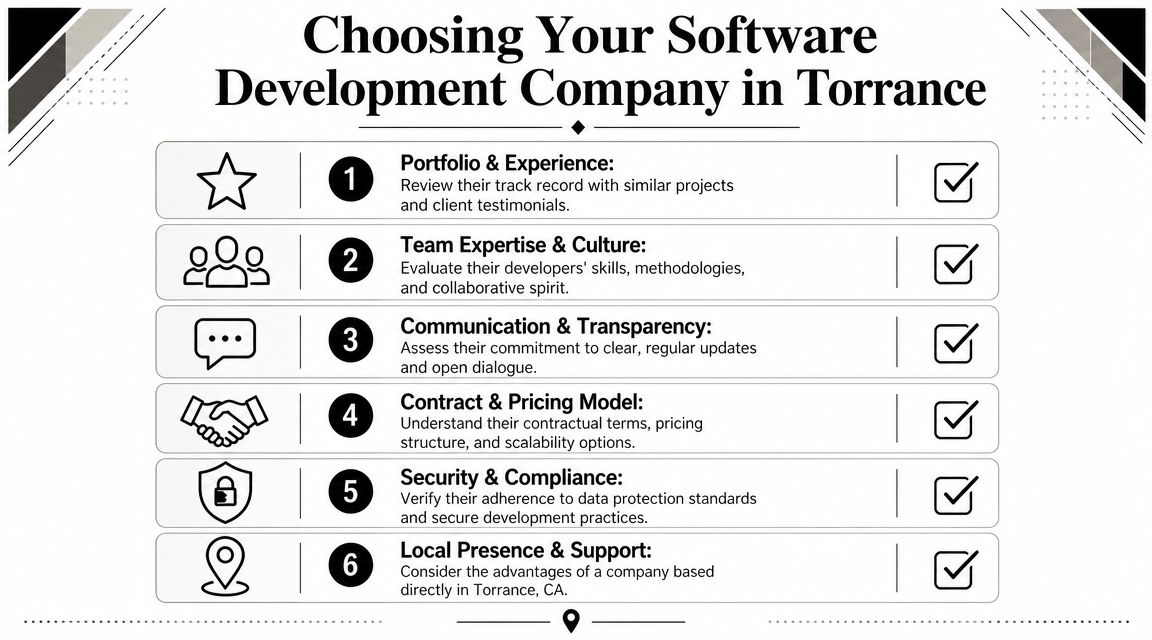
If you're hiring locally, don't reduce the decision to geography. A software development company in Torrance, CA can be a strong fit because it understands the local business context. But local proximity alone won't rescue a weak operating model.
What matters is whether the partner can work inside the reality of your workflows, your release risk, and your decision cadence.
Local fit matters when workflows are operationally complex
Torrance demonstrates a specificity that many city pages often overlook. The local hiring market includes demand for developers working with engineering, manufacturing, and enterprise data workflows, which suggests many buyers in the area need software that integrates with operational environments rather than just generic web or mobile products (Torrance software developer roles in manufacturing and enterprise workflows).
That changes how you should evaluate partners.
A vendor that mainly sells polished front-end work may still be a poor fit if your project touches production data, inventory systems, ERP processes, plant-floor reporting, or engineering handoffs. In those settings, the hard part isn't the interface. The hard part is controlling data quality, integration behavior, release risk, and operational continuity.
There's also a practical regional consideration. Some teams still benefit from local stakeholder workshops, architecture reviews, or cutover planning, especially when the software touches regulated or operationally sensitive processes. Others can run perfectly well with a remote-capable model. If you're operating around Los Angeles, this broader regional software delivery view for Los Angeles companies can help frame that choice.
Questions that expose delivery reality
Ask potential vendors questions that force operational specificity:
- How do you define done? Listen for testing, documentation, deployment readiness, and observability.
- What happens when a stakeholder introduces scope mid-sprint? You want a trade-off mechanism, not vague promises.
- How do you handle risky integrations? Good teams spike them early.
- Who can stop a release? If nobody owns release quality, that's a problem.
- How do you measure delivery health? Look for process-connected KPIs, not presentation metrics.
- What work do you automate first? Their answer reveals delivery maturity.
- When do you insist on on-site collaboration? Good partners know when proximity matters and when it doesn't.
A final check is simple. Ask them to walk through one recent project from discovery to post-launch support. Not the sales version. The operational version. What changed, what broke, what they learned, and what controls they put in place after the fact.
That answer will tell you more than any capabilities page.
If you're evaluating partners and want a team that approaches delivery as an operating model problem rather than a staffing problem, Silicon Prime AI is one option to review. The firm works on AI systems, modernization, DevOps, and managed application support with an emphasis on smaller, safer releases, leadership accountability, and practical adoption inside enterprise teams.
Comments