Your leadership team is probably stuck in a familiar loop. Product wants speed. Engineering wants a stack that won't become expensive to maintain. Data teams want AI flexibility. Finance wants a decision that doesn't trigger a second rebuild in eighteen months.
That's why the Node.js vs Python decision keeps resurfacing. It isn't a language debate. It's a platform bet that affects hiring, architecture, delivery pace, and how cleanly you can add AI into production without creating a brittle mess.
If your company needs a hands-free delivery partner while your internal team keeps control of strategy, that changes the equation too. The right stack is the one your business can scale, staff, and operate without dragging leadership into constant technical arbitration. That's also why many enterprises pair stack decisions with a broader software outsourcing strategy instead of treating implementation as an afterthought.
The Strategic Choice Before You
A CTO at a growing enterprise usually doesn't ask, “Which language is better?” They ask harder questions.
Which stack gets us to market faster without boxing us into expensive rewrites? Which stack can we hire for in multiple regions? Which stack supports the product we have now and the AI features the board will ask for next?
That's the core Node.js vs Python conversation.
Here's the plain answer. Node.js is usually the stronger choice for high-concurrency products, customer-facing APIs, and platforms that depend on front-end and back-end alignment. Python is usually the stronger choice for AI model work, analytics-heavy systems, and teams building around data science first. If you need both, pretending one language should do everything is a mistake.
Early in the decision, leadership should pressure-test four issues:
| Decision area | Node.js tends to win when | Python tends to win when | Business effect |
|---|---|---|---|
| Product delivery | You want one JavaScript-centered web stack | You need rapid experimentation around data workflows | Faster execution with fewer handoff points |
| Runtime fit | The system handles many simultaneous requests | The system leans on data processing or ML tooling | Better infrastructure efficiency |
| Hiring strategy | You want access to broad web engineering talent | You need specialists in AI, research, or analytics | Lower staffing friction or stronger specialization |
| Long-term platform design | You need scalable APIs and real-time services | You need native alignment with AI development | Lower rebuild risk |
Choose the stack that matches the workload your company will actually operate, not the one your team finds most familiar.
Most bad decisions happen when leaders optimize for developer preference instead of operating model. Familiarity feels cheap at the start. Mismatch gets expensive later.
Understanding Their Core Philosophies
Node.js and Python push teams toward different architectural habits. That matters more than syntax.
How Node.js thinks
Node.js is built around event-driven, non-blocking I/O. The easy business translation is this: it's designed to keep moving while waiting on network, database, or external service responses. That makes it natural for API layers, streaming systems, chat products, dashboards, gateways, and orchestration services.
A useful analogy is a barista handling many orders at once. The barista doesn't stand frozen while one espresso pours. They start one task, move to the next, and keep the line moving until each task is ready for attention again. Node.js works in that spirit.
That model shapes team behavior too:
- API-first development: Teams often use Node.js where request handling, integrations, and front-end coordination matter most.
- Real-time product design: WebSockets, notifications, and event-heavy workflows fit naturally.
- Service decomposition: Node.js works well in microservice environments where many lightweight services communicate constantly.
How Python thinks
Python comes from a different tradition. It prioritizes readability, directness, scripting ease, and broad utility across automation, scientific work, data analysis, and application logic. Teams often adopt Python because it makes experimentation easy and because its ecosystem supports serious work in AI and machine learning.
Its runtime model has historically been less naturally aligned with the kind of async-heavy concurrency that Node.js handles by design. That doesn't make Python weak. It makes it better suited to different jobs.
In practice, Python tends to pull teams toward:
- Research and prototyping workflows where clarity and iteration matter more than ultra-efficient connection handling.
- Data-centric pipelines where engineers, analysts, and ML practitioners need shared tooling.
- Compute and model-oriented services where the surrounding library ecosystem is the main advantage.
Python is often the language teams choose when the hardest part of the product is understanding data. Node.js is often the language teams choose when the hardest part is serving users quickly and concurrently.
Why philosophy becomes operating risk
This difference affects much more than runtime behavior.
If you choose Node.js for a business that lives on AI experimentation, your data team may feel constrained. If you choose Python for a platform that lives on real-time interaction and async request fan-out, your infrastructure and application teams may spend too much time tuning around the language instead of shipping features.
That's why smart leaders don't force a universal winner. They decide which runtime owns which responsibility, then keep the seams between them clean.
Performance I/O Throughput vs CPU Power
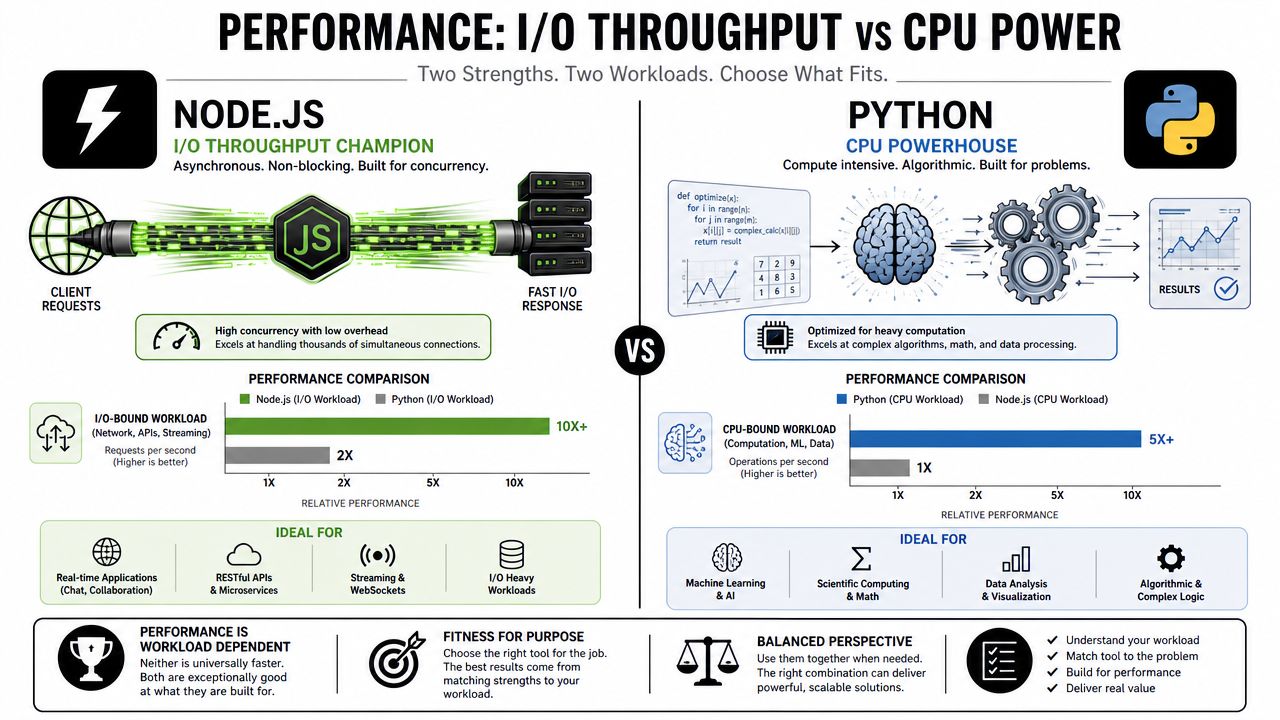
Performance arguments usually go wrong because people ask for one winner. There isn't one. There's only workload fit.
Where Node.js has the edge
For I/O-heavy systems, Node.js is the stronger operational choice. Independent benchmark summaries report Node.js outperforming Python in these workloads by 40–70%, with one cited benchmark showing roughly 44% higher requests per second and lower latency than Python FastAPI, as summarized in this Node.js and Python benchmark analysis.
That tracks with how Node.js is built. If your application spends much of its time waiting on databases, third-party APIs, queues, or user connections, non-blocking concurrency turns into real throughput.
This matters most for products such as:
- Customer-facing APIs that receive constant bursts of traffic
- Real-time systems like chat, alerts, collaboration, and streaming
- Microservices where many services call each other asynchronously
- AI integration layers that fan out requests to model endpoints and supporting systems
When a platform's bottleneck is connection handling, Node.js usually lowers operational strain. That can reduce the number of servers or containers you need to deliver the same user experience, and it often simplifies the architecture your team has to support.
A practical example is high-volume API orchestration. In a controlled comparison using the official OpenAI client, Node.js completed 1,800 tasks with a concurrency limit of 200, while Python completed 300 tasks with a concurrency limit of 20. The author also reported lower elapsed time and better throughput under load for Node.js in this OpenAI client concurrency comparison. For AI-enabled applications that orchestrate many outbound async calls, that difference is hard to ignore.
Where Python holds its ground
Python becomes attractive when the center of gravity moves away from connection management and toward computation, analysis, and ML workflows.
That's not because the raw interpreter always wins on speed. It's because Python's practical value is tightly tied to the libraries and workflows that surround it. If your team is training models, running data experiments, or building analytics pipelines, Python is often the shortest path to working software.
There's also evidence that optimized Node.js implementations can run substantially faster than Python 3 entries in compute-heavy microbenchmarks. The Benchmark Game page shows Node.js solutions with runtimes as low as 4.05 seconds, while the Python 3 section is slower across the comparable problem set in this Node.js and Python Benchmark Game comparison. But don't overread microbenchmarks. Enterprise systems don't live inside isolated loops.
The decision a CTO should make
If your money depends on throughput, concurrent users, low-latency APIs, or real-time behavior, choose Node.js first and optimize the delivery path with disciplined web application performance optimization.
If your money depends on model training, analytics workflows, or AI experimentation, Python should own that layer.
Practical rule: Put Node.js on the edge of the business where requests, events, and users pile up. Put Python where data, models, and experimentation create the value.
Ecosystems Developer Pools and Productivity
Technology choice becomes expensive when staffing gets hard. Under these circumstances, the Node.js vs Python debate turns into a hiring and execution problem.
The talent market isn't balanced
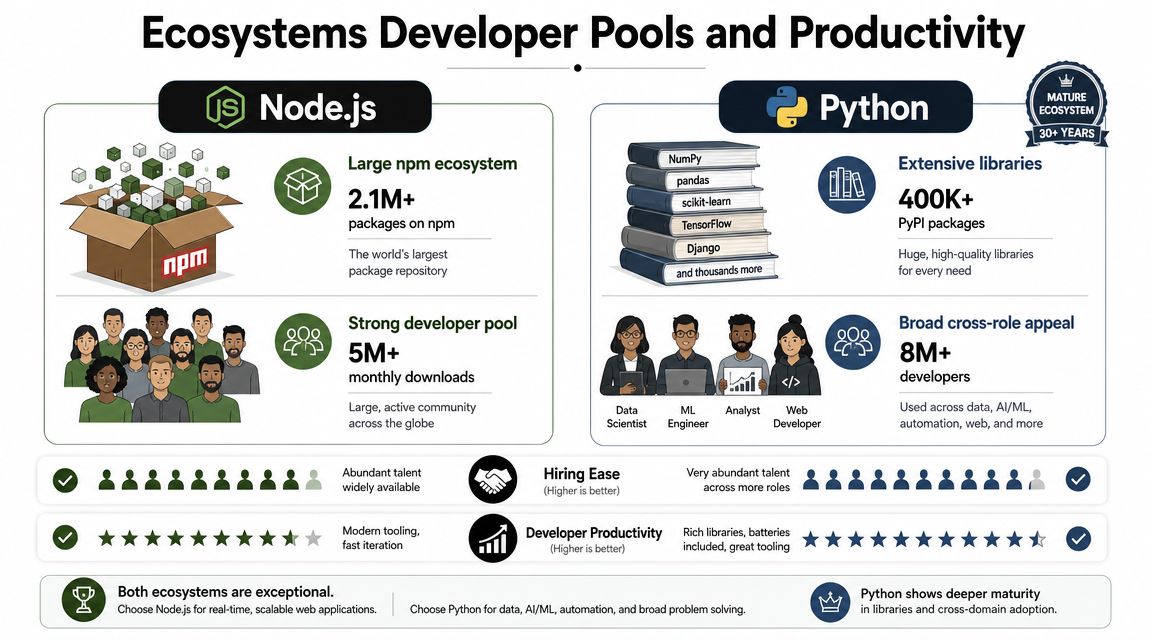
JavaScript still has the broadest footprint. In the 2025 Stack Overflow Developer Survey, JavaScript was used by 62% of respondents, while Python ranked second at 51%. The same survey also showed Python rising sharply, with usage increasing by 7 percentage points from 2024 to 2025, according to the 2025 Stack Overflow technology survey.
For enterprise hiring, that means two different things.
Node.js benefits from the sheer size of the JavaScript talent pool. If your company already runs modern web products, the path from front-end JavaScript to full-stack or back-end Node.js work is often shorter than the path into specialized Python roles.
Python's surge is real, but its momentum is closely tied to AI, data science, and analytics demand. That gives Python enormous strategic weight, but it also means you're often hiring into a more specialized, more contested labor market.
Package ecosystems shape delivery speed
Node.js teams live in the npm world. Python teams live across pip, Conda, and a broader data and scientific tooling ecosystem. The business point isn't package count. It's package alignment.
Use Node.js when your team mostly needs:
- Web framework velocity
- API middleware and integration tooling
- Shared language flow between browser and server
- Fast iteration for product engineering squads
Use Python when your team mostly needs:
- ML and data libraries
- Notebook-driven experimentation
- Data transformation workflows
- Research-to-production continuity for AI teams
A stack becomes productive when the majority of your daily work sits close to the center of its ecosystem. If your Node.js team spends half its time forcing AI workflows into awkward service boundaries, you lose time. If your Python team spends half its time wrestling with high-concurrency product traffic, you also lose time.
Hiring cost is really hiring friction
Procurement teams often ask which language is cheaper. That's not the right question. Ask which language is easier to hire for in the roles you need over the next two years.
A broad JavaScript market can reduce recruiting friction for product-heavy organizations. Python can be the higher-value option when the business needs scarce AI and analytics skills, even if staffing is narrower.
Augmentation is critical. If your roadmap requires both product engineers and AI specialists, a blended delivery model is often cleaner than trying to force one internal team to cover everything. A strong software team augmentation model lets leadership keep standards and priorities while plugging the exact skill gaps the platform needs.
The expensive stack isn't the one with the higher hourly rate. It's the one that leaves critical roles open for months.
The AI and Machine Learning Battleground
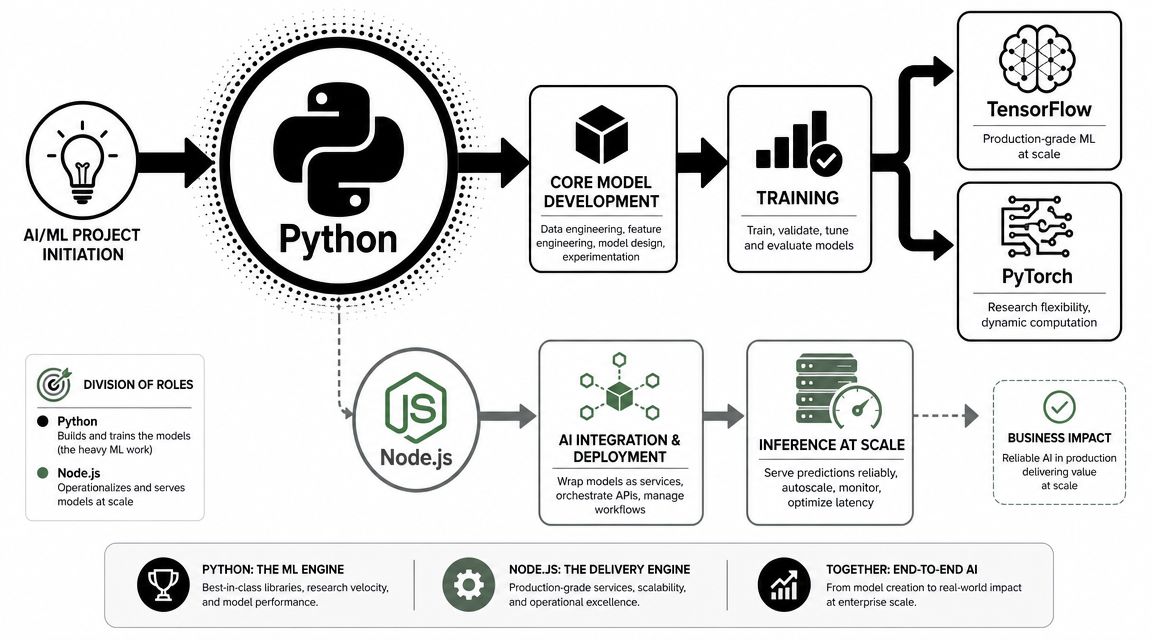
If AI matters to your roadmap, the answer is straightforward. Python should usually own model development. Node.js should often own the production interface around those models.
Python should lead model work
Python remains the practical default for machine learning because that ecosystem is where most AI teams build, test, train, and evaluate. If your organization is serious about model experimentation, data science workflows, or custom ML pipelines, fighting that reality is a waste of time.
That doesn't mean Python should automatically own your entire production stack.
A common enterprise mistake is taking a strong research language and turning it into the default answer for every surrounding system. That can work. It often isn't the best operational design.
Node.js is often better at serving AI to the business
The weak point in many AI programs isn't model quality. It's production delivery. Teams can build models, then struggle to expose them reliably through user-facing products, async workflows, partner APIs, and internal automation layers.
That's where Node.js becomes strategically useful.
When the production pattern involves many simultaneous requests, multiple third-party services, streaming responses, or orchestration across tools, Node.js is often a better fit for the application layer wrapped around AI. That includes chat platforms, AI copilots, middleware, retrieval orchestration, and API gateways in front of Python model services.
For teams dealing with heavy async fan-out, that earlier OpenAI client comparison is instructive. Node.js handled 1,800 tasks with concurrency set to 200, while Python handled 300 tasks with concurrency set to 20 in the referenced test. For enterprise AI products with bursty, integration-heavy traffic, Node.js's concurrency model can be a serious advantage.
Later in the delivery cycle, leaders also need solid data plumbing. AI fails in production when ingestion, transformation, and serving aren't aligned. That's why platform decisions should sit alongside a clear data engineering services strategy, not inside a model-only conversation.
This short walkthrough illustrates the deployment reality many teams face:
The recommendation
For most enterprises, the strongest AI architecture is hybrid.
- Python for model development, experimentation, and ML-heavy services
- Node.js for user-facing APIs, orchestration, real-time interfaces, and async integration layers
- Clear service boundaries so each runtime handles the work it does best
Don't force one language to carry your full AI stack. Split the problem by responsibility and your platform gets faster, easier to scale, and easier to staff.
That's the closest thing to proof of work that matters in AI delivery. Not a flashy prototype. A production design that lets strategy stay with leadership while implementation runs without constant executive intervention.
Analyzing Total Cost of Ownership
The build cost is only the opening invoice. The actual cost shows up in staffing delays, infrastructure waste, operational complexity, and the number of decisions leadership has to revisit.
Where Node.js can lower ownership cost
If your platform is traffic-heavy and I/O-bound, Node.js can lower total cost through efficiency. Better throughput in that operating pattern usually means fewer resources spent handling the same level of demand. Just as important, a JavaScript-centered product organization can reduce context switching between front-end and back-end teams.
That usually creates savings in three places:
- Infrastructure: Better fit for concurrent request handling can keep the serving layer leaner.
- Team shape: One language across more of the web stack often simplifies coordination.
- Delivery speed: Product squads can move with fewer handoffs between specialists.
Where Python can justify higher complexity
Python can still be the cheaper strategic choice when AI or analytics drive revenue. If the business value depends on model quality, experimentation speed, or data workflows, the wrong stack is the one that slows those teams down.
But Python can introduce more operational complexity when teams use it for workloads better suited to event-driven systems. The issue isn't that Python can't do the job. It's that your team may spend more time tuning concurrency, splitting services, or compensating with extra infrastructure and process.
The hidden TCO issue leaders miss
Most cost overruns come from ownership gaps, not language licenses or framework choices. They show up when:
- Platform teams inherit a stack they didn't design.
- AI teams build prototypes that product engineering can't operationalize cleanly.
- Monitoring, deployment, and service boundaries evolve without a coherent operating model.
That's why stack choice and delivery model belong in the same meeting. If you need to estimate the long-term implications of AI-heavy architecture, a disciplined AI cost estimation approach is more useful than arguing over language preference.
A CTO should ask one blunt question: which option reduces the amount of custom operational work our team must carry for the next several years?
That answer is usually more valuable than any benchmark chart.
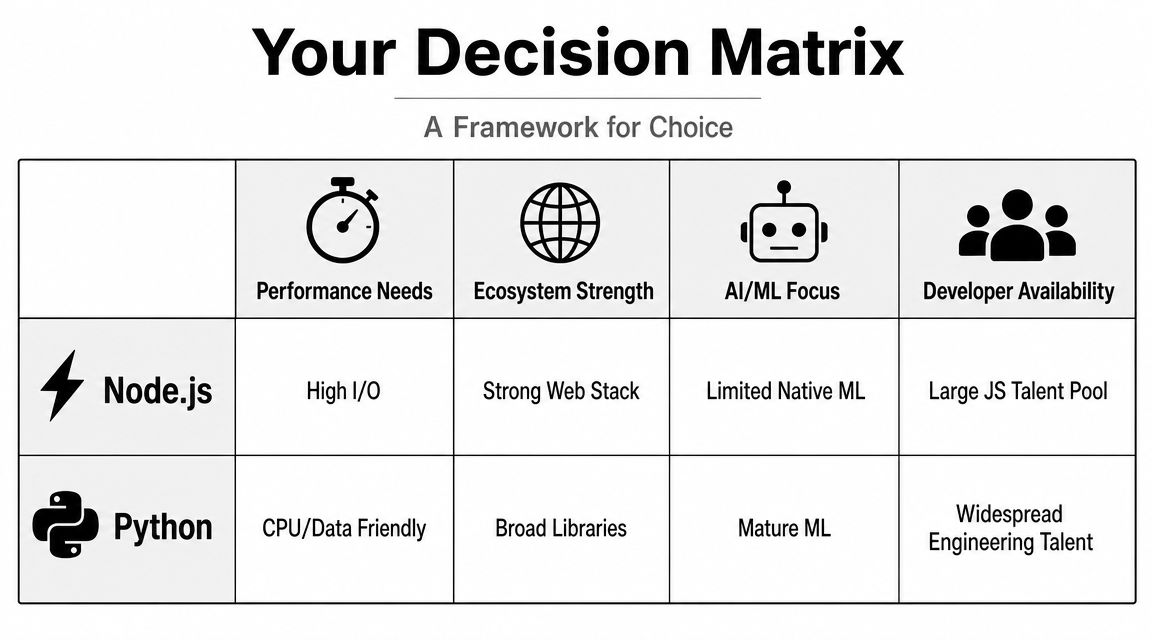
Your Decision Matrix A Framework for Choice
Most leadership teams don't need more theory. They need a usable recommendation.
A practical matrix for enterprise use
| Business scenario | Best fit | Why |
|---|---|---|
| Customer-facing SaaS API | Node.js | Better fit for high-concurrency request handling, product iteration, and web-team alignment |
| Real-time platform or event-heavy product | Node.js | Event-driven architecture maps cleanly to notifications, streaming, and many simultaneous connections |
| Internal data science hub | Python | Stronger alignment with analytics workflows, experimentation, and ML tooling |
| AI product with model training and live user traffic | Hybrid | Python handles models, Node.js handles serving, orchestration, and async product workflows |
| Standard corporate site or content platform | Node.js | Easier fit when speed of web delivery and broad JavaScript hiring matter most |
| Analytics-first internal system | Python | Data handling and AI readiness usually outweigh web-stack unification |
The recommendation I'd give a CTO
Pick Node.js if your business wins through responsive digital products, scalable APIs, and fast-moving web teams.
Pick Python if your business wins through data science, ML, and analytical depth.
Pick both if you're building serious AI products for real users. That's not indecision. It's architecture discipline.
The best Node.js vs Python answer for an enterprise is often a division of labor, not a single-language ideology.
The wrong move is choosing a stack as a badge of engineering culture. The right move is choosing a stack as an operating model. One reduces delivery drag. The other creates it.
If you need a partner that can translate this decision into delivery without adding management overhead, Silicon Prime AI helps enterprises design, build, and run the right mix of platform, AI, and engineering capability. You set strategy. We carry the weight.
Comments