Most advice on enterprise AI starts in the wrong place. It starts with model selection, prompt tricks, or a gallery of flashy demos. That's useful for exploration, but it's not how enterprises create durable value.
In practice, most AI initiatives fail much earlier and for less glamorous reasons. The workflow isn't clearly defined. The data is scattered. The owner of the business outcome isn't the owner of the implementation. Security review arrives late. Users don't trust the output. Finance asks how value will be measured, and nobody has a clean answer.
I've seen teams buy capable tools and still stall for months because they treated AI like a feature rollout instead of an operating model change. The companies that get real returns do something simpler. They pick a narrow problem with economic weight, design the workflow around that problem, integrate into systems people already use, and measure outcomes from day one. That's what makes AI real inside an enterprise.
Beyond the Buzzword What Is Enterprise AI
A lot of people still use “AI” to mean anything with a chatbot interface. That definition is too loose to help a buyer, an engineering leader, or an operations team make decisions.
Enterprise AI is a business capability, not a novelty layer. It connects models, data, rules, users, and systems to improve a specific process under real operating constraints. That means access controls, auditability, uptime expectations, workflow ownership, and measurable outcomes all matter as much as the model itself.
A simple analogy helps. A consumer AI tool is like a portable generator. It can be useful, fast to start, and perfect for a narrow job. Enterprise AI is the electrical grid in a factory. It has to power many processes, handle load, follow safety rules, and keep working when the business depends on it.
The budget patterns show that enterprise buyers already understand this shift. Menlo Ventures estimates companies spent $37 billion on generative AI in 2025, up from $11.5 billion in 2024, with $19 billion going to the application layer, meaning more than half of spend went to tools built on top of foundation models. Their breakdown also shows buying moving toward workflow-specific systems rather than generic copilots, with horizontal AI at $8.4 billion and growing 5.3x year over year, while departmental AI reached $7.3 billion and vertical AI $3.5 billion. The full breakdown appears in Menlo Ventures' 2025 state of generative AI in the enterprise.
Practical rule: If the system can't fit into an owned workflow, survive security review, and produce a business metric someone cares about, it isn't enterprise AI yet.
That's the mindset shift that matters. The key question isn't “Which model should we use?” It's “Which business decision or process should this system improve, and what has to be true operationally for people to trust it?”
Finding Your First Win Mapping AI to Business Functions
The first win usually isn't the most ambitious use case. It's the one where pain is obvious, data is available, and the workflow already exists.
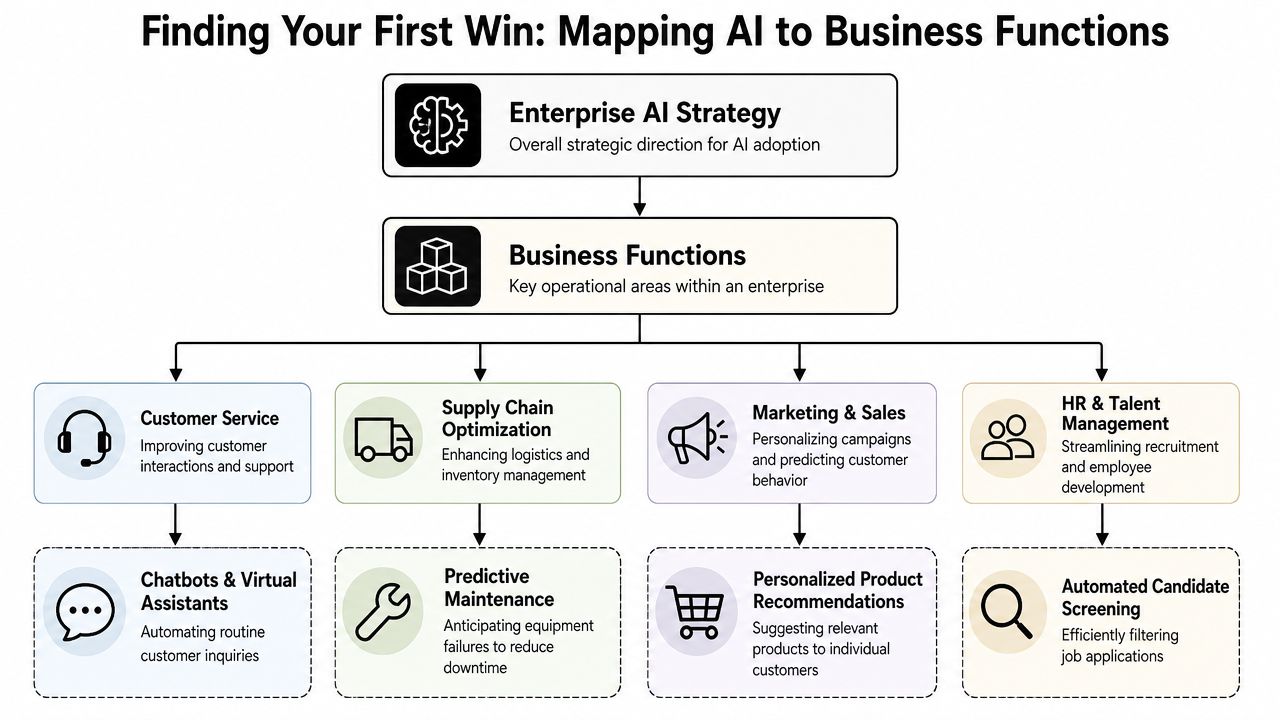
Start with friction not fascination
Teams often start with the tool they want to use. That's backwards. Start with repeated friction inside a business function.
Look for work that has these characteristics:
- High repetition: Staff spend time doing similar triage, drafting, classification, or review tasks every day.
- Slow handoffs: Work waits between systems, teams, or approvals.
- Messy information: People have to read across tickets, documents, emails, transcripts, or reports to do basic work.
- Economic visibility: The process affects revenue, cost, service quality, cycle time, or risk.
A good first pass is to map one business function at a time and ask where decisions are delayed, where experts are overloaded, and where process variation causes avoidable waste. That's also the logic behind enterprise workflow automation in practice, where the value often comes from redesigning handoffs rather than just adding model output.
Where early wins usually live
The strongest early use cases tend to cluster around a few functions.
Customer service works when teams need faster resolution, better routing, or agent support during live interactions. Good solutions summarize conversations, surface policy answers, and draft next actions. Weak solutions bolt on a chatbot that can answer questions but can't connect to ticketing, knowledge, or escalation paths.
Operations and supply chain benefit when planning teams need better forecasts, exception detection, or maintenance signals. The practical target isn't “AI everywhere.” It's identifying where a planner, buyer, or operator loses time reconciling fragmented signals.
Marketing and sales produce returns when AI improves segmentation, recommendation logic, proposal support, or lead qualification inside existing workflows. The mistake here is automating content production before fixing targeting, routing, and campaign decisioning.
Finance is often a strong candidate because the workflows are structured and the downside of inconsistency is obvious. Common patterns include anomaly review, document extraction, reconciliation support, and reporting assistance.
HR and talent can benefit from AI-assisted screening, internal knowledge support, and learning recommendations, but these use cases need tighter governance because fairness, explainability, and policy consistency matter more.
The fastest first win is usually not customer-facing. It's often an internal workflow with clear owners, stable data, and a visible cost of delay.
How to choose the first use case
Use a simple screen before funding anything:
- Can you name the workflow owner? If nobody owns the process, the project will drift.
- Can you describe the human decision being improved? “Use AI for support” is too broad. “Reduce manual triage time for tier-one tickets” is actionable.
- Can the system connect to the tools where work already happens? Standalone intelligence gets ignored.
- Can value be measured within one budgeting cycle? If the answer is vague, sponsorship fades.
- Can risk be bounded? Early projects should have review paths, override options, and clear escalation rules.
Adoption is no longer the main story. Scale is. A 2025 global survey summary reports that 78% of companies already use AI in daily operations, 90% either already use it or plan to start, 71% have used generative AI in at least one business function, and 42% of enterprise businesses with more than 1,000 employees use AI. The same summary notes McKinsey's finding that nearly two-thirds of organizations have not yet begun scaling AI across the enterprise, even though 62% say they are at least experimenting with AI agents. It also cites OpenAI enterprise users reporting 40 to 60 minutes per day saved and completion of new technical tasks such as data analysis and coding. Those figures are compiled in Exploding Topics' roundup of companies using AI.
That's why AI solutions for enterprises should start with a narrow operational win. Broad ambition comes later. First, prove that the workflow can change.
The Technical Blueprint Common AI Architectures
Architecture decisions shape cost, control, and speed to a degree that is often underestimated. I usually explain it this way. You can modify a reliable car you already own, build a race car from scratch, or use a transport service that handles most of the machinery for you. Each can be right. Each creates different constraints.
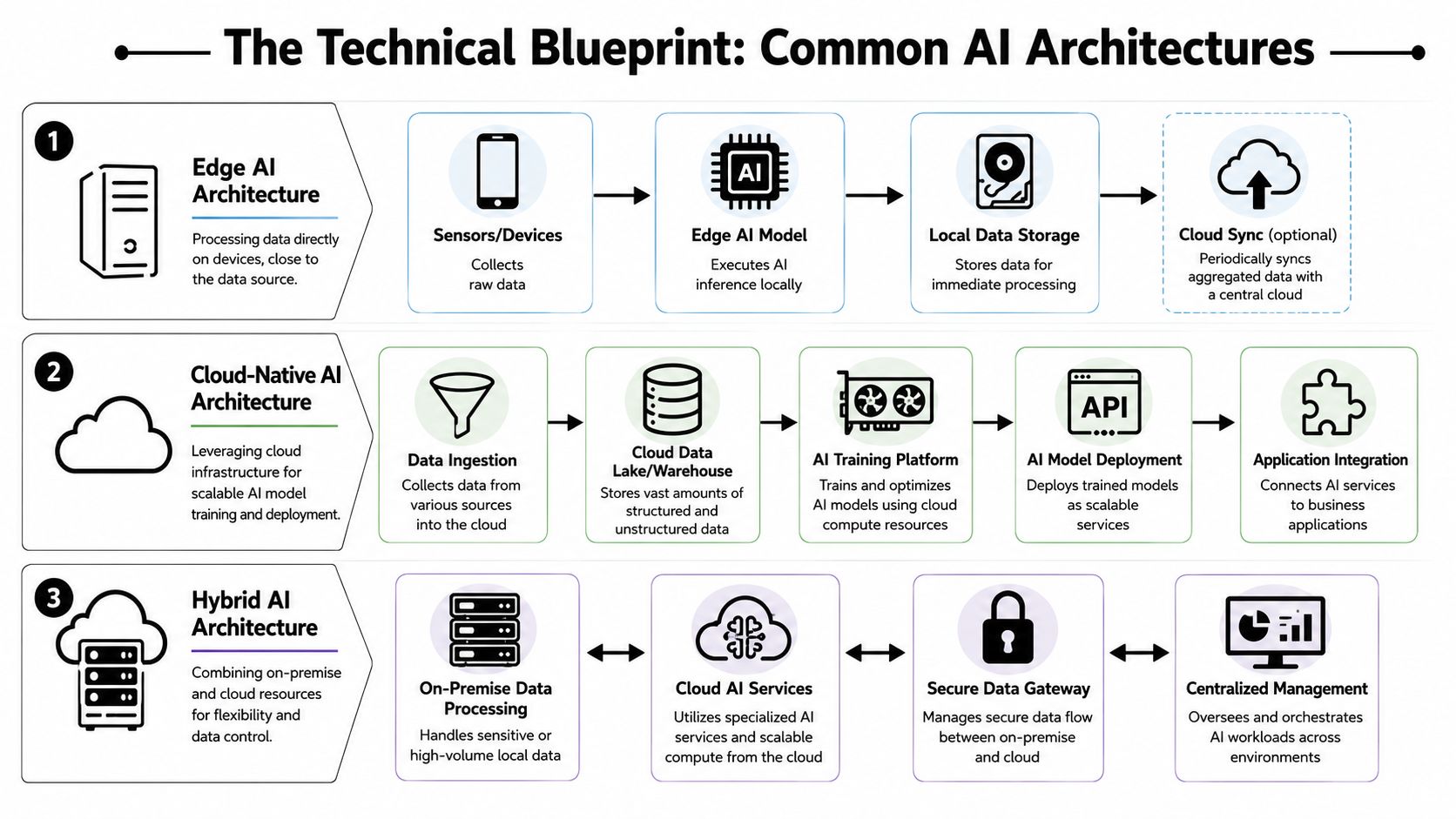
IBM's framing is useful here. Enterprise AI works best as an enterprise-scale platform that supports large deployments, many users, deep integration with business systems, and consistent security and governance. In practice, that means reliability and data access matter as much as model accuracy, as outlined in IBM's overview of enterprise AI.
Extend what already exists
This is the most common path for established companies. You add AI capabilities inside systems people already use, such as a CRM, ERP, support platform, or internal portal.
The advantage is adoption. Identity, permissions, workflow context, and source data often already live there. That reduces integration pain and shortens time to value.
The limitation is control. You inherit platform constraints, vendor roadmaps, and feature boundaries. If the use case is strategically differentiating, you may hit a ceiling quickly.
A good fit looks like this:
- Sales operations: Draft account summaries or meeting prep inside the CRM.
- Support operations: Suggest responses and summarize cases inside the ticketing stack.
- Finance workflows: Extract and classify documents within existing back-office tools.
Build a custom AI native system
This path makes sense when the workflow itself is the advantage. You're not just embedding AI into an existing process. You're building a new operating capability around proprietary data, unique logic, or a differentiated user experience.
Custom systems offer the highest flexibility. You can decide how retrieval works, how human review is triggered, how actions are logged, and how multiple models or rule engines interact.
They also demand the strongest engineering discipline. Teams need sound pipelines, evaluation routines, release management, observability, and rollback plans. Work like an end-to-end AI release pipeline matters because production AI fails in the seams between model output, application behavior, and operational change.
The expensive part of custom AI usually isn't the first demo. It's everything required to make that demo dependable.
Use a managed platform
Managed AI platforms sit between speed and control. They provide hosted infrastructure, model access, orchestration features, and operational tooling without forcing your team to build every layer.
This route works well when internal teams want to focus on use case delivery rather than platform engineering. It also helps when governance needs are serious but a company isn't ready to maintain its own full stack.
The trade-off is dependency. Vendor economics, portability, data boundaries, and feature abstraction all need scrutiny.
A simple decision table helps:
| Architecture path | Best for | Main advantage | Main risk |
|---|---|---|---|
| Extend existing platforms | Fast workflow improvements | Adoption and lower change friction | Limited differentiation |
| Custom AI-native build | Strategic workflows | Maximum control and tailored design | Higher delivery and maintenance complexity |
| Managed AI platform | Faster deployment with governance support | Balanced speed and operational support | Vendor dependency |
Whichever path you choose, the same rule applies. The architecture has to fit the operating model, not just the prototype.
From Pilot to Production Your AI Implementation Roadmap
Many teams don't struggle to launch a proof of concept. They struggle to turn it into a system that survives contact with real users, real data, and real governance.
That gap is visible in deployment patterns. A 2024 survey of organizations using generative AI found that only 11% had fully deployed it, while 59% were still experimenting and 29% were piloting. The same analysis points to talent gaps, weak data strategy, and governance shortfalls as major blockers rather than model quality itself, as summarized in Experion's enterprise AI solutions analysis.
Start with the roadmap, not the demo reel.
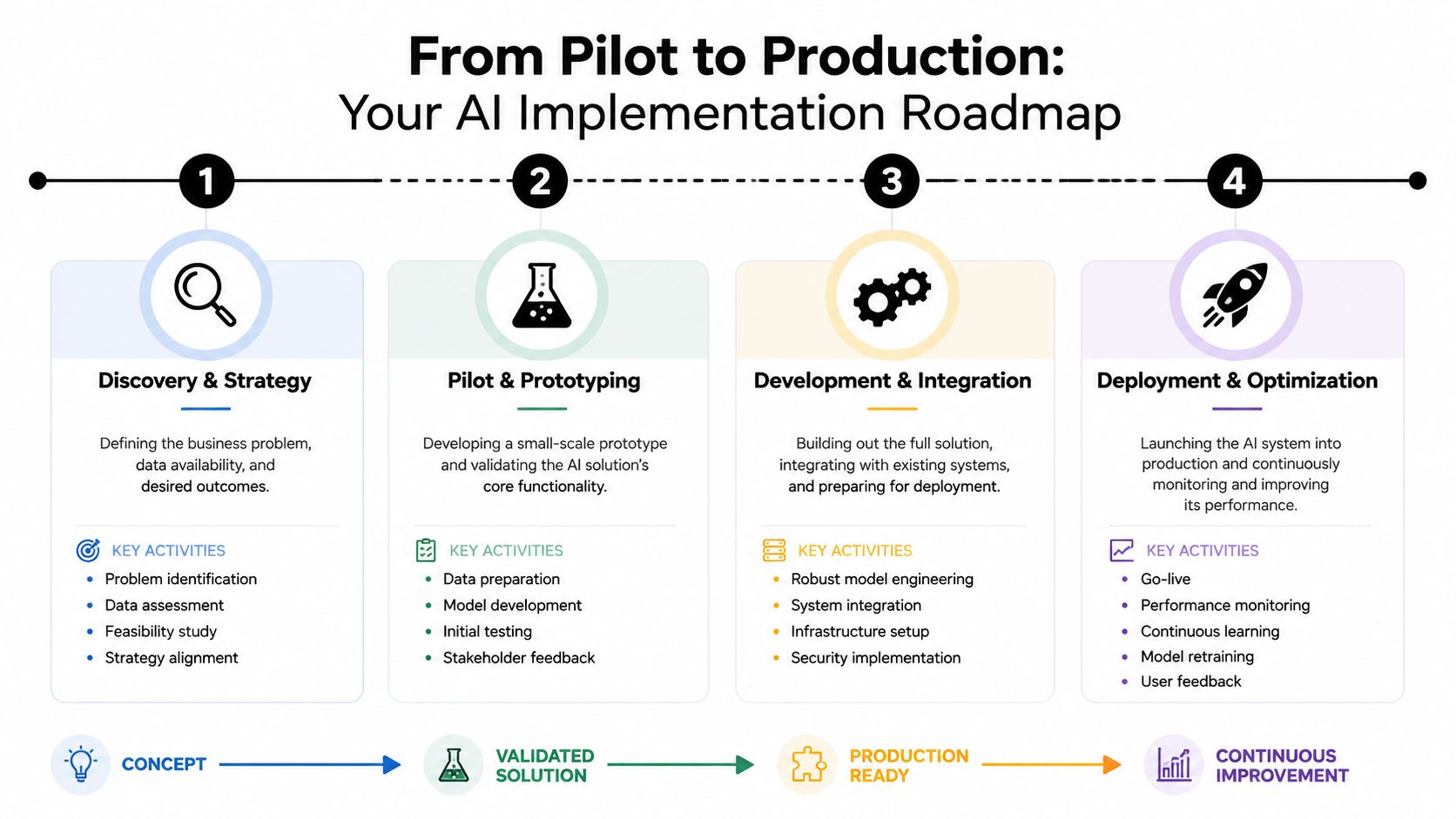
Phase one and two
Discovery and strategy is where strong projects get narrower, not broader. Define the business problem in operational terms. Identify the workflow owner. Confirm data sources, system dependencies, user groups, and review requirements. Decide what success looks like before anyone starts building.
After that comes the proof of concept. The point of a PoC isn't to impress executives. It's to learn whether the task can be completed at acceptable quality and where the workflow will break. Keep the scope tight. Test on representative data. Include the people who'll use the system.
In one recent engagement, an enterprise team came in asking for a broad AI assistant across several functions. We cut the scope down to one high-friction workflow with a clear owner and a measurable backlog problem. That decision removed months of confusion. It also gave the security and compliance teams something concrete to evaluate instead of an abstract platform promise.
A practical build sequence often looks like this:
- Validate the task: Confirm the model can handle the core job with real internal examples.
- Design human review: Decide when people approve, edit, or override output.
- Instrument the workflow: Capture time saved, rework, error patterns, and adoption signals.
- Pressure test access controls: Make sure the system only sees what it should.
A useful reference point for this stage is what it takes to reach a first production AI release in three months, especially when teams need a disciplined path instead of another open-ended experiment.
Later in the process, a short walkthrough can help stakeholders align on what changes between prototype and production:
Phase three and four
The third phase is a governed pilot. In this phase, many projects stall because the work no longer looks like model experimentation. It looks like software delivery, process redesign, and change management.
Users need training on when to trust output and when to challenge it. Managers need escalation rules. Security teams need logs and controls. Operations teams need support processes. Finance needs agreement on what metrics count.
I've seen governed pilots succeed when leaders treat them like workflow transitions, not technology showcases. In one anonymized retail project spanning 200+ locations, the team rolled out AI-assisted inventory forecasting in phases. By the end of the pilot, they had reduced stockouts by 15% and cut carrying costs by 10%, which was enough to secure executive backing for broader rollout.
The final phase is scaled rollout and optimization. This includes retraining, prompt and policy updates, drift checks, support ownership, and versioned releases. Production AI is never “done.” It moves with the business process, the underlying data, and user behavior.
If a pilot succeeds only because a small group of experts babysits it, it isn't ready for production.
Choosing the Right Partner How to Evaluate AI Vendors
A polished demo tells you almost nothing about whether a vendor can operate inside an enterprise. Good evaluation starts when the demo ends.
The first question is structural. Are you buying a tool, hiring an implementation partner, or asking your own team to build the capability internally? Those are different decisions, and companies often blur them together.
What a serious vendor conversation sounds like
Strong vendors answer operational questions with specifics. Weak vendors redirect to model benchmarks and feature lists.
Ask questions like these:
- Integration depth: Which systems have you integrated with in production, and how do you handle identity, permissions, and audit logs?
- Workflow design: Who maps the current process, and who decides how human review works?
- Evaluation method: How do you test output quality before launch, and how do you monitor regressions after launch?
- Security and governance: What controls exist for data handling, role-based access, and model usage policies?
- Change management: How do you train users, capture feedback, and adjust workflows after rollout?
- ROI model: What business metrics are defined before implementation starts, and how often are they reviewed?
One useful option in this market is a focused implementation partner such as Silicon Prime AI's consulting work, which is structured around AI readiness, workflow design, engineering delivery, and workforce enablement rather than just software licensing. That's one model. It won't be right for every company, but it's often more relevant than a feature-heavy vendor when the challenge is operational execution.
Compare delivery models before you compare demos
| Approach | Cost | Speed to Value | Customization | Maintenance Burden |
|---|---|---|---|---|
| Build in-house | Higher upfront team investment | Slower at the start | Highest | Highest |
| Buy off-the-shelf | Lower initial effort | Fastest if the fit is close | Limited | Lower to moderate |
| Use an implementation partner | Moderate to higher depending on scope | Faster than building from scratch | High if scoped well | Shared, then transitions based on operating model |
A few trade-offs matter more than price alone.
In-house build works when the use case is strategic, internal talent is strong, and leadership is prepared to fund platform work, not just use case work.
Off-the-shelf software fits common workflows, especially where the process doesn't create competitive separation. It fails when teams expect deep customization from a product designed for broad repeatability.
Implementation partners are most useful when the bottleneck is execution across business, engineering, security, and adoption. The risk is misalignment if the partner is strong technically but weak on workflow and organizational change.
The right partner should make the system simpler to operate over time. If they increase dependency while reducing internal understanding, you're renting momentum.
Proving the Value Measuring AI ROI and Avoiding Pitfalls
Many enterprise AI conversations get vague. Teams can describe what the system does, but not how the business will recognize the return.
That's a problem because many firms still struggle to prove financial value. McKinsey notes that while many companies are piloting generative AI, only a minority see enterprise-wide EBIT impact. The broader point, captured in Moveworks' discussion of enterprise AI solutions and ROI, is that implementation economics, governance, and change management often decide whether an initiative produces auditable value.
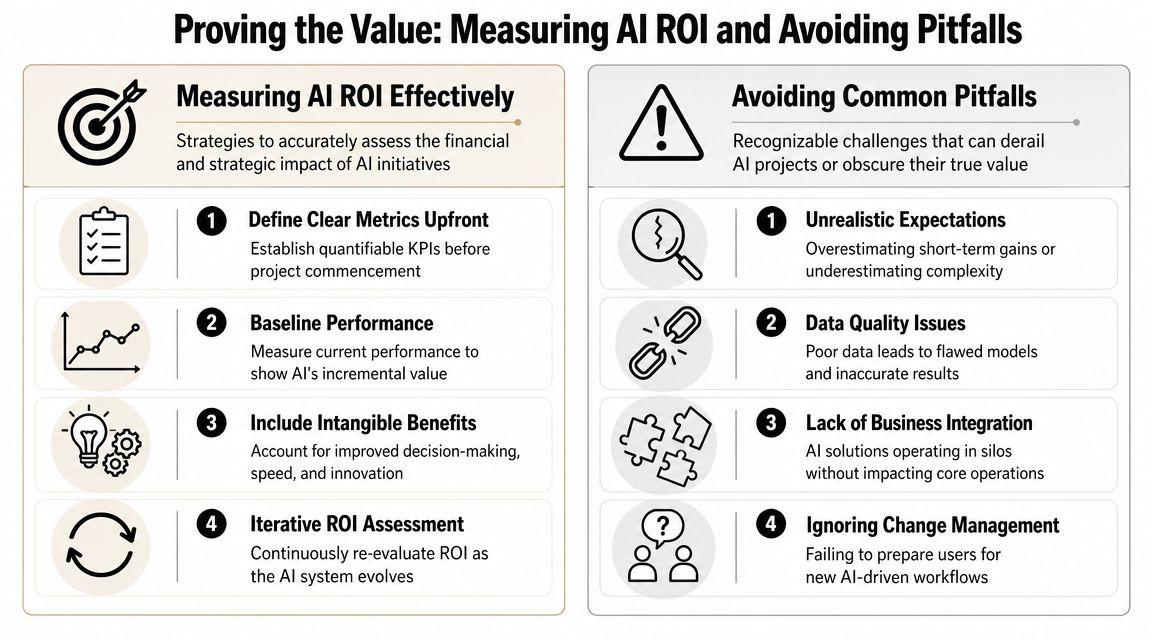
Measure value where finance can see it
The cleanest ROI models use three layers.
First, track hard operational impact. That includes reduced handling time, fewer manual touches, lower rework, lower external spend, or faster turnaround in a process tied to cost.
Second, track commercial impact where appropriate. This could mean better conversion support, improved retention workflows, or faster proposal generation. Be careful here. Revenue claims are often the least credible unless attribution is tight.
Third, track productivity gains with context. Time savings matter, but they only count if the organization can redeploy that capacity, improve service levels, or increase throughput. A saved hour with no change in output is interesting. A saved hour that clears a backlog or improves response quality is economic.
A practical measurement routine should include:
- Baseline first: Capture current performance before deployment. Without a baseline, every gain is arguable.
- Workflow metrics: Measure cycle time, error rates, escalation frequency, and completion rates.
- Adoption signals: Track who uses the system, where they override it, and where trust breaks down.
- Cost visibility: Include implementation, integration, monitoring, training, and ongoing support. A useful planning reference is this guide to AI cost estimation.
Pitfalls that distort the business case
The biggest ROI killer is choosing a low-value problem. Teams automate work that's visible but not economically important.
Another common failure is weak data readiness. If the source process is inconsistent, AI often amplifies the inconsistency instead of fixing it.
The third is poor workflow integration. Output that lives in a side panel or separate interface usually creates curiosity, not behavior change.
The last pitfall is neglecting post-launch operations. Models drift. Business rules change. Users find edge cases. If nobody owns monitoring and revision, early gains decay.
A business case is only credible when it includes the hidden work. Data cleanup, governance, user training, and ongoing monitoring are not side tasks. They are part of the cost of value.
Making AI Real in Your Enterprise
AI solutions for enterprises work when leaders stop treating AI as a standalone technology decision. It's an execution discipline that combines workflow design, systems integration, governance, and operating change.
That's why the strongest initiatives don't begin with a giant platform ambition. They begin with one painful process, one accountable owner, and one measurable outcome. Then they expand only after the organization proves it can deploy, govern, and maintain the system under real conditions.
The pattern is consistent. Start where the business friction is obvious. Choose the architecture that matches the level of control you need. Design the pilot around user behavior and operational constraints, not just model performance. Evaluate vendors on delivery depth, not presentation polish. Measure value in terms finance and operations can verify.
If you're deciding where to begin, don't chase the broadest use case. Pick the one with clear workflow boundaries, available data, and a visible economic cost. Ship a governed pilot. Learn what breaks. Fix the process around it. Then scale deliberately.
If your team needs help turning AI from a slide deck into an operating system improvement, Silicon Prime AI works on the practical side of adoption: readiness, workflow design, implementation, release discipline, and team enablement. The right next step isn't a massive transformation program. It's a focused pilot with a real owner, a measurable target, and a path to production.
Comments